
Cloud Migration Best Practices: Reducing Downtime by 50% During Your 2026 Transition
In the rapidly evolving digital landscape of 2026, cloud migration is no longer a luxury but a strategic imperative for businesses seeking agility, scalability, and cost-efficiency. However, the prospect of moving critical operations to the cloud often comes with a significant concern: downtime. The fear of service interruptions, data loss, and operational disruptions can deter even the most forward-thinking organizations. This comprehensive guide will delve into the best practices for cloud migration, with a specific focus on how to reduce downtime by 50% or more during your 2026 transition. By meticulously planning and executing your migration, you can unlock the full potential of cloud computing without sacrificing business continuity.
Understanding the Challenge of Cloud Migration Downtime
Before diving into solutions, it’s crucial to understand why cloud migration downtime occurs and its potential impact. Downtime during migration can stem from various factors, including inadequate planning, incompatible systems, data integrity issues, network bottlenecks, and unforeseen technical glitches. The consequences can be severe: lost revenue, damaged customer trust, decreased employee productivity, and even regulatory non-compliance. Therefore, minimizing downtime isn’t just a technical goal; it’s a critical business objective that directly impacts your bottom line and reputation.
The complexity of modern IT environments further exacerbates the challenge. Organizations often operate with a heterogeneous mix of legacy systems, custom applications, and vast datasets. Migrating such intricate architectures to a new cloud environment demands a sophisticated approach that accounts for every dependency and potential point of failure. Our goal here is to equip you with the knowledge and strategies to navigate this complexity successfully, ensuring your cloud migration downtime is kept to an absolute minimum.
Strategic Planning: The Foundation of a Seamless Migration
The cornerstone of any successful cloud migration with reduced downtime is meticulous and strategic planning. This phase is not merely about technical logistics; it encompasses business objectives, risk assessment, and resource allocation. A well-defined strategy can preempt many issues that typically lead to downtime.
1. Define Clear Business Objectives and KPIs
Before any technical work begins, clearly articulate why you are migrating to the cloud and what success looks like. Are you aiming for cost reduction, enhanced scalability, improved disaster recovery, or faster innovation? Establishing Key Performance Indicators (KPIs) related to downtime, performance, and cost will provide measurable targets for your migration project. For instance, a KPI might be to achieve less than X hours of unplanned downtime during the entire migration process. This clarity will guide all subsequent decisions and help prioritize efforts to minimize cloud migration downtime.
2. Comprehensive Application and Data Assessment
One of the most critical steps is a thorough assessment of your existing applications and data. This involves:
- Application Discovery: Identify all applications, their dependencies, and their current performance metrics. Categorize them based on their criticality to business operations.
- Data Inventory: Understand the volume, velocity, and variety of your data. Determine data residency requirements, compliance obligations, and security protocols.
- Migration Readiness: Assess each application’s compatibility with cloud environments. Some applications may require refactoring, re-platforming, or even replacement. This assessment helps in determining the most appropriate migration strategy for each component.
- Dependency Mapping: Create a detailed map of inter-application and data dependencies. This is crucial for orchestrating the migration order and avoiding cascading failures that cause cloud migration downtime.
3. Choosing the Right Cloud Provider and Migration Strategy
Selecting the appropriate cloud provider (AWS, Azure, Google Cloud, etc.) and migration strategy (rehost, replatform, refactor, repurchase, retire, retain – often called the ‘6 Rs’) is paramount. The choice should align with your business objectives and the findings from your application assessment. For example, ‘rehosting’ (lift and shift) might be faster but may not optimize for cloud-native benefits, while ‘refactoring’ can be more complex but offers greater long-term advantages. Each strategy has different implications for potential cloud migration downtime.
4. Develop a Detailed Migration Plan and Rollback Strategy
Your migration plan should be a living document, detailing every step, timeline, responsibilities, and success criteria. Crucially, it must include a robust rollback strategy. What happens if something goes wrong? How quickly can you revert to your on-premises environment? A well-tested rollback plan is your safety net, significantly reducing the risk of extended cloud migration downtime. This plan should also outline communication protocols for all stakeholders, ensuring transparency and managing expectations.
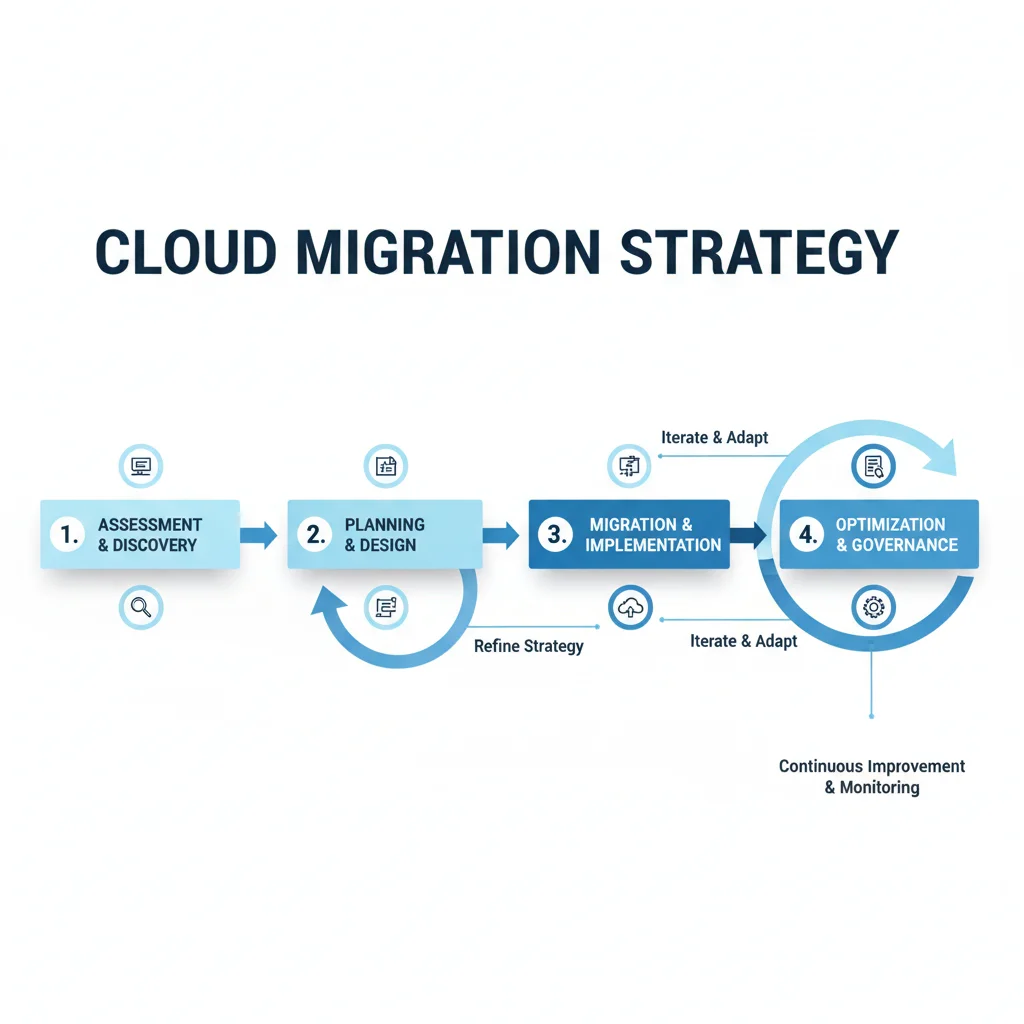
Phased Migration: Minimizing Risk and Downtime
A ‘big bang’ migration, where everything moves at once, is rarely advisable due to the high risk of extensive cloud migration downtime. A phased approach, often called a ‘wave’ migration, allows for controlled movement, testing, and optimization at each stage.
1. Pilot Migration and Proof of Concept (PoC)
Start with a small, non-critical application or dataset as a pilot. This PoC allows you to validate your migration strategy, identify unforeseen challenges, and refine your processes in a low-risk environment. Lessons learned from the pilot are invaluable for scaling the migration efficiently and reducing cloud migration downtime for critical systems.
2. Migrate Non-Critical Systems First
Once the pilot is successful, proceed with migrating less critical applications and data. This allows your team to gain experience and confidence without impacting core business operations. It also provides an opportunity to stress-test your cloud environment and identify performance bottlenecks before they affect critical services.
3. Data Migration Strategies for Minimal Downtime
Data migration is often the most challenging aspect. Consider these strategies:
- Offline Migration: For large datasets where some downtime is acceptable, data can be transferred offline using physical devices (e.g., AWS Snowball, Azure Data Box). This minimizes network impact.
- Online Migration with Replication: For critical data requiring near-zero cloud migration downtime, continuous data replication tools can be used. Data is synced in real-time from the source to the target cloud environment. Once the sync is complete, a cutover can occur with minimal disruption.
- Database Migration Services: Utilize cloud provider-specific services (e.g., AWS DMS, Azure Database Migration Service) that facilitate heterogeneous and homogeneous database migrations with minimal downtime.
4. Application Migration Techniques
- Lift and Shift with VM Migration Tools: For simple applications, use tools that replicate VMs directly to the cloud (e.g., VMware HCX, Azure Migrate). This can minimize application-specific cloud migration downtime.
- Containerization: Encapsulating applications in containers (Docker, Kubernetes) can simplify deployment and portability, allowing for blue/green deployments that virtually eliminate downtime during cutovers.
- Blue/Green Deployments: Maintain two identical production environments (Blue and Green). Deploy new versions or migrate to the cloud on the Green environment. Once tested, traffic is switched from Blue to Green. If issues arise, traffic can instantly revert to Blue, ensuring zero cloud migration downtime for end-users.
Robust Testing and Validation: Ensuring Operational Continuity
Even the best-laid plans can go awry without rigorous testing. Comprehensive testing and validation are paramount to identifying and rectifying issues before they impact production, thereby drastically reducing cloud migration downtime.
1. Pre-Migration Testing
- Performance Benchmarking: Establish baseline performance metrics for your applications in the on-premises environment. This provides a reference point for comparing performance post-migration.
- Compatibility Testing: Ensure all applications, dependencies, and integrations function correctly in the cloud environment.
- Security Audits: Verify that security configurations, access controls, and compliance requirements are met in the cloud.
2. Post-Migration Testing and Validation
- Functional Testing: Verify that all application functionalities work as expected in the cloud.
- Performance Testing: Conduct load testing, stress testing, and scalability testing to ensure the cloud environment can handle anticipated traffic and perform optimally. Compare against pre-migration benchmarks.
- User Acceptance Testing (UAT): Involve end-users to validate that the migrated applications meet their business requirements and provide a satisfactory user experience.
- Data Integrity Checks: Verify that all data has been migrated accurately and completely, with no corruption or loss.
- Disaster Recovery Testing: Test your DR plan in the cloud to ensure business continuity in case of an outage.
Automation and Tooling: Accelerating and Securing Your Migration
Leveraging automation and specialized tools is critical for efficient, repeatable, and low-downtime cloud migrations. Manual processes are prone to human error and can significantly prolong cloud migration downtime.
1. Infrastructure as Code (IaC)
Use IaC tools like Terraform, Ansible, or AWS CloudFormation/Azure Resource Manager to define and provision your cloud infrastructure. This ensures consistency, reduces configuration drift, and allows for rapid, error-free deployments and rollbacks, directly contributing to reduced cloud migration downtime.
2. Cloud Migration Tools
Cloud providers offer a suite of services designed to facilitate migration, such as AWS Migration Hub, Azure Migrate, and Google Cloud Migrate for Compute Engine. These tools assist with assessment, planning, migration execution, and monitoring, streamlining the process and minimizing manual intervention.
3. Monitoring and Observability Tools
Implement robust monitoring and observability solutions from day one. Tools like Datadog, Splunk, Prometheus, Grafana, or cloud-native monitoring services (CloudWatch, Azure Monitor, Google Cloud Monitoring) provide real-time insights into application performance, infrastructure health, and potential issues. Proactive monitoring helps detect and resolve problems before they cause significant cloud migration downtime.

Post-Migration Optimization and Continuous Improvement
A successful migration isn’t the end; it’s the beginning of a continuous journey of optimization. Post-migration activities are crucial for realizing the full benefits of the cloud and maintaining minimal cloud migration downtime.
1. Performance Tuning and Cost Optimization
Once applications are running in the cloud, continuously monitor their performance and resource utilization. Optimize configurations, right-size instances, and implement auto-scaling to ensure optimal performance at the lowest possible cost. Regular cost reviews prevent cloud sprawl and ensure you are getting the most value.
2. Security Enhancements
The cloud security landscape is dynamic. Continuously review and enhance your security posture with regular audits, vulnerability assessments, and adherence to best practices. Implement security automation and integrate security into your CI/CD pipelines.
3. Disaster Recovery and Business Continuity Planning
Regularly test and refine your disaster recovery (DR) and business continuity (BC) plans in the cloud. Ensure that your recovery time objectives (RTO) and recovery point objectives (RPO) are met and that your systems can withstand various failure scenarios without significant cloud migration downtime.
4. Employee Training and Skill Development
Your team needs to be proficient in managing and operating cloud environments. Invest in continuous training and skill development to ensure your staff can effectively leverage cloud capabilities and respond quickly to any issues, further minimizing cloud migration downtime.
Key Considerations for a 2026 Cloud Migration
As we look towards 2026, several trends and considerations will influence cloud migration strategies:
- AI and Machine Learning Integration: Cloud platforms are increasingly integrating AI/ML services. Plan how to leverage these for enhanced analytics, automation, and intelligent operations post-migration.
- Edge Computing: For organizations with significant data processing needs at the edge, consider hybrid cloud strategies that integrate edge computing with centralized cloud resources.
- Sustainability: Cloud providers are focusing on sustainability. Factor in the environmental impact and green initiatives of potential providers.
- Serverless Architectures: Embrace serverless computing where appropriate to reduce operational overhead and enhance scalability, further minimizing potential cloud migration downtime related to infrastructure management.
- Enhanced Security Threats: The threat landscape is constantly evolving. Your cloud security strategy must be robust, adaptive, and leverage advanced threat detection and response capabilities offered by cloud providers.
Conclusion: Achieving a 50% Reduction in Cloud Migration Downtime
Reducing cloud migration downtime by 50% or more during your 2026 transition is an ambitious yet achievable goal. It requires a holistic approach that combines strategic planning, phased execution, rigorous testing, and continuous optimization. By focusing on detailed assessments, leveraging automation, implementing robust data replication, and adopting blue/green deployment strategies, organizations can significantly mitigate risks and ensure business continuity throughout the migration process.
Remember, cloud migration is a journey, not a destination. By adhering to these best practices, you not only minimize cloud migration downtime but also lay the groundwork for a resilient, scalable, and innovative future in the cloud. Embrace the challenge, empower your teams, and embark on your cloud journey with confidence, knowing that your business operations will remain uninterrupted and performant.