Serverless Computing: Innovation in US Cloud Deployments by 2026

The Rise of Serverless Computing: 3 Use Cases Driving Innovation in US Cloud Deployments for 2026
The technological landscape is in a constant state of flux, with advancements emerging at an unprecedented pace. Among these, serverless computing has rapidly ascended as a pivotal force, reshaping how applications are designed, deployed, and scaled. This paradigm shift, characterized by its focus on abstracting away server management, is not merely a trend but a fundamental evolution in cloud architecture. By 2026, serverless computing is poised to be a dominant strategy for innovation in US cloud deployments, offering unparalleled agility, cost efficiency, and scalability.
In this comprehensive exploration, we delve into the core tenets of serverless computing, unraveling its benefits and the reasons behind its burgeoning popularity. We will then spotlight three critical use cases that are not only demonstrating its current prowess but are also indicative of its future trajectory in the US market. Understanding these applications is crucial for businesses aiming to remain competitive and leverage the full potential of modern cloud infrastructure. The journey towards a serverless future is well underway, and its impact on US cloud deployments is set to be profound.
What is Serverless Computing? A Paradigm Shift in Cloud Architecture
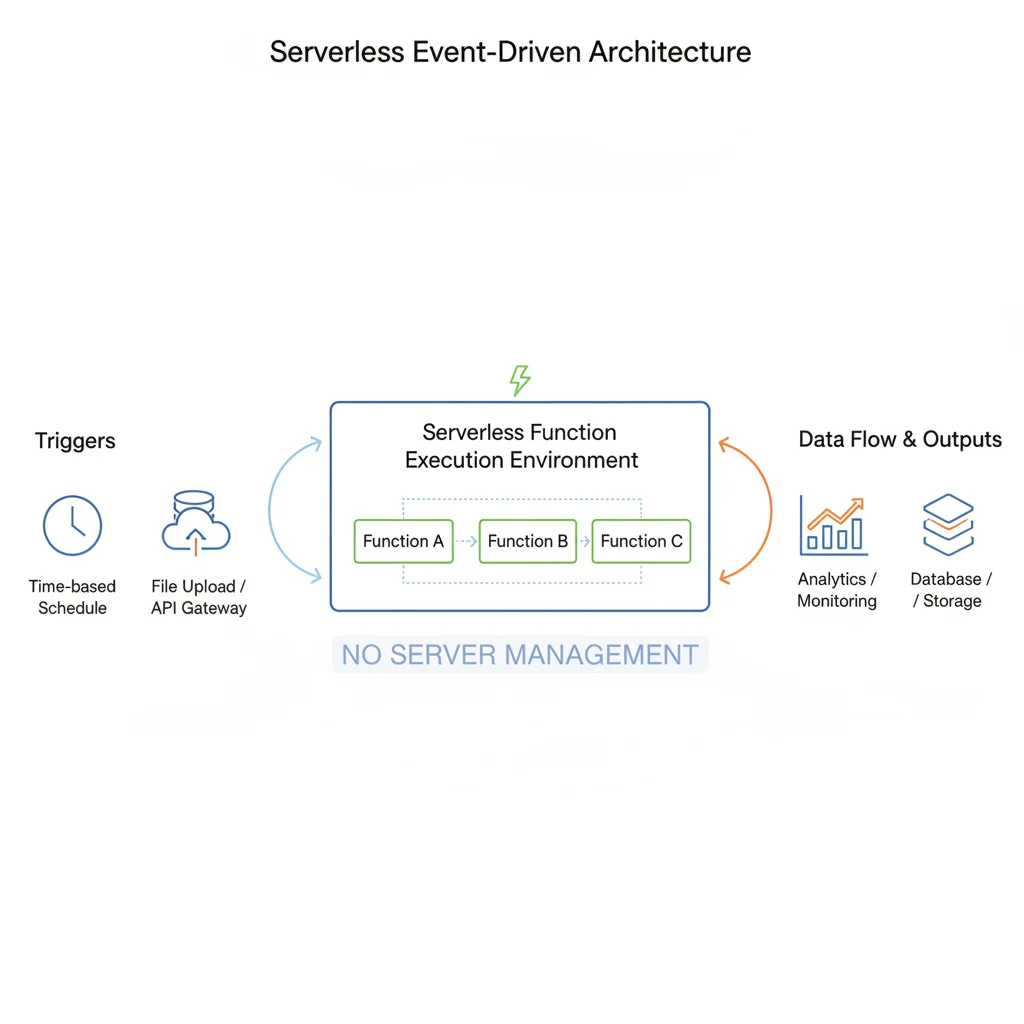
At its heart, serverless computing is a cloud execution model where the cloud provider dynamically manages the allocation and provisioning of servers. This means developers can write and deploy code without having to worry about the underlying infrastructure. While the term ‘serverless’ might suggest the absence of servers, it actually refers to the fact that server management and provisioning are entirely handled by the cloud provider. Developers focus solely on their code, often referred to as ‘functions,’ which are executed in response to specific events.
This model fundamentally differs from traditional approaches like Infrastructure as a Service (IaaS) and Platform as a Service (PaaS). In IaaS, users manage virtual machines, operating systems, and application runtimes. PaaS abstracts away the operating system, but users still manage application configurations and scaling. Serverless computing, particularly Function as a Service (FaaS), takes this abstraction a step further, removing almost all operational overhead. This allows for a significant increase in development velocity and a reduction in operational costs, as users only pay for the compute resources consumed during function execution, not for idle server time.
Key Characteristics of Serverless Computing:
- No Server Management: Developers are freed from provisioning, maintaining, and scaling servers.
- Event-Driven: Code execution is triggered by events, such as HTTP requests, database changes, or file uploads.
- Automatic Scaling: The cloud provider automatically scales the number of function instances up or down based on demand.
- Pay-per-Execution: Users are billed for the actual compute time consumed by their functions, often down to the millisecond.
- Stateless by Design: Functions are typically stateless, meaning they don’t retain data from one invocation to the next, promoting horizontal scaling and resilience.
The rise of serverless computing is closely tied to the broader trend of microservices architecture, where applications are broken down into smaller, independent services. Serverless functions are a natural fit for microservices, enabling developers to build highly modular and scalable applications. Major cloud providers like AWS (Lambda), Azure (Functions), and Google Cloud (Cloud Functions) have heavily invested in their serverless offerings, making it easier than ever for businesses to adopt this transformative technology.
Benefits Driving Serverless Adoption in US Cloud Deployments
The allure of serverless computing extends beyond mere technological novelty; it offers tangible benefits that are compelling businesses across various sectors in the US to embrace this model. These advantages are directly contributing to the accelerated pace of innovation in US cloud deployments, setting the stage for a serverless-dominated future by 2026.
1. Reduced Operational Costs
One of the most significant advantages of serverless computing is its cost-efficiency. With a pay-per-execution model, organizations only pay for the exact compute resources consumed when their code is running. This eliminates the need to provision and pay for idle server capacity, which can be a substantial cost saver, especially for applications with fluctuating or unpredictable workloads. For many businesses, the transition to serverless can lead to a considerable reduction in infrastructure expenses, allowing resources to be reallocated to development and innovation.
2. Enhanced Scalability and Elasticity
Serverless platforms inherently offer automatic scaling. As demand for an application increases, the cloud provider automatically provisions more instances of the function to handle the load. Conversely, when demand decreases, instances are scaled down. This elasticity ensures that applications can handle sudden spikes in traffic without manual intervention or over-provisioning, providing a seamless user experience and robust performance. This is particularly crucial for applications with unpredictable usage patterns, such as e-commerce platforms during sales events or data processing pipelines.
3. Faster Time to Market and Developer Productivity
By abstracting away infrastructure management, serverless computing allows developers to focus entirely on writing code and building features. This dramatically reduces the overhead associated with server provisioning, patching, and maintenance, accelerating the development cycle. Developers can deploy new features and updates much faster, leading to quicker iterations and a more agile development process. This increased developer productivity translates directly into a faster time to market for new products and services, a critical competitive advantage in today’s fast-paced digital economy.
4. Improved Focus on Business Logic
With the operational burden lifted, development teams can dedicate more time and resources to solving core business problems and innovating on their applications. This shift in focus from infrastructure to business logic can lead to more impactful solutions and a stronger competitive edge. Serverless enables businesses to be more responsive to market changes and customer needs, fostering a culture of continuous innovation.
5. Inherent High Availability and Fault Tolerance
Cloud providers design their serverless platforms with high availability and fault tolerance in mind. Functions are often deployed across multiple availability zones, ensuring that applications remain operational even if one zone experiences an outage. This built-in resilience reduces the need for complex disaster recovery planning and implementation by individual organizations, further simplifying operations and enhancing reliability.
These compelling benefits underscore why serverless computing is not just a passing fad but a foundational technology that will continue to drive significant innovation and efficiency in US cloud deployments through 2026 and beyond. Its ability to reduce costs, scale effortlessly, and empower developers makes it an indispensable tool for forward-thinking enterprises.
3 Key Use Cases Driving Serverless Cloud Innovation in the US by 2026
The theoretical advantages of serverless computing are impressive, but its true impact is best understood through its practical applications. In the US, several key use cases are demonstrating the transformative power of serverless, pushing the boundaries of what’s possible in cloud deployments. These applications highlight the versatility and efficiency that make serverless computing a cornerstone of future innovation.
Use Case 1: Real-time Data Processing and Analytics
One of the most impactful applications of serverless computing is in the realm of real-time data processing and analytics. Modern businesses generate vast amounts of data from various sources – IoT devices, web applications, mobile apps, and more. Processing this data in real-time is crucial for gaining immediate insights, responding to events, and making informed decisions. Serverless functions are perfectly suited for this task due to their event-driven nature and automatic scalability.
Imagine a scenario where thousands of IoT sensors are continuously sending data streams. A serverless architecture can ingest this data, trigger functions to process it (e.g., filter, transform, enrich), and then store it in a data warehouse or feed it into a real-time dashboard. All of this happens instantaneously, without the need to provision or manage servers for peak loads. Examples include:
- Log Analysis: Ingesting and processing application logs from various sources to identify anomalies or performance issues in real-time.
- Stream Processing: Analyzing clickstream data from websites to understand user behavior or detect fraudulent activities as they happen.
- IoT Data Ingestion: Collecting and processing data from millions of connected devices for monitoring, predictive maintenance, or smart city applications.
The ability to handle massive, unpredictable data streams with minimal operational overhead makes serverless an ideal choice for businesses looking to unlock the full potential of their data. This capability is driving significant innovation in sectors like manufacturing, healthcare, and retail, allowing for unprecedented levels of responsiveness and insight.
Use Case 2: Building Scalable APIs and Microservices
The development of robust, scalable APIs and microservices is another area where serverless computing shines. In a world increasingly reliant on interconnected applications, APIs serve as the backbone for communication between different services and platforms. Serverless functions provide an excellent foundation for building these APIs, offering inherent scalability and a pay-as-you-go model that aligns perfectly with fluctuating API traffic.
Instead of deploying a monolithic application or managing a fleet of servers for API endpoints, developers can create individual serverless functions for each API endpoint or microservice. These functions are then triggered by HTTP requests via an API Gateway. This approach offers several advantages:
- Granular Scaling: Each API endpoint can scale independently, ensuring that high-traffic endpoints don’t impact the performance of others.
- Cost-Efficiency: You only pay for the execution of the API calls, making it highly cost-effective for APIs with variable usage patterns.
- Simplified Development: Developers can focus on the business logic of each microservice without worrying about the underlying infrastructure.
- Resilience: The distributed nature of serverless microservices enhances fault tolerance, as the failure of one function does not necessarily bring down the entire application.
This use case is particularly prevalent in the e-commerce sector, where APIs handle everything from product catalog management to order processing and payment gateways. Financial services are also leveraging serverless for secure and scalable API endpoints. The agility and scalability afforded by serverless for APIs and microservices are accelerating the digital transformation efforts of many US enterprises, enabling them to build more resilient and responsive applications.
Use Case 3: Event-Driven Automation and Workflow Orchestration
Serverless computing is a natural fit for event-driven automation and complex workflow orchestration. Many business processes involve a series of steps that are triggered by specific events. Serverless functions can act as the glue that connects these disparate systems and automates these workflows, leading to increased efficiency and reduced manual effort.
Consider a typical business process like image processing for a media company. When a new image is uploaded to a storage service (an event), a serverless function can be triggered. This function might then resize the image, apply watermarks, generate thumbnails, and store the different versions in various locations. This entire workflow is automated, scalable, and only incurs costs when an image is actually processed.
Other examples include:
- Automated Backups: Triggering functions to backup databases or files at scheduled intervals or upon specific changes.
- Chatbot Backend: Powering the logic for chatbots, where user messages trigger functions to process requests and generate responses.
- CI/CD Pipelines: Automating steps in continuous integration and continuous delivery pipelines, such as code deployment or testing, in response to code commits.
- Data Transformation: Converting data formats between different systems as part of an ETL (Extract, Transform, Load) process.
This ability to automate complex, multi-step processes in a highly scalable and cost-effective manner is a significant driver of serverless cloud innovation. Businesses can create sophisticated, reactive systems that respond dynamically to events, improving operational efficiency and enabling new levels of automation across their organizations. This capability is particularly appealing to enterprises looking to streamline operations and build more intelligent, self-managing systems.

Challenges and Considerations for Serverless Adoption
While the benefits of serverless computing are compelling, it’s also important to acknowledge the challenges and considerations associated with its adoption. A balanced understanding is crucial for successful integration into US cloud deployments.
1. Vendor Lock-in
One of the primary concerns with serverless is the potential for vendor lock-in. Each major cloud provider offers its own serverless platform (e.g., AWS Lambda, Azure Functions, Google Cloud Functions), with proprietary APIs, SDKs, and integrations. Migrating serverless applications between providers can be complex and costly, as it often requires significant refactoring. Organizations need to carefully evaluate their long-term strategy and consider multi-cloud or hybrid cloud approaches if vendor lock-in is a major concern.
2. Observability and Monitoring
Monitoring and debugging serverless applications can be more challenging than traditional applications. The ephemeral nature of functions, distributed execution, and the lack of direct server access make it difficult to trace requests across multiple functions and services. While cloud providers offer monitoring tools, comprehensive end-to-end observability often requires additional tooling and strategies to gather logs, metrics, and traces effectively.
3. Cold Starts
When a serverless function is invoked after a period of inactivity, it might experience a ‘cold start.’ This means the cloud provider needs to initialize the execution environment, download the code, and spin up a new instance, which can introduce latency. For latency-sensitive applications, cold starts can be a concern. Strategies like ‘warming’ functions (periodically invoking them to keep them active) or optimizing function size can mitigate this issue, but it remains a consideration.
4. State Management
Serverless functions are typically stateless by design, which is excellent for scalability. However, many applications require state. This necessitates integrating with external state management services like databases, object storage, or caching layers. While this is a common pattern in distributed systems, it adds a layer of complexity that developers need to account for when designing serverless architectures.
5. Security Considerations
While cloud providers handle the underlying infrastructure security, developers are still responsible for securing their function code, configurations, and integrations. This includes managing access permissions, securing API endpoints, and protecting sensitive data. The distributed nature of serverless applications can sometimes introduce new security vectors that require careful consideration and robust security practices.
Addressing these challenges requires careful planning, architectural best practices, and leveraging the right tools. Despite these considerations, the overwhelming benefits of serverless computing continue to make it an attractive option for businesses striving for innovation and efficiency in their cloud strategies.
The Future of Serverless Computing in US Cloud Deployments
Looking ahead to 2026, the trajectory of serverless computing in US cloud deployments is one of continued growth and maturation. The technology is rapidly evolving, with cloud providers continually enhancing their offerings and addressing current limitations. We can anticipate several key developments that will further solidify serverless’s position as a cornerstone of modern cloud architecture.
1. Increased Adoption Across Industries
While serverless has already seen significant adoption in tech-forward companies, its reach will expand further into traditional industries like finance, healthcare, and government. As more businesses recognize the cost savings, scalability, and agility it offers, serverless will become a standard component of their IT strategies. This widespread adoption will be fueled by easier-to-use tools, more robust enterprise features, and a growing pool of skilled serverless developers.
2. Hybrid and Multi-Cloud Serverless Architectures
To mitigate vendor lock-in and leverage the best features from different providers, we will see an increase in hybrid and multi-cloud serverless architectures. Tools and frameworks that abstract away cloud-specific implementations will become more prevalent, allowing developers to deploy serverless functions across various environments with greater ease. This will provide businesses with more flexibility and resilience in their cloud strategies.
3. Edge Computing and Serverless
The convergence of serverless computing with edge computing is a significant area of innovation. As applications demand lower latency and local data processing, serverless functions deployed at the edge (closer to data sources and end-users) will become more common. This will enable ultra-low latency applications for IoT, augmented reality, and real-time analytics, further enhancing serverless cloud innovation.
4. Enhanced Observability and Security Tools
As serverless architectures become more complex, the need for advanced observability and security tools will grow. Cloud providers and third-party vendors will offer more sophisticated solutions for monitoring, tracing, and debugging serverless applications, making it easier for developers to manage and secure their distributed systems. We can expect more integrated security features and automated compliance checks tailored for serverless environments.
5. Serverless for AI/ML Workloads
The use of serverless functions for AI and Machine Learning (ML) inference and model serving will become increasingly common. Serverless provides an ideal environment for executing ML models on demand, scaling effortlessly with fluctuating inference requests. This will democratize access to AI capabilities, allowing more businesses to integrate intelligent features into their applications without managing complex ML infrastructure.
The journey of serverless computing is still unfolding, but its trajectory towards becoming a foundational technology for US cloud deployments by 2026 is undeniable. Its continuous evolution promises a future where businesses can focus even more intently on innovation, leaving the complexities of infrastructure management to the cloud providers.
Conclusion: Embracing Serverless for Future-Proof Cloud Deployments
Serverless computing represents a profound shift in how applications are built and deployed in the cloud. Its ability to abstract away infrastructure management, offer unparalleled scalability, and optimize costs has made it an indispensable tool for businesses seeking to innovate and thrive in the digital age. As we’ve explored, the benefits are substantial, driving significant advancements in areas like real-time data processing, scalable APIs, and event-driven automation across US cloud deployments.
While challenges such as vendor lock-in and observability exist, the continuous evolution of serverless platforms and tooling is steadily addressing these concerns. By 2026, serverless is not just expected to be a niche technology but a mainstream approach, powering a vast array of applications from edge devices to complex enterprise systems. Organizations that strategically embrace serverless computing today will be well-positioned to capitalize on its advantages, fostering greater agility, efficiency, and innovation.
The future of cloud computing in the US is undeniably serverless-centric. For businesses looking to future-proof their digital infrastructure and maintain a competitive edge, understanding and adopting serverless cloud innovation is not merely an option but a strategic imperative. The time to invest in serverless expertise and integrate this powerful paradigm into your development roadmap is now.