CRM Software Showdown: HubSpot, Salesforce, Zoho CRM Q1 2026 Updates
CRM Software Showdown: Comparing the Latest Updates of HubSpot, Salesforce, and Zoho CRM for Q1 2026
In the fast-evolving landscape of customer relationship management (CRM), staying abreast of the latest developments is not just beneficial—it’s imperative for business survival and growth. As we delve into Q1 2026, the leading CRM providers—HubSpot, Salesforce, and Zoho CRM—have once again pushed the boundaries of innovation, introducing a plethora of updates designed to enhance efficiency, deepen customer understanding, and drive revenue. This comprehensive showdown will dissect the most significant CRM software updates from these industry titans, offering insights into how these changes can impact your business strategy and operational effectiveness.
The CRM market is a dynamic arena, characterized by relentless competition and a constant drive towards more intelligent, integrated, and intuitive solutions. Each quarter brings new features, improved functionalities, and strategic shifts that reflect broader technological trends, such as the increasing prominence of artificial intelligence (AI), hyper-personalization, and seamless integration across diverse business functions. For businesses of all sizes, selecting and optimizing their CRM platform is a critical decision that directly influences customer satisfaction, sales performance, and marketing efficacy.
Our focus for this Q1 2026 analysis is to provide a detailed comparison of the key enhancements across HubSpot, Salesforce, and Zoho CRM. We’ll explore their respective strengths, highlight the most impactful new features, and discuss the implications for different business models. Whether you’re a small startup seeking an affordable yet powerful solution, a rapidly scaling mid-market company needing robust integration, or an enterprise demanding extensive customization and advanced analytics, understanding these CRM software updates is crucial for making informed decisions.
HubSpot: Expanding the Smart Ecosystem with AI-Driven Personalization and Enhanced Reporting
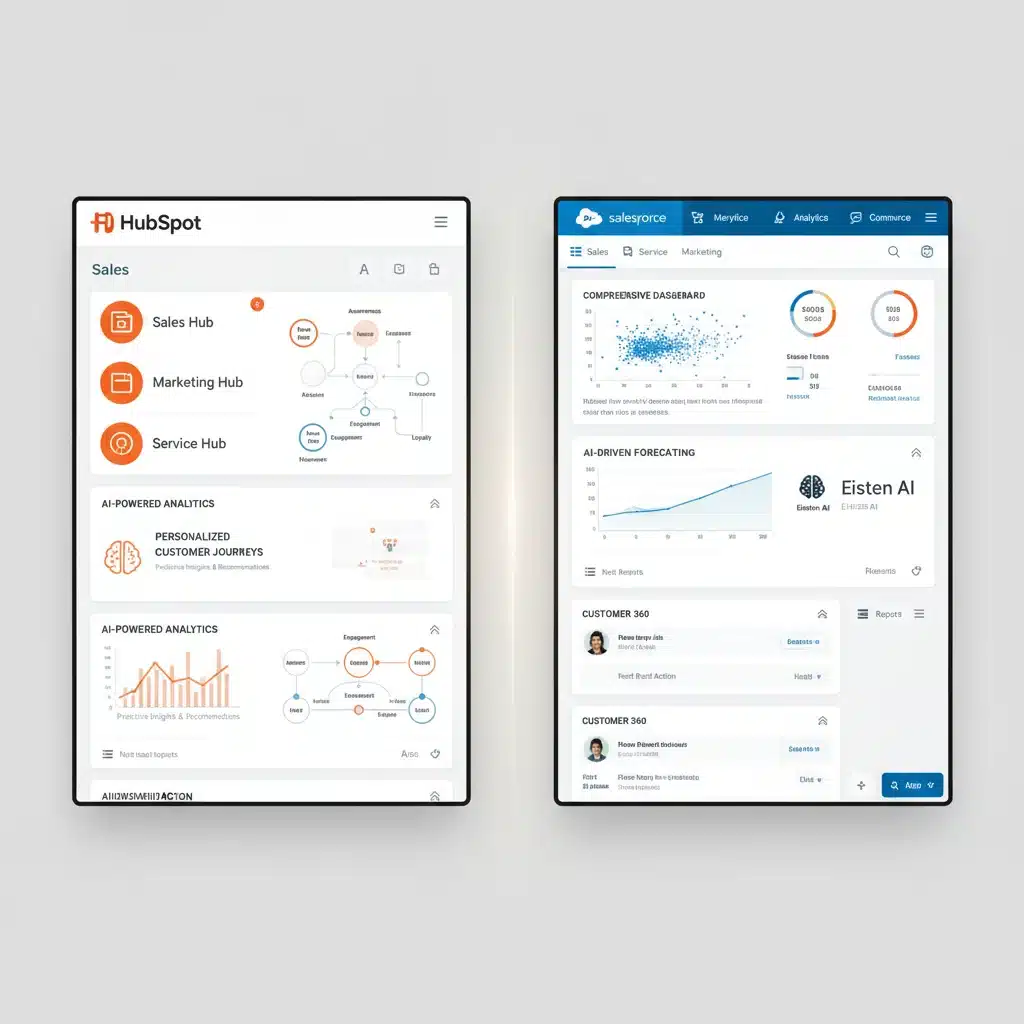
HubSpot has consistently positioned itself as a comprehensive growth platform, and its Q1 2026 updates further solidify this stance. Known for its user-friendly interface and integrated marketing, sales, service, and CMS hubs, HubSpot’s latest enhancements focus heavily on leveraging AI to deliver more personalized customer experiences and provide deeper, more actionable insights.
Key HubSpot Updates for Q1 2026:
- AI-Powered Content Generation and Optimization: HubSpot has significantly upgraded its AI content assistant across its Marketing Hub. This now includes advanced capabilities for generating blog posts, email copy, social media updates, and even website landing page content with greater nuance and brand voice consistency. New optimization tools offer real-time suggestions for SEO improvement and engagement rate prediction, making content creation more efficient and effective.
- Enhanced Predictive Lead Scoring: The Sales Hub sees a major boost with a refined predictive lead scoring model. Utilizing machine learning, this model now incorporates a wider array of behavioral data, historical conversions, and external market signals to provide more accurate lead qualification. This helps sales teams prioritize efforts and focus on the most promising prospects, significantly improving conversion rates.
- Personalized Customer Journeys with AI: In the Service Hub, HubSpot has introduced more sophisticated AI-driven personalization for customer journeys. This includes dynamic content delivery in support emails, personalized knowledge base recommendations, and intelligent routing of service tickets based on customer history and query complexity. The goal is to create a more seamless and satisfying customer support experience.
- Advanced Custom Reporting & Dashboards: HubSpot’s reporting capabilities have received a substantial overhaul. Users now have access to a more intuitive drag-and-drop interface for creating custom reports and dashboards, pulling data from across all HubSpot hubs. New visualization options and cross-object reporting allow for a more holistic view of the customer lifecycle and business performance, making these CRM software updates invaluable for data-driven decisions.
- Improved Integrations with Third-Party Apps: Recognizing the diverse tech stacks businesses employ, HubSpot has expanded its App Marketplace with deeper integrations for popular e-commerce platforms, ERP systems, and project management tools. This facilitates better data flow and automation across the entire business ecosystem, reducing manual data entry and improving overall operational efficiency.
HubSpot’s strategy continues to revolve around ease of use and an all-in-one platform approach. These Q1 2026 CRM software updates demonstrate a strong commitment to empowering businesses with intelligent tools that automate routine tasks, personalize customer interactions, and provide clearer insights into performance. For SMBs and mid-market companies looking for an integrated, intuitive, and AI-enhanced platform, HubSpot remains a compelling choice.
Salesforce: Deepening Enterprise Capabilities with Hyperforce and Einstein AI Evolution
Salesforce, the CRM behemoth, continues to dominate the enterprise market by focusing on scalability, robust customization, and advanced AI capabilities. Its Q1 2026 updates are largely centered around strengthening its core platform, enhancing its AI engine (Einstein), and expanding its global infrastructure with Hyperforce, ensuring compliance and data residency for its vast enterprise clientele.
Key Salesforce Updates for Q1 2026:
- Hyperforce Expansion and Data Residency Options: Salesforce has significantly accelerated the global rollout of Hyperforce, its next-generation public cloud infrastructure. This expansion provides customers with more choices for data residency, enhanced security, and improved performance, particularly crucial for multinational enterprises adhering to stringent data governance regulations. This foundational update underpins many other enhancements and is a key highlight among CRM software updates.
- Einstein AI Enhancements for Sales and Service Cloud: Einstein AI continues to be a cornerstone of Salesforce’s innovation. Q1 2026 brings more sophisticated predictive analytics for sales forecasting, identifying at-risk deals, and recommending next-best actions for sales reps. In the Service Cloud, Einstein’s capabilities have been extended to include more intelligent case routing, AI-powered knowledge article creation, and advanced sentiment analysis for customer interactions, leading to faster and more effective problem resolution.
- Flow Orchestrator for Complex Workflows: Salesforce has further refined its Flow Orchestrator, allowing administrators to build and manage highly complex, multi-step business processes that span across different clouds and systems. This enables greater automation of intricate workflows, from customer onboarding to contract management, reducing manual intervention and ensuring consistency across operations.
- Industry-Specific Cloud Innovations: Salesforce has continued to invest in its industry-specific clouds (e.g., Financial Services Cloud, Health Cloud, Manufacturing Cloud). Q1 2026 sees new pre-built components, data models, and processes tailored to the unique needs of these sectors, accelerating time-to-value for specialized businesses and further cementing Salesforce’s vertical expertise.
- Tableau Integration and Advanced Analytics: The integration with Tableau has been deepened, offering more seamless access to advanced data visualization and business intelligence tools directly within the Salesforce ecosystem. This allows for more powerful analysis of CRM data, uncovering trends and insights that drive strategic decision-making.
Salesforce’s Q1 2026 CRM software updates reinforce its position as the preferred platform for large enterprises requiring extensive customization, robust security, and advanced AI capabilities. Its continued investment in Hyperforce and Einstein AI underscores a commitment to providing a scalable, intelligent, and globally compliant CRM solution.
Zoho CRM: Value-Driven Innovation with AI, Low-Code, and Vertical Solutions
Zoho CRM has carved out a significant niche by offering a powerful, feature-rich CRM solution at a competitive price point, often appealing to SMBs and mid-market companies seeking comprehensive functionality without the premium cost. For Q1 2026, Zoho CRM’s updates highlight its focus on democratizing advanced technology, integrating AI more deeply, and expanding its suite of vertical-specific solutions.
Key Zoho CRM Updates for Q1 2026:
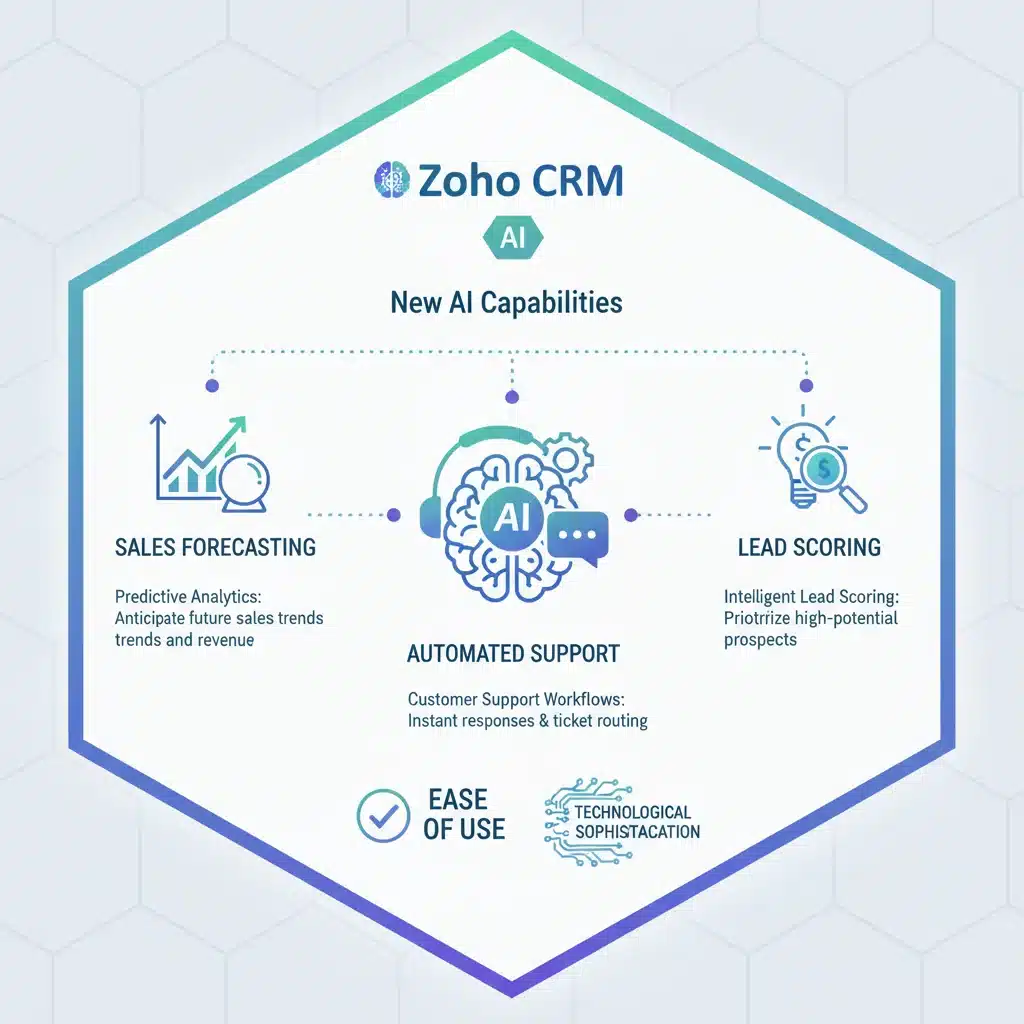
- Zia Voice and AI Assistant Enhancements: Zoho’s AI assistant, Zia, has received significant upgrades. Zia Voice now offers more natural language processing capabilities, allowing users to interact with the CRM through voice commands for tasks like fetching customer data, updating records, and generating reports. Zia’s predictive capabilities have been improved for lead scoring, deal prediction, and recommending optimal communication channels, making these AI software updates a strong contender for efficiency.
- Low-Code/No-Code Customization with Zoho Creator: Zoho continues to empower users with its low-code platform, Zoho Creator, which is now more deeply integrated with Zoho CRM. This allows businesses to build custom applications, automate complex workflows, and extend CRM functionalities with minimal coding expertise, catering to unique business needs without heavy development costs.
- Vertical CRM Editions and Industry Templates: Zoho has expanded its offering of industry-specific CRM editions and templates. These pre-configured solutions cater to sectors like real estate, healthcare, and financial services, providing tailored modules, workflows, and dashboards out-of-the-box. This significantly reduces setup time and ensures industry best practices are embedded from day one.
- Advanced Analytics and Business Intelligence: Zoho Analytics integration within Zoho CRM has been enhanced, providing users with more powerful data visualization and business intelligence tools. New pre-built dashboards and reporting templates focus on key performance indicators (KPIs) relevant to sales, marketing, and customer service, offering deeper insights into operational efficiency and customer behavior.
- Unified Customer Experience Platform: Zoho’s vision for a unified customer experience platform continues to evolve. Q1 2026 updates include tighter integration between Zoho CRM and other Zoho applications like Zoho Marketing Automation, Zoho Desk, and Zoho Commerce, creating a more cohesive and seamless customer journey across all touchpoints.
Zoho CRM’s Q1 2026 CRM software updates underscore its commitment to delivering value through comprehensive features, AI innovation, and user-friendly customization. It remains an excellent choice for businesses seeking an affordable yet powerful CRM that can scale with their growth and adapt to specific industry requirements.
Comparative Analysis: Who Leads in Q1 2026?
While all three CRM giants have delivered impressive updates, their strengths continue to cater to different market segments and business priorities. Here’s a brief comparative look:
Innovation in AI and Automation:
- Salesforce: Leads with its deep integration of Einstein AI, particularly for complex predictive analytics and enterprise-grade automation through Flow Orchestrator. Its AI capabilities are designed for large-scale, intricate business processes.
- HubSpot: Excels in AI-driven personalization and content generation, making it highly effective for marketing and sales teams focused on customer engagement and lead nurturing. Its AI is more geared towards immediate, actionable insights for front-line users.
- Zoho CRM: Offers significant AI enhancements with Zia, democratizing advanced features like voice commands and intelligent lead management at a more accessible price point. Its focus on low-code automation also empowers a wider range of users.
Scalability and Customization:
- Salesforce: Unmatched in scalability and customization for large enterprises, with Hyperforce providing the global infrastructure and its extensive app ecosystem supporting virtually any business requirement.
- HubSpot: Highly scalable for SMBs and mid-market companies, with increasing customization options through its CMS Hub and API integrations. While robust, it may not offer the same depth of enterprise-level customization as Salesforce.
- Zoho CRM: Offers excellent scalability for SMBs and mid-market, with its Zoho Creator platform providing powerful low-code customization. Its vertical editions also enhance its adaptability for specific industries.
Ease of Use and Implementation:
- HubSpot: Generally considered the most user-friendly, with an intuitive interface and a strong focus on inbound methodologies, making it easier for new users to adopt.
- Zoho CRM: Offers a good balance of features and usability, with a relatively straightforward setup process, especially with its industry templates.
- Salesforce: While powerful, it has a steeper learning curve due to its vast array of features and customization options, often requiring dedicated administrators or consultants for optimal implementation.
Strategic Implications for Businesses
The Q1 2026 CRM software updates from HubSpot, Salesforce, and Zoho CRM have significant strategic implications for businesses:
- For Enterprises: Salesforce’s continued investment in Hyperforce and advanced Einstein AI positions it as the leader for global companies needing robust security, data residency, and highly sophisticated predictive capabilities. The deeper Tableau integration also means better strategic insights from vast datasets.
- For Mid-Market Companies: HubSpot offers a compelling, integrated platform for those focused on efficient customer acquisition, engagement, and retention through personalized experiences. Its enhanced reporting and AI content tools are particularly valuable for scaling marketing and sales efforts. Zoho CRM also presents a strong value proposition, especially for those seeking powerful features and customization without the enterprise price tag, or those in specific vertical markets.
- For Small Businesses: Zoho CRM’s accessibility, low-code customization, and comprehensive feature set make it an attractive option for small businesses looking to leverage advanced CRM capabilities on a budget. HubSpot also remains a strong contender due to its user-friendliness and integrated approach, particularly for businesses focused on inbound strategies.
Beyond the individual features, a recurring theme across all three platforms is the increasing emphasis on data intelligence and automation. Businesses that fail to leverage these advancements risk falling behind competitors who are using AI to personalize interactions, automate mundane tasks, and gain deeper insights into customer behavior. Therefore, evaluating these CRM software updates through the lens of your specific business objectives and customer engagement strategy is paramount.
Another critical consideration is the evolving compliance landscape. With Hyperforce, Salesforce is clearly addressing the growing need for data residency and enhanced security, a vital factor for businesses operating in regulated industries or across multiple geographies. HubSpot and Zoho CRM also continue to strengthen their security protocols and compliance features, acknowledging the universal importance of data privacy.
Furthermore, the trend towards unified platforms is undeniable. All three providers are striving to offer a more cohesive experience across sales, marketing, and service. This means less data silos, more consistent customer interactions, and a single source of truth for customer data, ultimately leading to improved operational efficiency and a better customer experience. Businesses should look for CRM solutions that facilitate this unification, allowing them to break down departmental barriers and foster a truly customer-centric approach.
Looking Ahead: The Future of CRM Post Q1 2026
The Q1 2026 CRM software updates paint a clear picture of the future: CRM platforms will become even more intelligent, interconnected, and indispensable. We can expect continued advancements in:
- Generative AI: Beyond content creation, generative AI will likely play a larger role in automating more complex tasks, such as drafting personalized sales proposals, creating dynamic customer service scripts, and even simulating customer interactions for training purposes.
- Hyper-Personalization at Scale: The ability to deliver truly individualized experiences to millions of customers will become a standard expectation, driven by increasingly sophisticated AI and real-time data analytics.
- Embedded Analytics and Business Intelligence: CRM systems will further integrate advanced analytics directly into workflows, providing insights to users at the moment of need, rather than requiring separate reporting efforts.
- Vertical-Specific Solutions: The trend of tailored CRM solutions for niche industries will continue to grow, offering out-of-the-box functionality that addresses highly specific business challenges.
- Ethical AI and Trust: As AI becomes more pervasive, there will be a greater emphasis on ethical AI development, transparency in algorithms, and building customer trust around data usage.
The competition among HubSpot, Salesforce, and Zoho CRM will undoubtedly continue to drive innovation, benefiting businesses of all sizes. The key for any organization is to regularly assess its CRM needs against the capabilities of these evolving platforms. What works today might not be sufficient tomorrow, and understanding these ongoing CRM software updates is crucial for maintaining a competitive edge.
Conclusion
The Q1 2026 CRM software updates from HubSpot, Salesforce, and Zoho CRM demonstrate a robust and competitive market, with each vendor pushing the envelope in distinct ways. HubSpot continues to excel in delivering an intuitive, integrated platform with strong AI-driven personalization for growth-focused businesses. Salesforce solidifies its dominance in the enterprise space with unparalleled scalability, deep customization, and advanced Einstein AI, backed by its global Hyperforce infrastructure. Zoho CRM, meanwhile, continues to offer a compelling value proposition, democratizing advanced AI, low-code customization, and vertical solutions for a broader market.
Choosing the right CRM is not just about features; it’s about aligning the platform with your business goals, budget, and long-term vision. By carefully evaluating these latest updates, businesses can make informed decisions that will empower their sales, marketing, and service teams, ultimately leading to stronger customer relationships and sustainable growth in 2026 and beyond. The future of CRM is intelligent, integrated, and intensely customer-focused, and these three leaders are clearly paving the way.