Mastering Multi-Cloud Security: Strategies for a Hybrid World

Mastering Multi-Cloud Security: Strategies for a Hybrid World
In today’s rapidly evolving digital landscape, enterprises are increasingly adopting multi-cloud strategies to leverage the unique strengths and offerings of various cloud providers. While this approach offers unparalleled flexibility, scalability, and resilience, it also introduces a new frontier of complex security challenges. The distributed nature of multi-cloud environments, coupled with the varying security models of different providers, demands a sophisticated and holistic approach to cybersecurity. This article delves deep into essential multi-cloud security strategies, providing a comprehensive guide for organizations aiming to secure their hybrid cloud infrastructure effectively.
The journey to mastering multi-cloud security strategies begins with understanding the inherent complexities. Unlike a single-cloud setup where security policies and tools can be more uniformly applied, a multi-cloud environment often involves disparate security controls, identity management systems, and compliance frameworks across different platforms. This fragmentation can lead to security gaps, increased attack surfaces, and difficulties in maintaining a consistent security posture. Therefore, a proactive and well-orchestrated strategy is not just beneficial; it’s absolutely critical for safeguarding sensitive data and maintaining operational integrity.
As businesses continue their digital transformation, the adoption of multi-cloud architectures is no longer a niche trend but a mainstream reality. Gartner predicts that by 2025, 80% of organizations will have adopted a multi-cloud strategy. This widespread adoption underscores the urgent need for robust multi-cloud security strategies that can adapt to dynamic environments and protect against sophisticated threats. Without a clear and comprehensive security roadmap, the benefits of multi-cloud can quickly be overshadowed by significant risks, including data breaches, compliance violations, and reputational damage.
Understanding the Multi-Cloud Security Landscape
Before diving into specific multi-cloud security strategies, it’s crucial to grasp the unique characteristics of the multi-cloud security landscape. This environment is characterized by:
- Distributed Infrastructure: Workloads and data are spread across multiple public clouds (e.g., AWS, Azure, Google Cloud) and often private clouds or on-premises data centers, creating a hybrid cloud model.
- Varied Security Models: Each cloud provider offers its own set of security tools, APIs, and shared responsibility models. Integrating these disparate systems seamlessly is a significant challenge.
- Increased Attack Surface: More endpoints, more APIs, and more data flows across different environments mean a larger potential attack surface for cybercriminals.
- Complexity in Governance and Compliance: Ensuring consistent governance and meeting regulatory compliance requirements (e.g., GDPR, HIPAA, PCI DSS) across multiple cloud providers can be incredibly complex.
- Skill Gap: Organizations often struggle to find security professionals with expertise across all the cloud platforms they utilize.
Addressing these challenges requires a strategic shift from siloed security approaches to an integrated, platform-agnostic methodology. The goal is to create a unified security posture that provides consistent protection, visibility, and control regardless of where workloads and data reside. This is the essence of effective multi-cloud security strategies.
Pillar 1: Centralized Identity and Access Management (IAM)
One of the foundational elements of any strong multi-cloud security strategy is a robust and centralized Identity and Access Management (IAM) system. In a multi-cloud world, managing user identities and their access privileges across various platforms can quickly become a tangled web. Without a unified approach, organizations risk inconsistent access policies, orphaned accounts, and unauthorized access, all of which can lead to significant security vulnerabilities.
Implementing a Unified IAM Solution
To overcome these challenges, enterprises should prioritize implementing a unified IAM solution that can integrate with all their cloud providers. This typically involves:
- Single Sign-On (SSO): Enabling users to authenticate once and gain access to resources across all cloud environments, reducing password fatigue and improving security.
- Multi-Factor Authentication (MFA): Enforcing MFA for all user accounts, especially privileged ones, adds an essential layer of security against credential theft.
- Role-Based Access Control (RBAC): Defining granular roles and permissions that are consistently applied across all cloud platforms, ensuring that users only have access to the resources necessary for their job functions (principle of least privilege).
- Centralized Directory Services: Leveraging a central directory (e.g., Active Directory, Okta, Azure AD) that synchronizes identities across all cloud providers.
- Automated Provisioning and Deprovisioning: Automating the creation and removal of user accounts and their associated permissions to ensure timely updates and prevent lingering access for departed employees or changed roles.
By centralizing IAM, organizations gain better control over who can access what, when, and from where, significantly reducing the risk of unauthorized access and enhancing their overall multi-cloud security strategies. This unified approach simplifies administration, improves auditability, and strengthens the security perimeter.
Pillar 2: Consistent Data Protection and Encryption
Data is the lifeblood of any organization, and protecting it across diverse cloud environments is paramount. Different cloud providers offer various encryption services and data residency options, making it challenging to maintain a consistent data protection posture. Effective multi-cloud security strategies must include a comprehensive plan for data encryption, data loss prevention (DLP), and data residency management.
Key Data Protection Measures
- Encryption Everywhere: Implement encryption for data at rest (storage) and data in transit (network communications). While cloud providers offer native encryption, consider using your own encryption keys (BYOK – Bring Your Own Key) for enhanced control and compliance.
- Data Loss Prevention (DLP): Deploy DLP solutions that can monitor, detect, and block sensitive data from leaving your controlled environments, whether it’s moving between clouds or to unauthorized external locations.
- Data Residency and Sovereignty: Understand and adhere to data residency requirements, ensuring that data is stored and processed in specific geographic locations as mandated by regulations or business policies.
- Regular Data Backups and Disaster Recovery: Implement robust backup and disaster recovery plans that span across your multi-cloud environment. Ensure that backups are also encrypted and regularly tested for restorability.
- Data Classification: Classify data based on its sensitivity (e.g., public, internal, confidential, highly confidential) to apply appropriate security controls and access policies.
A consistent approach to data protection not only safeguards against breaches but also helps meet stringent regulatory requirements. Without strong data protection measures, even the most advanced multi-cloud security strategies can fall short, leaving critical information vulnerable.
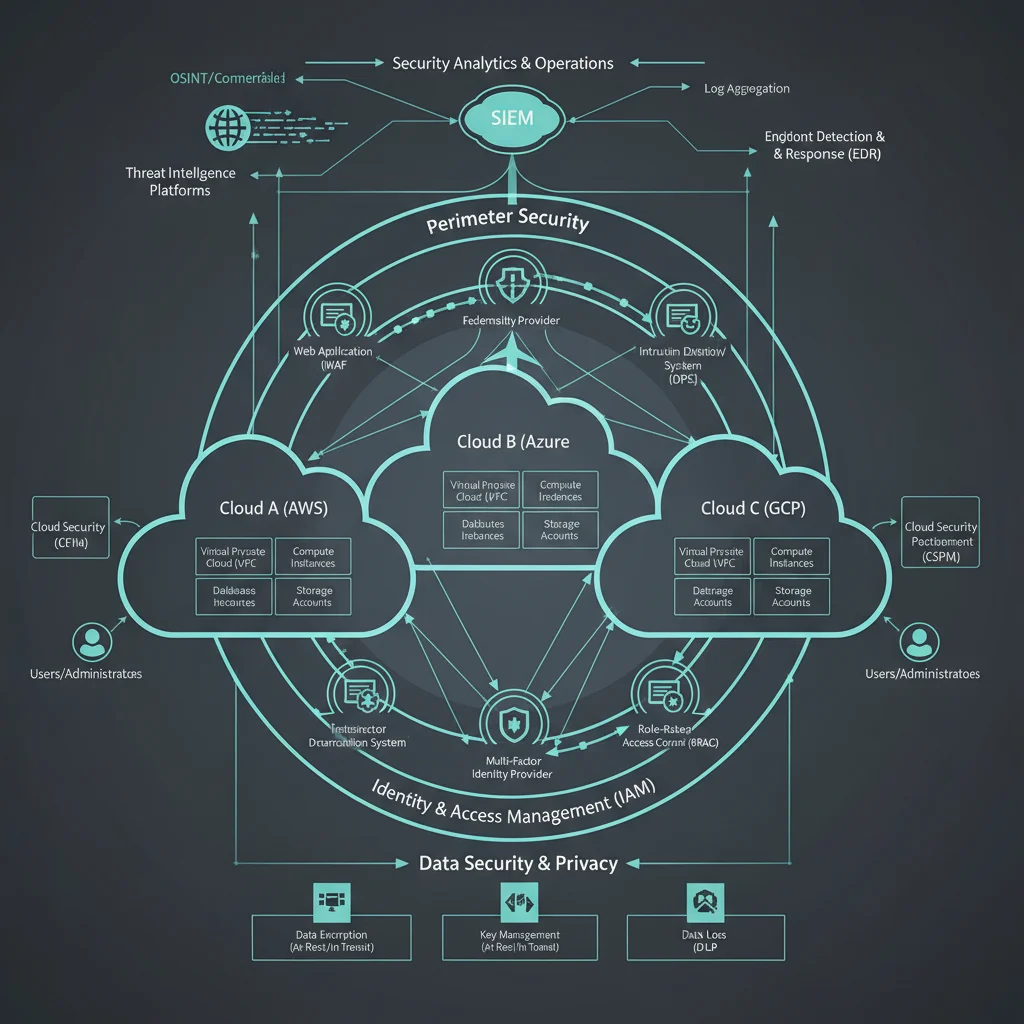
Pillar 3: Unified Security Posture Management and Visibility
One of the most significant hurdles in multi-cloud environments is achieving a unified view of the security posture. Each cloud provider has its own dashboards, logging mechanisms, and security tools, making it difficult to gain a holistic understanding of threats, vulnerabilities, and compliance status across the entire infrastructure. Effective multi-cloud security strategies demand centralized visibility and management.
Tools and Practices for Unified Visibility
- Cloud Security Posture Management (CSPM): Implement CSPM tools that continuously monitor your multi-cloud environment for misconfigurations, compliance violations, and security risks. These tools provide a single pane of glass for assessing and improving your security posture.
- Cloud Workload Protection Platforms (CWPP): CWPPs offer comprehensive protection for workloads (VMs, containers, serverless functions) across multiple clouds, including vulnerability management, runtime protection, and host-based intrusion detection.
- Security Information and Event Management (SIEM) / Security Orchestration, Automation, and Response (SOAR): Integrate logs and security events from all cloud providers into a centralized SIEM/SOAR platform. This enables real-time threat detection, correlation of events, and automated incident response across the entire multi-cloud estate.
- Network Security and Segmentation: Implement consistent network security policies, including micro-segmentation, across all cloud environments to restrict lateral movement of threats. Use cloud-native firewalls and Web Application Firewalls (WAFs) where appropriate, but also consider cloud-agnostic solutions for consistency.
- Threat Intelligence Integration: Incorporate threat intelligence feeds into your security operations to proactively identify and mitigate emerging threats relevant to your multi-cloud infrastructure.
By adopting these tools and practices, organizations can move from reactive security measures to a proactive, intelligence-driven approach, significantly strengthening their multi-cloud security strategies. Unified visibility empowers security teams to detect and respond to threats more efficiently, reducing the mean time to detect (MTTD) and mean time to respond (MTTR).
Pillar 4: Compliance and Governance Across Clouds
Navigating the complex web of regulatory compliance frameworks (e.g., GDPR, HIPAA, PCI DSS, SOC 2) becomes exponentially more challenging in a multi-cloud environment. Each cloud provider has its own compliance certifications and shared responsibility model, and ensuring that your applications and data adhere to all relevant regulations across all platforms is a critical component of robust multi-cloud security strategies.
Achieving Multi-Cloud Compliance
- Shared Responsibility Model Understanding: Clearly understand the shared responsibility model for each cloud provider. While the cloud provider secures the ‘cloud itself,’ you are responsible for security ‘in the cloud’ (your data, applications, configurations).
- Automated Compliance Checks: Utilize CSPM tools to automate compliance checks against various regulatory frameworks. These tools can identify deviations from compliance standards and recommend corrective actions.
- Policy as Code: Implement security policies as code, allowing for consistent deployment and enforcement across all cloud environments. This ensures that security configurations are standardized and auditable.
- Regular Audits and Assessments: Conduct regular internal and external audits of your multi-cloud security posture to identify gaps and ensure continuous compliance.
- Vendor Management: Thoroughly vet cloud providers and third-party services for their security practices and compliance certifications. Ensure that their security posture aligns with your organizational requirements.
- Data Governance Framework: Establish a comprehensive data governance framework that defines how data is collected, stored, processed, and protected across all cloud platforms, ensuring compliance with data protection laws.
Effective compliance and governance are not merely about avoiding fines; they are about building trust with customers and partners, and demonstrating a commitment to responsible data handling. Integrating compliance into your multi-cloud security strategies from the outset is far more efficient than trying to retroactively enforce it.
Additional Best Practices for Multi-Cloud Security
Beyond the four core pillars, several other best practices are crucial for fortifying your multi-cloud security strategies:
- Cloud Security Architecture Review: Regularly review your multi-cloud architecture to identify potential security weaknesses and ensure that security is built-in from the design phase.
- DevSecOps Integration: Embed security practices into your development and operations pipelines (DevSecOps) to automate security checks, vulnerability scanning, and compliance validation throughout the software development lifecycle.
- Continuous Monitoring and Threat Detection: Implement 24/7 monitoring of your multi-cloud environment for suspicious activities, anomalies, and potential threats. Leverage AI and machine learning for advanced threat detection.
- Incident Response Plan: Develop and regularly test a comprehensive incident response plan tailored for your multi-cloud environment. This plan should outline procedures for detection, containment, eradication, recovery, and post-incident analysis.
- Security Awareness Training: Educate employees about multi-cloud security best practices, phishing attacks, and their role in maintaining a secure environment. Human error remains a significant factor in security breaches.
- API Security: Secure all APIs used to connect cloud services and applications. Implement API gateways, authentication, authorization, and rate limiting to protect against API-specific attacks.
- Container and Kubernetes Security: If utilizing containers and orchestration platforms like Kubernetes, implement specialized security measures for container images, registries, runtime protection, and network policies.

The Future of Multi-Cloud Security
As multi-cloud adoption continues to grow, the landscape of multi-cloud security strategies will also evolve. We can expect to see further advancements in:
- AI and Machine Learning in Security: More sophisticated AI/ML-driven tools for anomaly detection, threat prediction, and automated response across complex multi-cloud environments.
- Serverless and Edge Computing Security: Increased focus on securing serverless functions and edge computing deployments, which introduce new security considerations.
- Zero Trust Architectures: A stronger shift towards Zero Trust principles, where no user or device is implicitly trusted, regardless of their location or prior authentication.
- Cloud-Native Security Controls: Enhanced native security features from cloud providers, coupled with better interoperability between different cloud security services.
- Unified Cloud Security Platforms: The emergence of more comprehensive platforms that offer integrated CSPM, CWPP, and network security capabilities across all major cloud providers.
Staying ahead of these trends and continuously adapting your multi-cloud security strategies will be crucial for maintaining a resilient and secure digital infrastructure in the years to come. The proactive adoption of emerging technologies and methodologies will define the success of future multi-cloud deployments.
Conclusion: Building a Resilient Multi-Cloud Security Posture
The embrace of multi-cloud architectures offers immense strategic advantages for enterprises, but it comes with a non-negotiable prerequisite: a robust and adaptive security framework. Implementing comprehensive multi-cloud security strategies is not a one-time project but an ongoing commitment to protecting your digital assets in an increasingly complex and interconnected world.
By focusing on centralized IAM, consistent data protection and encryption, unified security posture management and visibility, and stringent compliance and governance, organizations can build a resilient multi-cloud security posture. These pillars, supported by continuous monitoring, incident response planning, and security awareness, form the bedrock of a secure multi-cloud environment.
As you navigate your multi-cloud journey, remember that security should never be an afterthought. It must be an integral part of your strategy, designed and implemented with foresight and continuous adaptation. Only then can your enterprise truly harness the power of multi-cloud without compromising on the security and integrity of your operations. Mastering multi-cloud security strategies is not just about mitigating risks; it’s about enabling innovation and ensuring business continuity in the hybrid cloud era.