API Security Solutions 2026: Safeguarding U.S. Developer Projects

In the rapidly evolving digital landscape of 2026, Application Programming Interfaces (APIs) have become the backbone of modern software development, powering everything from mobile applications and cloud services to IoT devices and enterprise systems. For U.S. developers, the proliferation of APIs brings immense opportunities but also significant security challenges. As APIs expose critical business logic and sensitive data, they inherently become prime targets for cyberattacks. Therefore, understanding and implementing robust API security solutions is not just a best practice; it’s a fundamental necessity.
The stakes are higher than ever. Data breaches can lead to catastrophic financial losses, reputational damage, and severe regulatory penalties. With new threats constantly emerging, developers must stay ahead of the curve, adopting proactive and comprehensive security strategies. This article delves deep into the essential API security solutions that U.S. developers must consider in 2026, offering insights into leading software, best practices, and future trends to safeguard their applications and data effectively.
The Evolving Threat Landscape for APIs
Before exploring specific API security solutions, it’s crucial to grasp the current threat landscape. Attackers are becoming increasingly sophisticated, leveraging automated tools and advanced techniques to exploit API vulnerabilities. The Open Web Application Security Project (OWASP) API Security Top 10 provides a critical framework for understanding the most common API risks. In 2026, these threats continue to evolve, with new attack vectors emerging.
Common API Vulnerabilities
- Broken Object Level Authorization (BOLA): This remains a top threat, allowing attackers to access unauthorized resources by manipulating API requests.
- Broken User Authentication: Weak authentication mechanisms can lead to compromised user accounts and unauthorized access.
- Excessive Data Exposure: APIs often expose more data than necessary, creating opportunities for attackers to harvest sensitive information.
- Lack of Resources & Rate Limiting: Without proper rate limiting, APIs are vulnerable to denial-of-service (DoS) attacks and brute-force attempts.
- Broken Function Level Authorization: Similar to BOLA, but at the function level, allowing attackers to access administrative or privileged functions.
- Mass Assignment: Attackers can guess or infer object properties and send them in API requests, potentially modifying data they shouldn’t.
- Security Misconfiguration: Default settings, open cloud storage, and improperly configured HTTP headers can expose APIs to risk.
- Injection Flaws: SQL, NoSQL, and command injection attacks can still compromise APIs if input validation is inadequate.
- Improper Assets Management: Outdated or unmanaged APIs can become forgotten entry points for attackers.
- Insufficient Logging & Monitoring: A lack of visibility into API traffic hinders the detection and response to security incidents.
Beyond these, emerging threats include advanced persistent threats (APTs) specifically targeting API infrastructures, supply chain attacks affecting API dependencies, and the increasing use of AI and machine learning by attackers to automate reconnaissance and exploitation. U.S. developers need comprehensive API security solutions to combat this multifaceted threat environment.
Core Pillars of Effective API Security
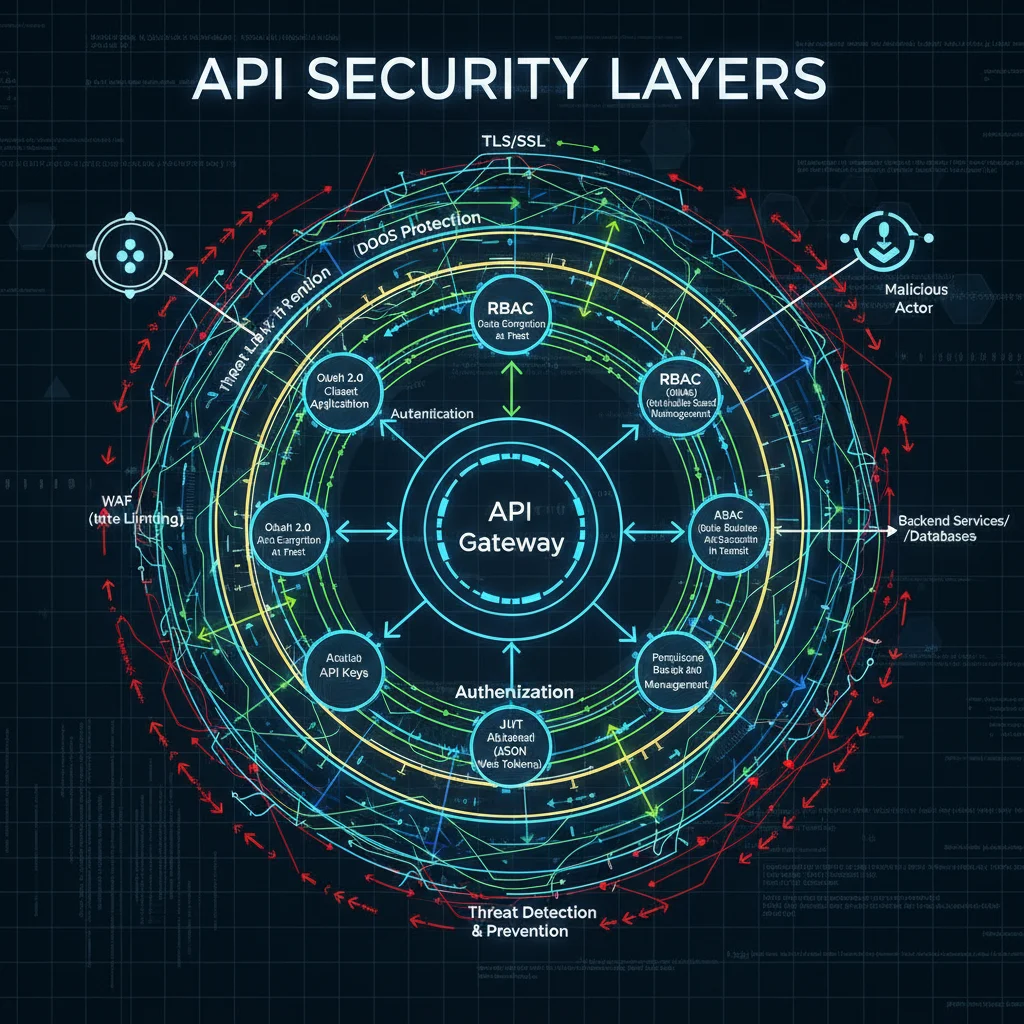
Building a robust API security posture requires a multi-layered approach, encompassing various tools, processes, and architectural considerations. Here are the core pillars that form the foundation of effective API security solutions in 2026:
1. API Gateway and Management
An API Gateway acts as the single entry point for all API calls, providing a crucial layer of security, control, and management. It’s often the first line of defense for your API security solutions strategy. Key functionalities include:
- Authentication and Authorization: Enforcing strong authentication (e.g., OAuth 2.0, OpenID Connect, API Keys, JWTs) and granular authorization policies.
- Rate Limiting and Throttling: Protecting against DoS attacks and abuse by controlling the number of requests an API can handle.
- Traffic Management: Routing, load balancing, and caching to improve performance and availability.
- Policy Enforcement: Applying security policies, such as input validation, header manipulation, and content filtering.
- Monitoring and Analytics: Providing visibility into API usage, performance, and security events.
Leading API Gateway providers offer integrated security features that are indispensable for any modern application architecture.
2. Authentication and Authorization Mechanisms
Strong identity and access management (IAM) are paramount. For API security solutions, this translates to:
- OAuth 2.0 and OpenID Connect (OIDC): Industry-standard protocols for secure delegation of access and identity verification.
- API Keys: While simple, API keys should be used with caution and primarily for client identification rather than strong authentication. They should be rotated regularly and never embedded directly in client-side code.
- JSON Web Tokens (JWTs): A compact, URL-safe means of representing claims to be transferred between two parties. JWTs are often used with OAuth 2.0 to transmit user identity and authorization information.
- Multi-Factor Authentication (MFA): Adding an extra layer of security for critical API access or administrative interfaces.
- Role-Based Access Control (RBAC) and Attribute-Based Access Control (ABAC): Implementing fine-grained authorization to ensure users and applications only access resources they are explicitly permitted to use.
3. Data Encryption and Privacy
Protecting data in transit and at rest is a non-negotiable aspect of API security solutions. This involves:
- TLS/SSL: Ensuring all API communication is encrypted using Transport Layer Security (TLS), preventing eavesdropping and tampering.
- Data Encryption at Rest: Encrypting sensitive data stored in databases or file systems that your APIs interact with.
- Tokenization and Data Masking: Replacing sensitive data with non-sensitive substitutes to reduce the risk of exposure.
- Privacy by Design: Incorporating privacy considerations from the initial design phase of APIs, adhering to regulations like GDPR, CCPA, and other U.S. specific privacy laws.
4. Input Validation and Output Sanitization
Many API vulnerabilities stem from improper handling of input and output. Robust API security solutions must include:
- Strict Input Validation: Validating all input parameters against predefined schemas, data types, lengths, and acceptable values. This prevents injection attacks and unexpected behavior.
- Output Sanitization: Ensuring that any data returned by the API is properly encoded or sanitized to prevent cross-site scripting (XSS) or other client-side attacks.
5. API Security Testing
Proactive testing is essential to identify and remediate vulnerabilities before they can be exploited. Key testing methodologies for API security solutions include:
- Static Application Security Testing (SAST): Analyzing source code for security flaws without executing the application.
- Dynamic Application Security Testing (DAST): Testing a running application for vulnerabilities by simulating attacks.
- Interactive Application Security Testing (IAST): Combining elements of SAST and DAST, IAST tools analyze application behavior during runtime from within the application.
- Penetration Testing: Manual and automated attempts to exploit vulnerabilities, often performed by ethical hackers.
- Fuzz Testing: Feeding malformed or unexpected inputs to an API to discover crashes or vulnerabilities.
6. Continuous Monitoring and Threat Detection
Even with the best preventative measures, breaches can occur. Effective API security solutions require continuous monitoring and rapid response capabilities:
- API Security Gateways: As mentioned, these often provide initial logging and monitoring capabilities.
- Security Information and Event Management (SIEM) Systems: Centralizing security logs from various sources, including API gateways, applications, and infrastructure, for correlation and analysis.
- API Threat Detection Platforms: Specialized tools that use behavioral analytics and machine learning to detect anomalous API usage patterns indicative of attacks.
- Web Application Firewalls (WAFs): While primarily for web applications, WAFs can offer some protection for APIs by filtering malicious traffic.
- Incident Response Plan: A well-defined plan for detecting, containing, eradicating, recovering from, and post-incident analysis of security incidents.
Top Software Solutions for API Security in 2026
The market for API security solutions is robust and growing, with many vendors offering specialized tools. Here are some of the leading software solutions U.S. developers should consider in 2026:
API Management Platforms with Integrated Security
These platforms offer a comprehensive suite of tools for designing, deploying, securing, and managing APIs.
- Google Apigee: A powerful API management platform that includes robust security features like OAuth 2.0, API key validation, threat protection, and bot detection. Its analytics capabilities are also crucial for security monitoring.
- Kong Enterprise: An open-source-based platform that offers extensive API gateway capabilities with a strong focus on security plugins, including authentication, authorization, rate limiting, and WAF integration.
- MuleSoft Anypoint Platform: Provides comprehensive API management with advanced security policies, data governance, and compliance features, essential for enterprise-grade API security solutions.
- Amazon API Gateway: For AWS users, this service offers built-in security features, including IAM integration, request validation, and integration with AWS WAF for advanced threat protection.
Dedicated API Security Platforms
These solutions specialize exclusively in API security, offering deeper analysis and threat detection capabilities.
- Salt Security: A leading API security platform that focuses on discovering all APIs, detecting sophisticated attacks, and protecting against API vulnerabilities. It uses AI and machine learning for behavioral analysis.
- Noname Security: Offers a comprehensive API security platform for discovery, posture management, runtime protection, and API security testing. It provides visibility into all API traffic and identifies vulnerabilities.
- Cequence Security: Provides an API security platform that includes API discovery, risk assessment, and real-time threat protection against advanced API attacks, including bot attacks and sophisticated exploits.
- Imperva API Security: Part of Imperva’s broader security suite, this solution offers API discovery, deep threat inspection, and protection against OWASP API Top 10 vulnerabilities.
Application Security Testing Tools (AST)
These tools are crucial for embedding security throughout the development lifecycle.
- OWASP ZAP (Zed Attack Proxy): A popular open-source DAST tool for finding vulnerabilities in web applications and APIs during development and testing.
- Postman: While primarily an API development and testing tool, Postman can be extended with scripts and collections to perform basic security tests and validate API responses.
- Burp Suite: A comprehensive set of tools for web application security testing, including proxy, scanner, and intruder features, highly valuable for API penetration testing.
- Synk: Offers SAST and SCA (Software Composition Analysis) capabilities to identify vulnerabilities in code and open-source dependencies, which are critical for API security solutions.
- Veracode: Provides a unified platform for SAST, DAST, IAST, and SCA, offering a comprehensive view of application and API security risks.
Cloud Security Posture Management (CSPM) and Cloud Workload Protection Platforms (CWPP)
As many APIs are cloud-native, these solutions are vital for managing security in cloud environments.
- Palo Alto Networks Prisma Cloud: Offers comprehensive security for cloud-native applications, including API security, by providing visibility, threat detection, and compliance across multi-cloud environments.
- CrowdStrike Cloud Security: Provides runtime protection for cloud workloads, including containerized APIs, detecting and preventing threats in real-time.
Best Practices for U.S. Developers in 2026
Beyond specific tools, adopting a security-first mindset and adhering to best practices are crucial for robust API security solutions.
1. Shift Left with DevSecOps
Integrate security into every stage of the API development lifecycle, from design to deployment and maintenance. This ‘shift left’ approach means:
- Security by Design: Incorporate security requirements from the initial API design phase.
- Automated Security Testing: Integrate SAST, DAST, and IAST into CI/CD pipelines.
- Developer Education: Train developers on secure coding practices and common API vulnerabilities.
2. Implement Strong Authentication and Authorization
Never compromise on identity. Use industry-standard protocols, enforce MFA, and implement the principle of least privilege, ensuring APIs only grant the minimum necessary access.
3. Validate All Inputs and Sanitize All Outputs
Treat all incoming data as untrusted. Rigorous input validation and output sanitization are fundamental to preventing injection attacks and data exposure.
4. Implement Rate Limiting and Throttling
Protect your APIs from abuse, DoS attacks, and brute-force attempts by setting appropriate rate limits and throttling mechanisms.
5. Encrypt Data in Transit and at Rest
Always use TLS/SSL for API communication and encrypt sensitive data wherever it is stored.
6. Comprehensive API Discovery and Inventory
You can’t secure what you don’t know exists. Implement tools and processes to discover and maintain an up-to-date inventory of all your APIs, including shadow APIs and zombie APIs.
7. Continuous Monitoring and Alerting
Monitor API traffic, logs, and security events in real-time. Set up alerts for suspicious activities and have a clear incident response plan.
8. Regular Security Audits and Penetration Testing
Periodically engage third-party security experts to conduct comprehensive audits and penetration tests to identify overlooked vulnerabilities.
9. Secure API Gateway Configuration
Properly configure your API Gateway with strong security policies, including WAF rules, access controls, and threat protection.
10. Versioning and Deprecation Strategy
Manage API versions carefully and have a clear strategy for deprecating old, less secure APIs. Unmanaged older versions can become a significant security risk.

The Future of API Security: Trends for 2026 and Beyond
The landscape of API security solutions is constantly evolving. U.S. developers should keep an eye on these emerging trends:
AI and Machine Learning in Threat Detection
AI and ML are becoming indispensable for detecting sophisticated API attacks. These technologies can analyze vast amounts of API traffic, identify behavioral anomalies, and predict potential threats with greater accuracy than traditional rule-based systems. Expect more advanced AI-driven platforms that offer predictive security and automated response.
API Security Mesh and Zero Trust Architectures
The concept of a "security mesh" where security is distributed and enforced at every service boundary is gaining traction. Coupled with Zero Trust principles (never trust, always verify), this approach ensures that every API interaction is authenticated, authorized, and continuously validated, regardless of its origin.
Shift Towards API-First Security
As organizations increasingly adopt an API-first development approach, security will also become API-first. This means designing security controls and policies specifically for APIs, rather than retrofitting traditional web application security measures.
Enhanced Runtime Protection
While preventative measures are crucial, runtime protection for APIs will become more sophisticated. This includes real-time threat detection, anomaly behavior analysis, and automated blocking of malicious requests at the API layer.
Regulatory Compliance and Data Sovereignty
With increasing data privacy regulations (e.g., CCPA, state-specific privacy laws, potential federal privacy legislation), API security solutions will need to offer more robust features for data governance, access control, and auditability to ensure compliance and respect data sovereignty requirements for U.S. organizations.
API Security as a Service (ASaaS)
The complexity of API security may lead to a greater adoption of specialized API Security as a Service offerings, allowing organizations to offload the burden of managing advanced security infrastructures to expert providers.
Conclusion: A Proactive Stance on API Security
For U.S. developers in 2026, the imperative to secure APIs cannot be overstated. The interconnected nature of modern applications means that a single API vulnerability can have widespread ramifications. By adopting a proactive, multi-layered approach to API security solutions, developers can build resilient applications that withstand the evolving threat landscape.
Embracing comprehensive API management platforms, dedicated API security tools, robust application security testing, and a strong adherence to best practices like DevSecOps and Zero Trust principles will be key. Continuous monitoring, regular audits, and staying informed about emerging threats and technologies will empower developers to protect sensitive data, maintain user trust, and ensure the operational integrity of their digital infrastructure. The future of software development in the U.S. is deeply intertwined with the strength of its API security. Invest wisely, secure diligently, and build the future with confidence.