
Cloud Disaster Recovery: Building Resilient Systems with 99.99% Uptime for 2026
In an increasingly digital and interconnected world, the phrase “downtime is unacceptable” has become more than just a mantra; it’s a critical business imperative. Organizations across all sectors are facing unprecedented challenges, from sophisticated cyberattacks and natural disasters to human error and infrastructure failures. The ability to recover swiftly and maintain continuous operations is no longer a luxury but a fundamental requirement for survival and growth. This is where Cloud Disaster Recovery (CDR) emerges as the cornerstone of modern business resilience. As we look towards 2026, the demand for robust, efficient, and highly available systems will only intensify, pushing the boundaries of traditional disaster recovery approaches.
The goal of achieving 99.99% uptime, often referred to as “four nines” availability, translates to less than an hour of downtime per year. For many businesses, particularly those operating in e-commerce, financial services, healthcare, and critical infrastructure, even a few minutes of outage can result in catastrophic financial losses, reputational damage, and loss of customer trust. Traditional disaster recovery methods, often characterized by high costs, complex management, and lengthy recovery times, are proving inadequate for these stringent demands. Cloud Disaster Recovery, leveraging the scalability, flexibility, and cost-effectiveness of cloud computing, offers a compelling solution to meet and exceed these expectations.
This comprehensive article will delve deep into the world of Cloud Disaster Recovery, exploring its fundamental principles, key benefits, and the strategic approaches necessary to build highly resilient systems. We will examine the critical components of a successful CDR strategy, from understanding Recovery Point Objectives (RPO) and Recovery Time Objectives (RTO) to implementing advanced replication techniques and automated failover mechanisms. Furthermore, we will look ahead to 2026, discussing emerging trends, technological advancements, and the evolving landscape of threats that will shape the future of disaster recovery in the cloud. Our aim is to provide a definitive guide for organizations striving to achieve and maintain 99.99% uptime, ensuring unparalleled business continuity in the years to come.
Understanding the Imperative: Why Cloud Disaster Recovery is Non-Negotiable
The digital transformation journey has placed data and applications at the heart of every business operation. This reliance, while enabling unprecedented efficiency and innovation, also introduces significant vulnerabilities. A single point of failure can bring an entire enterprise to a grinding halt, impacting everything from customer service and sales to internal operations and regulatory compliance. The cost of downtime is staggering, often running into thousands, if not millions, of dollars per hour, depending on the industry and scale of the business.
Traditional disaster recovery solutions typically involve maintaining a secondary physical data center, often with identical hardware and software configurations to the primary site. This approach is inherently expensive, requiring significant capital expenditure for infrastructure, real estate, power, cooling, and ongoing maintenance. Furthermore, the complexity of managing and synchronizing two separate physical environments can be immense, leading to potential inconsistencies and longer recovery times. Testing these traditional DR plans is also a resource-intensive endeavor, often leading to infrequent testing and a false sense of security.
Cloud Disaster Recovery fundamentally shifts this paradigm. By utilizing the vast, globally distributed infrastructure of cloud providers like AWS, Azure, and Google Cloud, organizations can create a highly resilient and cost-effective DR solution. Instead of duplicating entire physical environments, CDR allows businesses to replicate their critical data and applications to a cloud environment, which can then be spun up on-demand in the event of a disaster. This ‘pay-as-you-go’ model dramatically reduces upfront costs and operational overhead, making advanced disaster recovery accessible to a wider range of organizations.
Beyond cost savings, CDR offers unparalleled flexibility and scalability. Cloud environments can dynamically adjust resources to meet recovery needs, ensuring that critical systems are brought back online quickly and efficiently. The global footprint of cloud providers also allows for geo-redundancy, placing recovery sites in different geographical regions to protect against region-wide outages or natural disasters. This inherent resilience is a major driver for the adoption of Cloud Disaster Recovery as a non-negotiable component of modern IT strategy.
The Core Pillars of a Robust Cloud Disaster Recovery Strategy
A successful Cloud Disaster Recovery strategy is built upon several foundational pillars, each contributing to the overall resilience and effectiveness of the plan. Understanding and meticulously planning each of these components is crucial for achieving 99.99% uptime.
Defining Recovery Point Objective (RPO) and Recovery Time Objective (RTO)
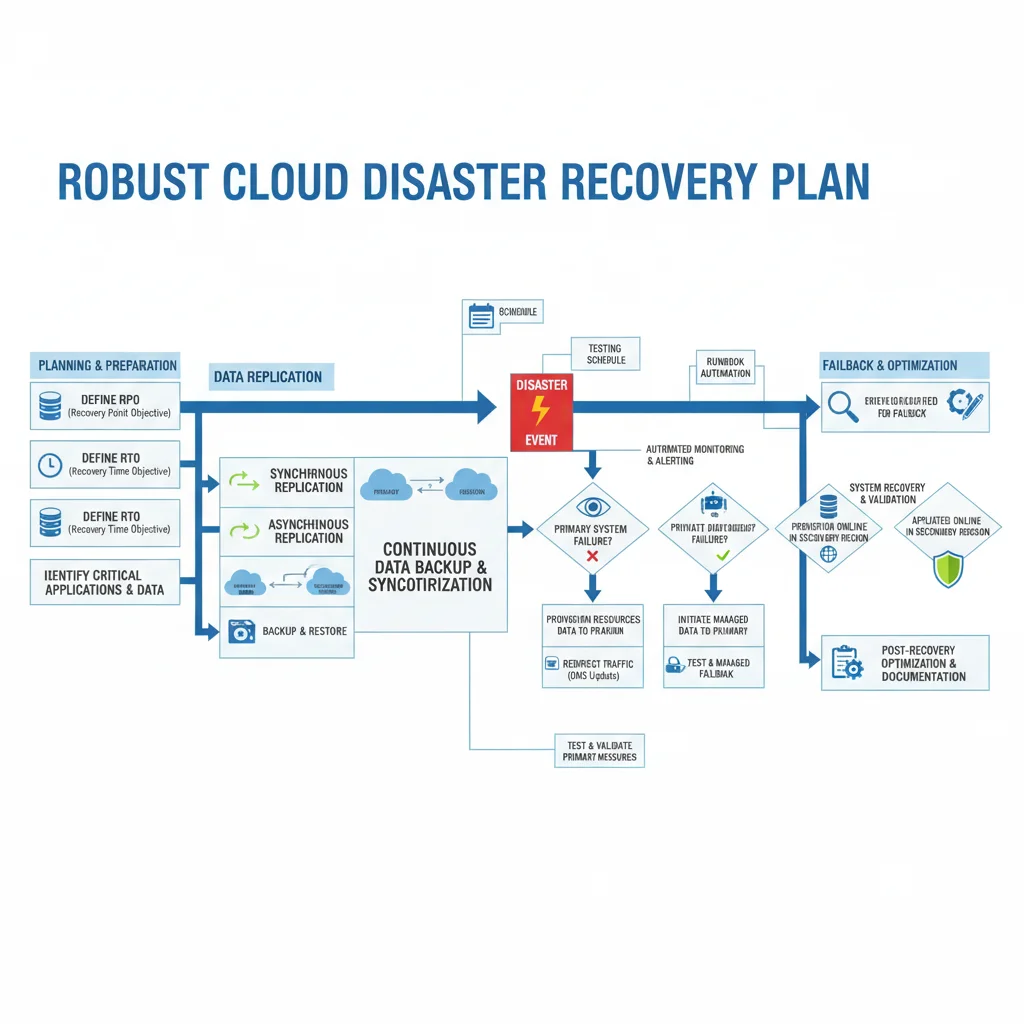
These two metrics are the bedrock of any disaster recovery plan. RPO defines the maximum acceptable amount of data loss measured in time. For example, an RPO of one hour means that in the event of a disaster, you can afford to lose up to one hour’s worth of data. RTO, on the other hand, defines the maximum acceptable amount of time that an application or system can be down after a disaster. An RTO of four hours means that the business can tolerate up to four hours of downtime before critical operations are restored. The determination of RPO and RTO should be a business-driven decision, taking into account the impact of data loss and downtime on various business functions. Mission-critical applications will typically demand very low RPOs and RTOs, often measured in minutes or even seconds.
Data Replication and Backup Strategies
Effective data replication is central to meeting RPO targets. In a Cloud Disaster Recovery scenario, this involves continuously replicating data from the primary environment to the cloud recovery site. Various replication methods exist, including:
- Synchronous Replication: Ensures that data is written to both the primary and secondary sites simultaneously. This offers zero data loss (RPO near zero) but can introduce latency, making it suitable for geographically close sites or very high-priority data.
- Asynchronous Replication: Data is written to the primary site first, then replicated to the secondary site with a slight delay. This offers a balance between RPO and performance, suitable for most enterprise applications.
- Snapshot-based Replication: Point-in-time copies of data are taken and replicated to the cloud. This is simpler to manage but results in a higher RPO.
Beyond replication, robust backup strategies are also essential. While replication focuses on continuous data synchronization for rapid recovery, backups provide a historical archive of data, crucial for recovering from data corruption, accidental deletions, or long-term retention requirements. Cloud-native backup solutions offer automated, scalable, and cost-effective ways to store backups, often with built-in immutability features to protect against ransomware.
Automated Failover and Failback Mechanisms
Manual failover processes are prone to human error and can significantly extend RTOs. Modern Cloud Disaster Recovery solutions emphasize automation. This involves pre-configured scripts and orchestration tools that can automatically detect outages in the primary environment and initiate the failover process to the cloud recovery site. This includes:
- Provisioning virtual machines and network resources in the cloud.
- Mounting replicated data volumes.
- Starting applications in the correct order, respecting dependencies.
- Updating DNS records to redirect traffic to the recovered applications.
Failback, the process of returning operations to the primary site once it’s restored, is equally important. An effective failback plan ensures a smooth transition without data loss or prolonged disruption. Automation plays a key role here too, minimizing manual intervention and reducing the risk of errors.
Network Connectivity and Security
Reliable and secure network connectivity between the primary data center and the cloud recovery site is paramount. This often involves establishing dedicated connections (e.g., AWS Direct Connect, Azure ExpressRoute) or secure VPN tunnels to ensure low latency and high bandwidth for data replication and application access during recovery. Security, of course, remains a top priority. Implementing robust access controls, encryption for data in transit and at rest, and network segmentation within the cloud environment are critical to protect sensitive data during a disaster and throughout the recovery process.
Implementing Cloud Disaster Recovery: Best Practices for 2026
Achieving 99.99% uptime by 2026 requires more than just understanding the components; it demands a strategic and continuous approach to implementation and management. Here are some best practices for your Cloud Disaster Recovery journey:
Conduct a Thorough Business Impact Analysis (BIA)
Before designing any DR plan, a BIA is essential. This process identifies critical business functions, assesses the impact of disruptions, and helps define appropriate RPO and RTO targets for each application and data set. The BIA will inform resource allocation and prioritization within your CDR strategy.
Choose the Right Cloud Provider and Architecture
The choice of cloud provider (AWS, Azure, Google Cloud, etc.) will depend on existing cloud adoption, specific technical requirements, and budgetary considerations. Evaluate providers based on their global reach, range of DR services (e.g., managed DRaaS solutions), security certifications, and pricing models. Design your cloud recovery architecture to be highly available, leveraging multiple availability zones and regions within the chosen cloud provider to protect against localized outages.
Automate Everything Possible
Manual processes are the enemy of rapid recovery. Invest in automation tools and orchestration platforms that can streamline replication, failover, and failback. Infrastructure as Code (IaC) tools like Terraform or CloudFormation can be invaluable for defining and deploying your recovery infrastructure consistently and efficiently.
Regular and Rigorous Testing
A DR plan is only as good as its last test. Regular testing is paramount to ensure that your Cloud Disaster Recovery solution works as expected. This includes:
- Tabletop Exercises: Walk through the DR plan with key stakeholders to identify gaps and refine procedures.
- Simulated Failovers: Periodically perform actual failovers to the cloud environment to validate recovery processes, RTOs, and RPOs.
- Application Testing: After a failover, thoroughly test applications in the cloud environment to ensure full functionality and performance.
- Failback Testing: Practice the process of returning operations to the primary site.
Testing should be conducted without impacting production environments, which is often easier to achieve with cloud-based DR solutions due to their isolated environments and flexible resource provisioning.
Comprehensive Monitoring and Alerting
Implement robust monitoring for both your primary environment and your cloud recovery site. This includes monitoring replication status, network connectivity, application health, and resource utilization. Set up automated alerts to notify relevant teams immediately of any issues that could impact your disaster recovery capabilities.
Documentation and Training
Maintain up-to-date documentation of your entire Cloud Disaster Recovery plan, including procedures, contact lists, and architectural diagrams. Regularly train your IT staff on DR procedures and roles to ensure they can execute the plan effectively during a crisis.
The Future of Cloud Disaster Recovery: 2026 and Beyond
As technology continues to evolve at a rapid pace, so too will the landscape of Cloud Disaster Recovery. Several key trends and advancements are shaping the future, pushing towards even greater resilience and efficiency.
AI and Machine Learning for Predictive DR
Artificial Intelligence (AI) and Machine Learning (ML) are poised to revolutionize DR by enabling predictive capabilities. AI algorithms can analyze vast amounts of operational data to identify patterns and anomalies that might indicate an impending failure, allowing for proactive intervention before a disaster strikes. ML can also optimize resource allocation during recovery, predict recovery times more accurately, and even automate complex decision-making processes during a crisis, further reducing RTOs.
Serverless and Containerized DR
The increasing adoption of serverless computing and containerization (e.g., Kubernetes) is transforming application deployment and, by extension, disaster recovery. Serverless functions and containerized applications are inherently more portable and resilient. DR for these environments will focus on replicating code, configuration, and data, allowing for rapid re-deployment in a different cloud region or provider. This approach promises even faster recovery times and greater efficiency.
Multi-Cloud and Hybrid Cloud DR Strategies
Many organizations are adopting multi-cloud or hybrid cloud strategies to avoid vendor lock-in and leverage the best services from different providers. This trend extends to DR, where businesses might replicate critical data and applications across multiple cloud providers or between their on-premises data centers and different clouds. While this introduces complexity, it also offers an even higher degree of resilience against a single cloud provider outage.
Enhanced Security and Compliance in DR
Cybersecurity threats are growing in sophistication, and DR plans must evolve to counter them. Future Cloud Disaster Recovery solutions will incorporate advanced security features, including immutable backups, sophisticated threat detection, and automated incident response workflows. Compliance requirements, such as GDPR, HIPAA, and industry-specific regulations, will also continue to drive the need for robust data governance and auditable recovery processes within cloud environments.
Disaster Recovery as a Service (DRaaS) Evolution
DRaaS offerings will become even more sophisticated, providing highly automated, turnkey solutions for businesses. These services will integrate more deeply with existing IT infrastructure, offer more granular control over recovery processes, and leverage advanced analytics to provide real-time insights into DR readiness. The shift towards managed DRaaS will allow organizations to focus on their core business while entrusting their recovery needs to specialized providers.

Challenges and Considerations in Cloud Disaster Recovery
While the benefits of Cloud Disaster Recovery are substantial, organizations must also be aware of potential challenges and considerations to ensure a successful implementation.
Cost Management
Although CDR is generally more cost-effective than traditional DR, managing cloud costs requires careful planning. Unexpected charges can arise from data transfer, storage, and compute resources used during testing or actual recovery. Implementing cost governance strategies, such as reserved instances for steady-state DR resources and careful monitoring of usage, is crucial.
Data Gravity and Egress Costs
Moving large volumes of data into and out of the cloud can incur significant egress costs. Organizations need to factor these into their DR budget and optimize data transfer strategies. Data gravity, the phenomenon where large datasets attract applications and services to their location, can also influence DR architecture decisions, especially in multi-cloud scenarios.
Vendor Lock-in Concerns
While multi-cloud strategies can mitigate this, relying heavily on a single cloud provider for DR can lead to vendor lock-in. This can manifest in proprietary tools, APIs, and services that make it difficult to migrate DR solutions to another provider. Careful planning and the use of open standards or cloud-agnostic tools can help reduce this risk.
Complexity of Hybrid Environments
Many organizations operate in hybrid environments, with some applications on-premises and others in the cloud. Designing a unified DR plan that spans both environments can be complex, requiring seamless integration and consistent management across disparate infrastructures. Tools and strategies that bridge these environments are essential.
Security and Compliance in the Cloud
While cloud providers offer robust security, the shared responsibility model means that organizations are still responsible for securing their data and applications within the cloud. This includes proper configuration of security controls, identity and access management, and ensuring compliance with relevant regulations. A thorough understanding of the shared responsibility model is critical.
Conclusion: Achieving Unprecedented Resilience with Cloud Disaster Recovery by 2026
The journey towards achieving 99.99% uptime and building truly resilient systems by 2026 is an ambitious yet attainable goal with the strategic implementation of Cloud Disaster Recovery. As businesses become more reliant on their digital infrastructure, the ability to withstand disruptions and recover swiftly will differentiate leaders from those left behind. Cloud-based DR offers a powerful combination of cost-effectiveness, scalability, flexibility, and advanced automation that traditional methods simply cannot match.
By focusing on clearly defined RPOs and RTOs, implementing robust data replication and backup strategies, embracing automation for failover and failback, and rigorously testing plans, organizations can significantly enhance their business continuity posture. Looking ahead, the integration of AI and ML, the evolution of serverless and containerized DR, and the growth of multi-cloud strategies will further refine and strengthen our ability to recover from any eventuality.
However, the path to optimal Cloud Disaster Recovery is not without its challenges. Careful consideration of cost management, data egress, vendor lock-in, hybrid environment complexities, and cloud security responsibilities is vital. By proactively addressing these factors and continuously adapting to the evolving threat landscape, businesses can leverage the full potential of cloud technology to safeguard their operations, protect their data, and maintain an unwavering commitment to their customers. The future of business resilience is undoubtedly in the cloud, and those who master Cloud Disaster Recovery will be best positioned for success in 2026 and beyond.