
In the rapidly evolving landscape of digital transformation, cloud computing has become the backbone of modern enterprises. While offering unparalleled agility, scalability, and innovation, the cloud also presents a significant challenge: managing costs effectively. Unchecked cloud spending can quickly erode budgets, turning a strategic advantage into a financial burden. This is where FinOps cloud cost management emerges as a critical discipline, offering a transformative approach to financial accountability in the cloud era. Our goal is not just to manage costs, but to achieve an ambitious 18% better budget control by 2026, setting a new benchmark for financial prudence and operational excellence.
The promise of the cloud is immense, but its realization often hinges on an organization’s ability to govern its financial aspects with the same rigor it applies to technical operations. Traditional financial management practices often fall short in the dynamic, on-demand nature of cloud environments. FinOps bridges this gap, fostering a culture of collaboration between finance, operations, and business teams to drive financial accountability and maximize business value from cloud investments. By embracing FinOps, organizations can move beyond reactive cost cutting to proactive cost optimization, aligning cloud spend with business objectives.
Understanding the Core Principles of FinOps Cloud Cost Management
At its heart, FinOps is an operational framework and cultural practice that brings financial accountability to the variable spend model of cloud. It’s about empowering everyone in an organization to make financially intelligent decisions, driving value and efficiency. The FinOps Foundation identifies three core principles:
- Collaboration: Breaking down silos between finance, technology, and business units. FinOps emphasizes shared responsibility and communication to achieve common goals.
- Visibility and Understanding: Providing clear, granular visibility into cloud spending. This includes understanding what is being spent, by whom, and for what purpose, enabling informed decision-making.
- Optimization and Continuous Improvement: Actively working to optimize cloud resources and spending. This is not a one-time event but an ongoing process of monitoring, analyzing, and adjusting.
These principles form the bedrock of an effective FinOps cloud cost strategy. Without them, organizations risk flying blind, making decisions based on incomplete data, and ultimately failing to harness the full potential of their cloud investments. Achieving 18% better budget control by 2026 is not merely a numbers game; it’s a testament to the successful integration of these principles into an organization’s DNA.
Why FinOps is More Than Just Cost Cutting
Many organizations initially view FinOps as a synonym for cost cutting. While cost optimization is a significant outcome, FinOps is far more holistic. It’s about maximizing business value. Consider the scenario where a development team needs more resources to accelerate a critical project. A traditional cost-cutting approach might deny these resources, potentially delaying time-to-market. A FinOps approach, however, would evaluate the business value of the project against the increased cloud spend, potentially approving the resources if the return on investment is clear. This strategic alignment of spend with value is a hallmark of successful FinOps cloud cost implementation.
Furthermore, FinOps promotes efficiency. It encourages teams to right-size resources, eliminate waste, and leverage cost-effective services, not just to save money, but to ensure that every dollar spent on the cloud delivers tangible business outcomes. This proactive stance is crucial for achieving ambitious targets like 18% better budget control.
The FinOps Lifecycle: Inform, Optimize, Operate
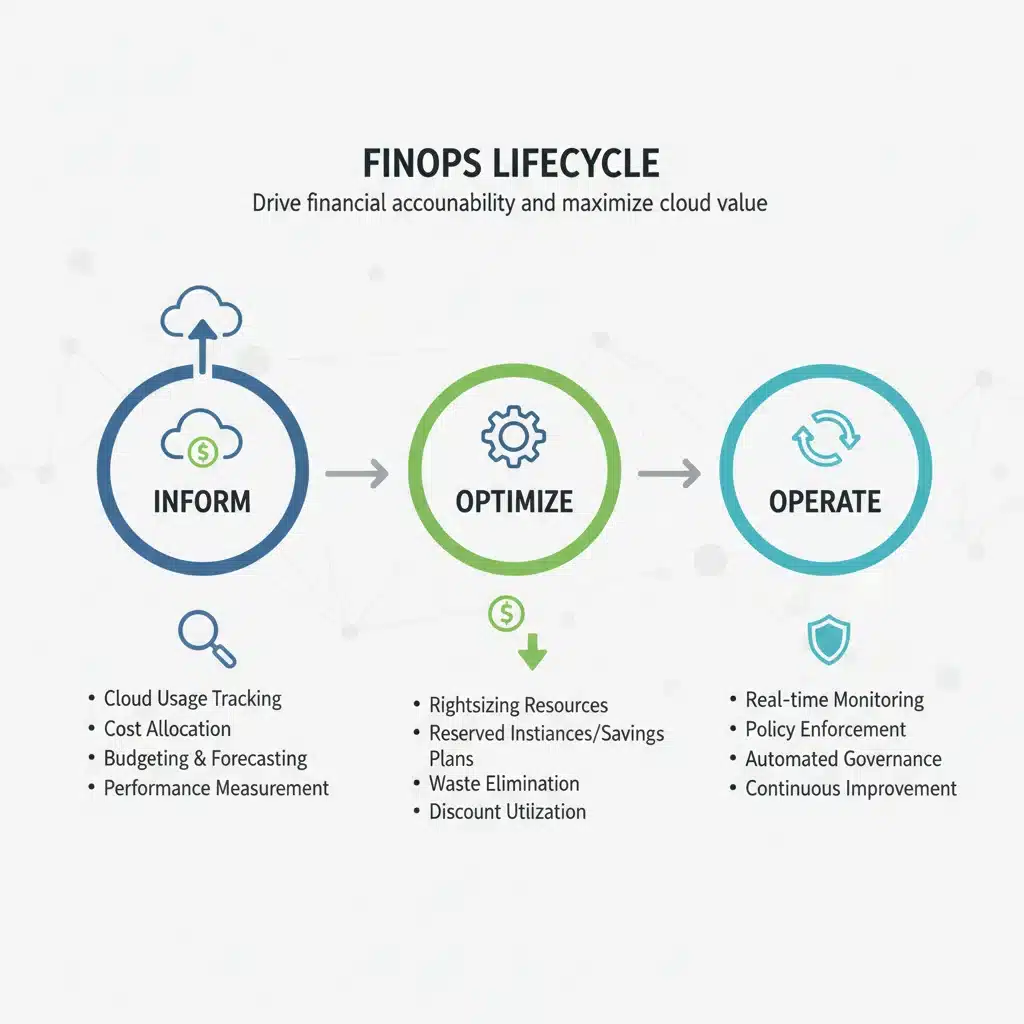
The FinOps framework is often described as a continuous lifecycle comprising three iterative phases: Inform, Optimize, and Operate. Understanding these phases is crucial for any organization looking to implement or mature its FinOps cloud cost practices.
1. Inform Phase: Gaining Visibility and Understanding
The first step in any FinOps journey is to gain complete visibility into cloud spending. This involves collecting, aggregating, and analyzing data from various cloud providers (AWS, Azure, GCP, etc.) and internal systems. Key activities in this phase include:
- Data Ingestion and Normalization: Bringing all cloud billing data into a central platform and normalizing it for consistent analysis.
- Cost Allocation and Tagging: Implementing robust tagging strategies to accurately allocate costs to specific teams, projects, applications, and business units. This is fundamental for accountability.
- Budgeting and Forecasting: Establishing clear budgets and developing accurate forecasts based on historical data and future plans.
- Reporting and Dashboards: Creating intuitive dashboards and reports that provide relevant stakeholders with actionable insights into their cloud spend.
- Anomaly Detection: Setting up alerts to identify sudden spikes or unusual patterns in spending that might indicate misconfigurations or inefficiencies.
Without a solid ‘Inform’ phase, any optimization efforts will be akin to shooting in the dark. Clear, accurate, and timely information is the foundation upon which all other FinOps activities are built. It empowers teams to understand their consumption and its financial implications, which is a prerequisite for making informed decisions and ultimately, for achieving that 18% improvement in budget control.
Consider an organization that historically struggled with understanding why cloud costs were rising. By implementing a robust tagging strategy and centralized reporting during the Inform phase, they could pinpoint that a specific development team was provisioning expensive GPU instances for non-GPU-intensive tasks. This visibility alone enabled them to address the issue, leading to immediate cost savings and a clearer picture of resource utilization.
2. Optimize Phase: Driving Efficiency and Savings
Once there’s a clear understanding of cloud spend, the ‘Optimize’ phase focuses on actively reducing waste and improving efficiency. This is where technical and financial teams collaborate closely to implement cost-saving measures without compromising performance or business objectives. Key optimization strategies include:
- Right-Sizing Resources: Adjusting compute, storage, and database instances to match actual usage requirements, eliminating over-provisioning.
- Elasticity and Auto-Scaling: Leveraging cloud elasticity to scale resources up and down automatically based on demand, preventing idle resources during low-usage periods.
- Purchasing Options (Reserved Instances, Savings Plans, Spot Instances): Strategically committing to long-term usage discounts (Reserved Instances, Savings Plans) or utilizing highly discounted, interruptible capacity (Spot Instances) for fault-tolerant workloads.
- Storage Optimization: Implementing intelligent tiering, lifecycle policies, and deleting unneeded snapshots to reduce storage costs.
- Network Optimization: Analyzing data transfer costs and optimizing network architecture to minimize egress fees.
- Serverless and Managed Services Adoption: Shifting to serverless architectures and fully managed services where appropriate, as they often offer a pay-per-use model that can be more cost-effective for certain workloads.
- Containerization: Utilizing containers (e.g., Docker, Kubernetes) to improve resource utilization and reduce infrastructure overhead.
The Optimize phase requires continuous effort and a deep understanding of cloud provider offerings. It’s not enough to implement these strategies once; they must be regularly reviewed and adjusted as workloads evolve and new cloud services become available. A dedicated FinOps team, working closely with engineering, can identify and implement these optimizations, directly contributing to the 18% budget control goal.
3. Operate Phase: Sustaining and Automating FinOps Practices
The ‘Operate’ phase is about embedding FinOps practices into the organization’s daily operations and automating as much as possible to ensure sustainability. This phase focuses on continuous monitoring, policy enforcement, and fostering a culture of cost awareness. Key activities include:
- Performance Monitoring and Alerting: Continuously monitoring resource utilization and costs, with automated alerts for deviations from budgets or best practices.
- Policy Enforcement: Implementing automated policies to ensure compliance with cost optimization strategies (e.g., automatically shutting down idle development environments).
- Chargeback/Showback Mechanisms: Implementing systems to attribute cloud costs back to the responsible teams or business units, fostering accountability. Showback provides visibility without direct billing, while chargeback directly bills departments.
- Continuous Improvement Loops: Regularly reviewing FinOps processes, tools, and strategies to identify areas for improvement.
- Education and Training: Providing ongoing training to engineering, finance, and business teams on FinOps principles, best practices, and tools.
- Tooling and Automation: Leveraging FinOps platforms and automation tools to streamline reporting, optimization, and policy enforcement.
The Operate phase ensures that the gains made in the Inform and Optimize phases are not lost. It transforms FinOps from a project into an ongoing, integral part of how an organization manages its cloud estate. By making FinOps an intrinsic part of operations, organizations can consistently achieve and even exceed their financial targets, like the 18% better budget control by 2026.
Key Strategies for Achieving 18% Better Budget Control by 2026
To reach an ambitious target like 18% better budget control, organizations need to go beyond basic FinOps implementation. Here are advanced strategies that can make a significant difference:
1. Establish a Dedicated FinOps Team or Center of Excellence (CoE)
While FinOps is a shared responsibility, a dedicated team or CoE can drive its adoption and maturity. This team acts as a central hub, providing expertise, developing best practices, and facilitating collaboration across departments. Their responsibilities would include:
- Developing and enforcing cloud cost policies.
- Managing cloud billing and cost allocation tools.
- Identifying and prioritizing optimization opportunities.
- Providing training and support to other teams.
- Reporting on cloud financial performance to leadership.
Without a central driving force, FinOps initiatives can lose momentum. A CoE ensures consistent application of principles and continuous progress towards financial goals.
2. Implement Granular Cost Allocation and Tagging Policies
Accurate cost allocation is the cornerstone of accountability. Organizations must develop and strictly enforce a comprehensive tagging strategy that allows for detailed breakdown of costs by project, application, environment, owner, and business unit. This includes:
- Mandatory Tagging: Ensuring all provisioned resources are tagged.
- Automated Tagging: Using infrastructure-as-code (IaC) and automation tools to enforce tagging at resource creation.
- Tag Compliance Audits: Regularly auditing tags for accuracy and completeness.
- Cost Center Mapping: Linking cloud tags directly to internal cost centers for seamless financial reporting.
The more granular the cost visibility, the better teams can understand their financial impact and take ownership. This precision directly contributes to the 18% budget control target.
3. Leverage Advanced Cloud Purchasing Strategies
Beyond basic Reserved Instances (RIs) or Savings Plans (SPs), explore more sophisticated purchasing strategies:
- Portfolio Optimization: Continuously analyze your RI/SP portfolio to ensure optimal coverage and utilization, considering exchanges and modifications.
- Flexible Savings Plans: Utilize the flexibility of compute savings plans across different instance families and regions.
- Spot Instance Adoption: Aggressively identify and migrate appropriate workloads (e.g., batch processing, testing, stateless applications) to Spot Instances for significant cost reductions.
- Container-Specific Pricing: Explore pricing models specific to container services (e.g., Fargate Spot) for further optimization.
These advanced strategies require careful planning and monitoring but can unlock substantial savings, directly impacting the budget control objective.
4. Drive a Culture of Cost Awareness and Accountability
FinOps is as much about culture as it is about technology. Foster a mindset where every engineer, developer, and team lead understands the financial implications of their actions in the cloud. This involves:
- Regular Communication: Sharing cost reports and insights with relevant teams regularly.
- Gamification and Incentives: Introducing friendly competitions or incentives for teams that demonstrate significant cost optimization.
- Embedding FinOps into SDLC: Integrating cost considerations into the Software Development Lifecycle (SDLC), from design to deployment.
- "Cost of Ownership" Mindset: Encouraging teams to think about the total cost of ownership for their applications, not just development costs.
When everyone takes ownership of FinOps cloud cost, the collective impact on budget control is immense.
5. Automate as Much as Possible
Manual FinOps processes are prone to errors and can’t keep up with the pace of cloud environments. Invest in automation tools for:
- Resource Lifecycle Management: Automatically shutting down idle resources, deleting old snapshots, and enforcing resource expiration.
- Policy Enforcement: Automatically applying tagging policies, enforcing instance types, or restricting resource creation in certain regions.
- Anomaly Detection and Remediation: Setting up automated alerts and even automated remediation actions for unexpected cost spikes.
- Reporting and Alerting: Automating the generation and distribution of cost reports and alerts to relevant stakeholders.
Automation frees up your FinOps team to focus on strategic initiatives rather than repetitive tasks, accelerating your journey towards 18% better budget control.
6. Embrace Cloud Native Architectures and Serverless
Re-architecting applications to be cloud-native and leveraging serverless computing can significantly reduce operational overhead and optimize costs. Serverless platforms often provide:
- Pay-per-use Billing: You only pay for the compute time consumed, eliminating costs for idle resources.
- Reduced Operational Burden: The cloud provider manages the underlying infrastructure, freeing your teams to focus on innovation.
- Automatic Scaling: Resources scale automatically to meet demand, preventing over-provisioning.
While initial re-architecting costs may exist, the long-term FinOps cloud cost benefits can be substantial.
Tools and Technologies for Effective FinOps Cloud Cost Management
The right tools are essential for successful FinOps implementation. These can range from native cloud provider tools to third-party solutions:
- Cloud Provider Cost Management Tools: AWS Cost Explorer, Azure Cost Management + Billing, Google Cloud Billing reports and dashboards. These provide foundational visibility.
- Third-Party FinOps Platforms: Solutions like CloudHealth by VMware, Apptio Cloudability, Flexera One, and Harness provide advanced capabilities for cost optimization, governance, and reporting across multi-cloud environments.
- Infrastructure-as-Code (IaC) Tools: Terraform, AWS CloudFormation, Azure Resource Manager (ARM) templates, and Google Cloud Deployment Manager help enforce consistent resource provisioning and tagging.
- Monitoring and Observability Tools: Datadog, New Relic, Splunk, Prometheus, and Grafana provide insights into resource utilization, which is crucial for right-sizing.
- Automation and Scripting: Python, AWS Lambda, Azure Functions, Google Cloud Functions, and various scripting tools for automating FinOps tasks.
Choosing the right combination of tools depends on your organization’s specific needs, cloud footprint, and maturity level. The goal is to create an integrated toolchain that supports the entire FinOps lifecycle and facilitates achieving the 18% budget control target.
Overcoming Common FinOps Challenges
Implementing FinOps is not without its hurdles. Organizations often face challenges such as:
- Lack of Cultural Buy-in: Resistance to change, especially from engineering teams who may perceive FinOps as an impediment to innovation.
- Data Overload and Complexity: The sheer volume and complexity of cloud billing data can be overwhelming.
- Multi-Cloud Complexity: Managing costs across multiple cloud providers adds another layer of complexity.
- Lack of Skills: A shortage of professionals with both financial acumen and cloud technical expertise.
- Tool Sprawl: Too many disparate tools that don’t integrate well.
Addressing these challenges requires a strategic approach. Leadership buy-in is paramount to foster a FinOps culture. Investing in training and cross-functional team building can bridge skill gaps. Standardizing on a core set of integrated tools can simplify data management. By proactively tackling these issues, organizations can accelerate their FinOps journey and increase their chances of achieving the 18% budget control target by 2026.
The Future of FinOps: AI, ML, and Predictive Cost Management
As cloud environments become even more complex, the future of FinOps cloud cost management will increasingly rely on advanced technologies:
- AI and Machine Learning for Anomaly Detection and Forecasting: AI/ML algorithms can analyze vast amounts of data to detect subtle anomalies, predict future spending with greater accuracy, and even recommend optimization actions.
- Predictive Cost Optimization: Moving beyond reactive optimization to proactive, predictive models that anticipate cost issues before they arise.
- Automated Remediation: AI-powered systems that not only identify issues but also automatically implement remediation steps.
- Advanced Benchmarking: Comparing your cloud spend and efficiency against industry peers and best practices using anonymized data.
- Sustainability and Green Cloud: Integrating environmental impact considerations into FinOps, optimizing for both cost and carbon footprint.
These advancements will empower organizations to achieve even greater levels of budget control and efficiency. The 18% target for 2026 is just the beginning; continuous innovation in FinOps will unlock even more significant value from cloud investments.

Case Studies and Success Stories in FinOps Adoption
Numerous organizations have already reaped significant benefits from adopting FinOps. For instance, a large e-commerce company, struggling with spiraling cloud costs due to rapid expansion, implemented a comprehensive FinOps framework. By focusing on granular cost allocation, right-sizing, and leveraging Reserved Instances, they were able to reduce their monthly cloud bill by 25% within the first year, exceeding their initial 15% target. This success was largely attributed to the cultural shift towards cost awareness among their engineering teams, fostered by regular FinOps training and transparent reporting.
Another example comes from a SaaS provider that utilized FinOps to optimize their multi-cloud environment. They faced challenges with inconsistent tagging and disparate billing data. By centralizing their FinOps cloud cost data and implementing an automated tagging enforcement policy, they gained unprecedented visibility. This led to the identification and elimination of significant idle resources, resulting in a 1.5 million dollar annual saving. Their success highlights the importance of a unified approach and robust tooling in complex cloud landscapes.
These examples underscore that achieving substantial budget control, such as our target of 18% by 2026, is not only possible but is being realized by forward-thinking organizations globally. The common threads in these success stories are strong leadership support, a commitment to cultural change, and the systematic application of FinOps principles.
Conclusion: The Path to 18% Better Budget Control by 2026
The journey to achieving 18% better budget control by 2026 through FinOps cloud cost management is a strategic imperative for any organization leveraging the cloud. It requires more than just technical expertise; it demands a cultural shift, a commitment to collaboration, and a continuous pursuit of efficiency.
By embracing the FinOps principles of Inform, Optimize, and Operate, organizations can transform their relationship with cloud spending from one of reactive cost-cutting to proactive value maximization. Establishing dedicated FinOps teams, implementing granular cost allocation, leveraging advanced purchasing strategies, fostering a culture of cost awareness, and automating processes are all crucial steps on this path.
The benefits extend far beyond mere financial savings. Effective FinOps leads to better resource utilization, increased business agility, improved decision-making, and a stronger alignment between IT and business objectives. As cloud environments continue to evolve, so too will FinOps, with AI and ML promising even greater levels of predictive control and optimization.
The target of 18% better budget control by 2026 is ambitious, yet entirely achievable for organizations committed to integrating FinOps into their operational DNA. Start your FinOps journey today, and unlock the full financial potential of your cloud investments, ensuring sustainable growth and innovation for years to come.