
Data Lakes vs. Data Warehouses in the Cloud: A 2026 Comparison for Strategic Decisions
In the rapidly evolving landscape of enterprise data management, making informed decisions about your underlying data architecture is paramount. As we approach 2026, the distinctions and convergences between data lakes and data warehouses, particularly in cloud environments, have become more nuanced and critical than ever. This comprehensive guide delves into the core aspects of both, offering a strategic comparison to help businesses optimize their cloud data strategy for future success.
The digital transformation journey for most organizations is deeply intertwined with how they collect, store, process, and analyze vast amounts of data. The choice between a data lake and a data warehouse, or even a hybrid approach, profoundly impacts an organization’s ability to derive insights, foster innovation, and maintain a competitive edge. Understanding these complex systems is not just an IT concern; it’s a fundamental business imperative that shapes strategic decisions.
The Evolution of Data Architectures: A 2026 Perspective
For decades, data warehouses have been the cornerstone of business intelligence (BI), providing structured, cleaned, and aggregated data for reporting and analytical queries. They are designed for consistency, accuracy, and performance in answering well-defined questions. However, the explosion of big data – characterized by its volume, velocity, and variety – introduced new challenges that traditional data warehouses struggled to address effectively. This led to the emergence of data lakes.
Data lakes, by contrast, offer a more flexible approach, storing raw, unstructured, and semi-structured data at scale, often at a lower cost. They are designed for exploration, machine learning, and advanced analytics, allowing data scientists to delve into uncharted territories without the rigid schema requirements of a data warehouse. The cloud has been a game-changer for both, providing unprecedented scalability, flexibility, and cost-effectiveness, making these sophisticated architectures accessible to a wider range of businesses.
As we look to 2026, the lines between these two paradigms are blurring. Hybrid models, often referred to as ‘data lakehouses,’ are gaining traction, attempting to combine the best features of both: the flexibility and cost-effectiveness of a data lake with the structure and performance of a data warehouse. This evolution underscores the importance of a well-defined cloud data strategy that can adapt to changing analytical needs and technological advancements.
Understanding Data Warehouses in the Cloud
A data warehouse is a centralized repository of integrated data from one or more disparate sources. It stores current and historical data in one single place that is used for creating analytical reports for workers throughout the enterprise. The data stored in the warehouse is typically structured, cleaned, and transformed to ensure high quality and consistency, making it ideal for traditional BI tools and reporting.
Key Characteristics of Cloud Data Warehouses:
- Structured Data: Primarily deals with relational data, organized into tables with predefined schemas.
- Schema-on-Write: Data is structured and validated upon ingestion, ensuring data quality from the outset.
- Optimized for BI and Reporting: Designed for fast query performance on aggregated data, supporting dashboards and routine reports.
- Historical Data: Stores historical data for trend analysis and forecasting.
- Scalability and Elasticity (Cloud): Cloud-based data warehouses (e.g., Snowflake, Amazon Redshift, Google BigQuery, Azure Synapse Analytics) offer unparalleled scalability, allowing organizations to scale compute and storage independently and on demand.
- Managed Services: Many cloud data warehouses are offered as fully managed services, reducing operational overhead.
- Cost: Can be more expensive for storing raw, untransformed data due to processing and storage costs associated with structured formats.
Common Use Cases:
- Financial reporting and analysis
- Sales performance monitoring
- Customer relationship management (CRM) analytics
- Supply chain optimization
- Regulatory compliance reporting
For businesses that require consistent, reliable, and highly structured data for their core analytical operations, a cloud data warehouse remains an indispensable component of their cloud data strategy. It provides the single source of truth necessary for critical business decisions.
Exploring Data Lakes in the Cloud
A data lake is a centralized repository that allows you to store all your structured and unstructured data at any scale. You can store your data as is, without having to first structure the data, and run different types of analytics—from dashboards and visualizations to big data processing, real-time analytics, and machine learning—to guide better decisions.
Key Characteristics of Cloud Data Lakes:
- Raw, Diverse Data: Can store structured, semi-structured, and unstructured data (e.g., text, images, video, audio, logs, sensor data).
- Schema-on-Read: Data is stored in its original format, and a schema is applied only when the data is read or queried. This offers immense flexibility.
- Optimized for Advanced Analytics: Ideal for data exploration, data science, machine learning, and predictive analytics, where the full fidelity of raw data is crucial.
- Cost-Effective Storage: Leverages inexpensive object storage (e.g., Amazon S3, Azure Blob Storage, Google Cloud Storage) for massive data volumes.
- Scalability: Inherently scalable to petabytes and exabytes of data.
- Flexibility: Supports a wide array of data processing frameworks and tools (e.g., Apache Spark, Hadoop, Presto).
- Data Governance Challenges: Can become a ‘data swamp’ without proper metadata management, governance, and data cataloging.
Common Use Cases:
- IoT data analytics
- Customer behavior analysis (clickstream, social media data)
- Fraud detection
- Predictive maintenance
- Real-time analytics and personalization
- Machine learning model training
Data lakes are fundamental for organizations looking to innovate with data, uncover hidden patterns, and build AI-driven applications. They are a cornerstone of a forward-looking cloud data strategy that prioritizes agility and discovery.
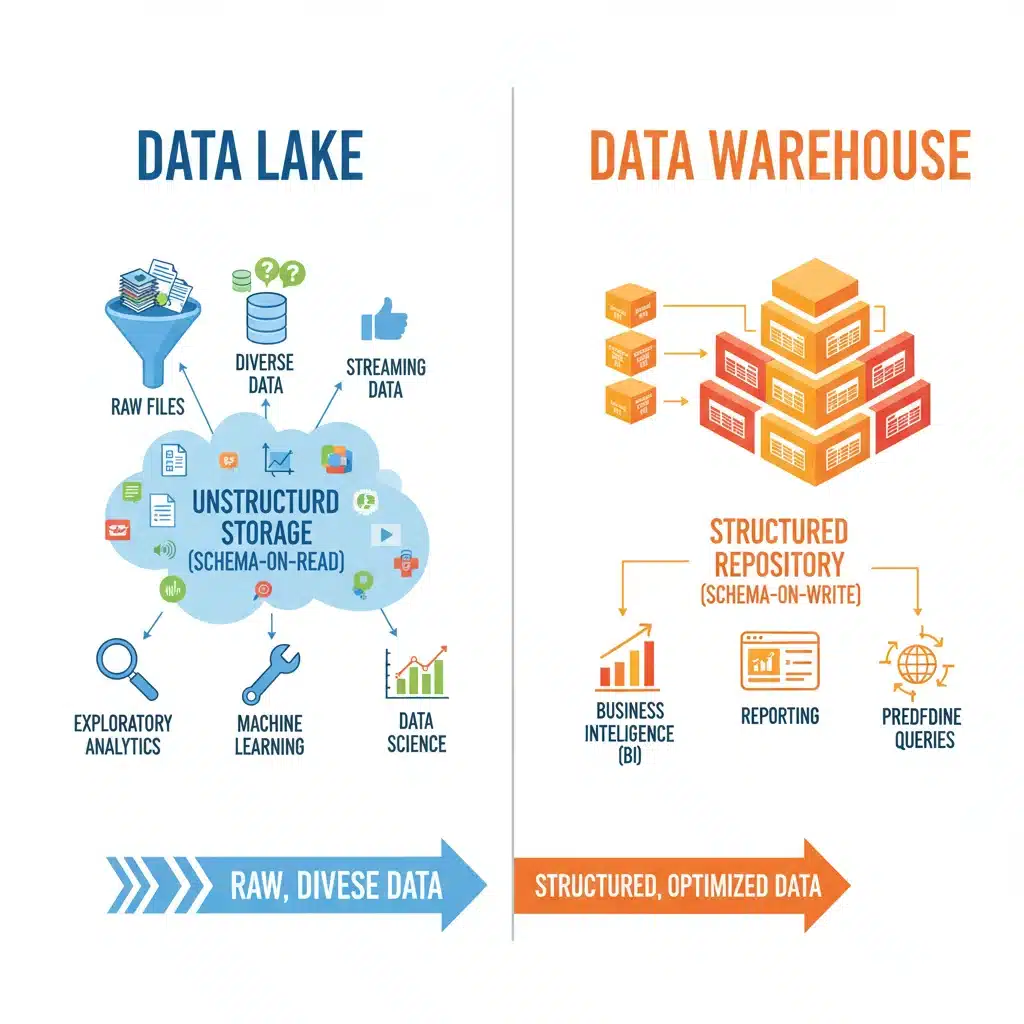
Data Lakes vs. Data Warehouses: A 2026 Comparative Analysis
To truly understand which solution fits your needs for 2026, let’s break down the comparison across several critical dimensions:
1. Data Type and Structure
- Data Warehouse: Primarily structured, relational data. Requires a predefined schema. Best for quantitative data where consistency is key.
- Data Lake: Handles all data types – structured, semi-structured, and unstructured. No predefined schema required (schema-on-read). Ideal for qualitative data, logs, media, and raw sensor data.
2. Data Ingestion and Processing
- Data Warehouse: ETL (Extract, Transform, Load) process. Data is transformed and cleaned before being loaded into the warehouse. This ensures high data quality but can be time-consuming and rigid.
- Data Lake: ELT (Extract, Load, Transform) process. Data is loaded into the lake in its raw form, and transformations occur as needed when data is queried or processed for specific analytical tasks. This offers greater agility.
3. User Base and Use Cases
- Data Warehouse: Business analysts, executives, and operational users who need consistent reports and dashboards for decision-making. Focus on traditional BI.
- Data Lake: Data scientists, machine learning engineers, and advanced analysts who require raw data for exploration, predictive modeling, and experimentation. Focus on advanced analytics and AI.
4. Performance and Querying
- Data Warehouse: Optimized for fast, complex queries on structured data, especially for aggregations and joins. Performance is predictable for known query patterns.
- Data Lake: Performance can vary widely depending on the query engine and data format. While modern engines (e.g., Spark, Presto, Impala) can be highly performant, querying raw, untransformed data can be slower without proper optimization and indexing.
5. Data Quality and Governance
- Data Warehouse: High data quality due to rigorous ETL processes and schema enforcement. Strong governance frameworks are typically in place.
- Data Lake: Data quality can be a significant challenge without robust data governance, metadata management, and data cataloging tools. The ‘garbage in, garbage out’ principle applies heavily here.
6. Cost Considerations
- Data Warehouse: Generally higher cost per terabyte for storage and computation, especially for proprietary cloud solutions, but offers optimized query performance and managed services. Cost scales with data volume and complexity of queries.
- Data Lake: Lower storage costs due to leveraging object storage. Processing costs are incurred when data is accessed and analyzed. Overall cost-effectiveness for storing massive volumes of raw data.
The Rise of the Data Lakehouse in 2026
As organizations strive for the best of both worlds, the concept of a ‘data lakehouse’ has emerged as a prominent cloud data strategy for 2026. A data lakehouse architecture attempts to combine the flexibility, scalability, and cost-effectiveness of a data lake with the data management features and performance capabilities of a data warehouse.
This is often achieved by building a structured layer on top of a data lake using open table formats like Delta Lake, Apache Iceberg, or Apache Hudi. These formats enable ACID transactions, schema enforcement, data versioning, and other data warehousing features directly on data stored in object storage. This allows data teams to perform both traditional BI and advanced analytics on the same data, eliminating data silos and reducing data movement.
Benefits of a Data Lakehouse:
- Unified Platform: Supports both BI and AI/ML workloads on a single data platform.
- Reduced Data Duplication: Eliminates the need to move data between a lake and a warehouse.
- Improved Data Freshness: Real-time data can be ingested and made available for both operational and analytical uses.
- Cost Efficiency: Leverages inexpensive cloud object storage while offering data warehouse performance.
- Simplified Architecture: Reduces the complexity of managing multiple, disparate data systems.
For many enterprises, the data lakehouse represents the future of their cloud data strategy, offering a flexible yet robust foundation for all data-driven initiatives.
Choosing the Right Cloud Data Strategy for Your Business
The decision between a data lake, a data warehouse, or a data lakehouse is not a one-size-fits-all answer. It depends heavily on your specific business needs, data characteristics, budget, and strategic goals for 2026 and beyond. Here’s a framework to guide your choice:
Consider a Cloud Data Warehouse if:
- Your primary need is traditional business intelligence, reporting, and dashboarding.
- You mainly deal with structured, relational data.
- Data quality, consistency, and compliance are paramount.
- Your users are primarily business analysts and executives who need curated, easy-to-understand data.
- You have well-defined data models and clear analytical questions.
Opt for a Cloud Data Lake if:
- You need to store vast amounts of raw, diverse, and unstructured data at low cost.
- Your organization is heavily invested in data science, machine learning, and advanced analytics.
- You require schema flexibility and the ability to process data ‘as is’.
- You need to perform exploratory analysis and uncover unknown patterns.
- You need to capture everything without prior transformation.
Embrace a Data Lakehouse if:
- You need to support both traditional BI and advanced analytics/AI workloads on the same data.
- You want to reduce data duplication and simplify your data architecture.
- You require ACID transactions and data quality features on top of your raw data.
- You are looking for a future-proof cloud data strategy that combines flexibility with performance.
- You aim to democratize data access for a wide range of users, from business analysts to data scientists.
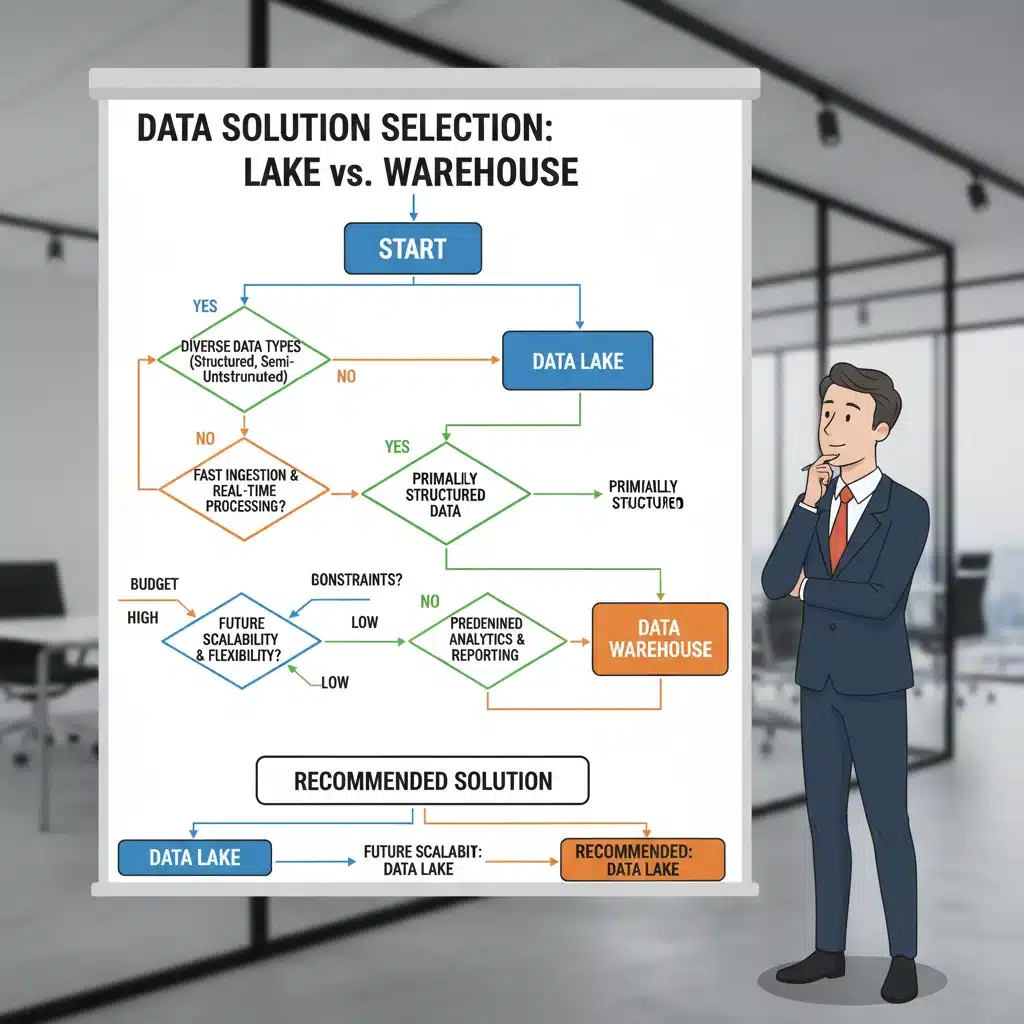
Key Considerations for Your 2026 Cloud Data Strategy
Regardless of your primary choice, several cross-cutting concerns will be vital for any robust cloud data strategy in 2026:
Data Governance and Security:
As data volumes grow, robust data governance frameworks become non-negotiable. This includes data lineage, metadata management, access controls, compliance (e.g., GDPR, CCPA), and data masking. Cloud providers offer a suite of security services, but implementing a comprehensive governance strategy across your data lake and/or warehouse is crucial to prevent data swamps and ensure data integrity.
Data Integration:
Seamless integration of data from various sources – on-premises, other cloud services, SaaS applications – is critical. Modern ETL/ELT tools, API integrations, and streaming technologies will play a key role in feeding your data architecture efficiently.
Cost Management:
While cloud services offer elasticity, managing costs effectively requires careful planning. This includes optimizing storage tiers, rightsizing compute resources, monitoring usage, and leveraging reserved instances or savings plans where appropriate. A clear understanding of your data access patterns and analytical workloads will help in cost optimization.
Talent and Skills:
The success of your data strategy hinges on the expertise of your team. Investing in skills development for data engineers, data scientists, and cloud architects is essential. The demand for professionals proficient in cloud data platforms, advanced analytics, and machine learning will only intensify by 2026.
Scalability and Performance:
Your chosen architecture must be able to scale both horizontally and vertically to accommodate future data growth and increasing analytical demands. Cloud-native solutions inherently offer this, but proper design and optimization are still necessary to maintain performance at scale.
Real-time Analytics:
The need for real-time insights is growing. Whether through streaming data directly into a data lake for immediate processing or leveraging real-time data warehousing capabilities, your strategy should account for low-latency analytics where business critical.
Conclusion: Crafting a Future-Proof Cloud Data Strategy
As we navigate towards 2026, the decision between a data lake and a data warehouse is no longer an either/or proposition for many organizations. Instead, it’s about understanding their complementary strengths and how they can be combined into a cohesive cloud data strategy that meets diverse analytical needs. The data lakehouse paradigm is rapidly emerging as a compelling solution, offering a unified platform for both traditional BI and cutting-edge AI/ML workloads.
Ultimately, the most effective cloud data strategy will be one that is agile, scalable, secure, and aligned with your organization’s overarching business objectives. By carefully evaluating your data types, analytical requirements, user personas, and future growth projections, you can build a data architecture in the cloud that empowers your business to thrive in the data-driven era of 2026 and beyond. The journey towards data maturity is continuous, and choosing the right foundational elements is the first critical step.
Embrace the flexibility of the cloud, leverage advanced analytics, and build a robust data foundation that propels your strategic decisions forward. The future of business intelligence and AI depends on it.