Data Sovereignty in Cloud: Navigating US Regulations 2026

In an increasingly interconnected digital world, the concept of data sovereignty has become a cornerstone of legal and operational strategy for businesses leveraging cloud computing. As we approach 2026, the United States continues to refine its regulatory landscape, presenting both opportunities and significant challenges for organizations operating within or serving the US market. Understanding and navigating US Data Sovereignty in the cloud is not merely a legal obligation; it’s a critical component of risk management, customer trust, and competitive advantage.
The digital transformation has propelled vast amounts of data into the cloud, offering unparalleled scalability, flexibility, and cost efficiency. However, this migration also introduces intricate questions about where data resides, who controls it, and which jurisdictional laws apply. For businesses, the stakes are incredibly high. Non-compliance can lead to hefty fines, reputational damage, and loss of consumer confidence. This comprehensive guide aims to dissect the current and projected state of US Data Sovereignty in the cloud, offering insights into the regulatory framework, compliance strategies, and future outlook for 2026 and beyond.
Defining US Data Sovereignty in the Cloud
At its core, data sovereignty refers to the idea that digital data is subject to the laws of the country in which it is collected, stored, or processed. In the context of cloud computing, this means that even if a company’s data is stored on a server physically located in another country, the laws of the data’s origin or the data subject’s location might still apply. This concept is particularly nuanced in the US, where a patchwork of federal and state laws governs various aspects of data. The challenge is compounded by the global nature of cloud services, where data can traverse multiple jurisdictions in seconds.
For US businesses and those interacting with US data, understanding US Data Sovereignty involves comprehending how different legal frameworks intersect with cloud infrastructure. Key aspects include:
- Data Location: The physical geographic location where data is stored. While cloud providers often offer regional data centers, data can still be moved, replicated, or accessed from various locations globally.
- Jurisdiction: Which country’s laws apply to the data. This is often determined by the data’s origin, the data subject’s residency, or the location of the processing entity.
- Legal Access: The ability of government agencies to access data stored within their jurisdiction, even if owned by foreign entities. Laws like the CLOUD Act in the US are prime examples of this.
- Data Residency: A specific requirement that data must be stored within a particular geographic boundary, often mandated by industry-specific regulations or national laws.
The dynamic nature of cloud environments means that data can be highly portable. While this offers immense operational benefits, it simultaneously creates a complex web of legal considerations for US Data Sovereignty. Companies must not only consider where their data is today but also where it might be tomorrow and under what legal authority it could be accessed or processed.
The Evolving US Regulatory Landscape for 2026
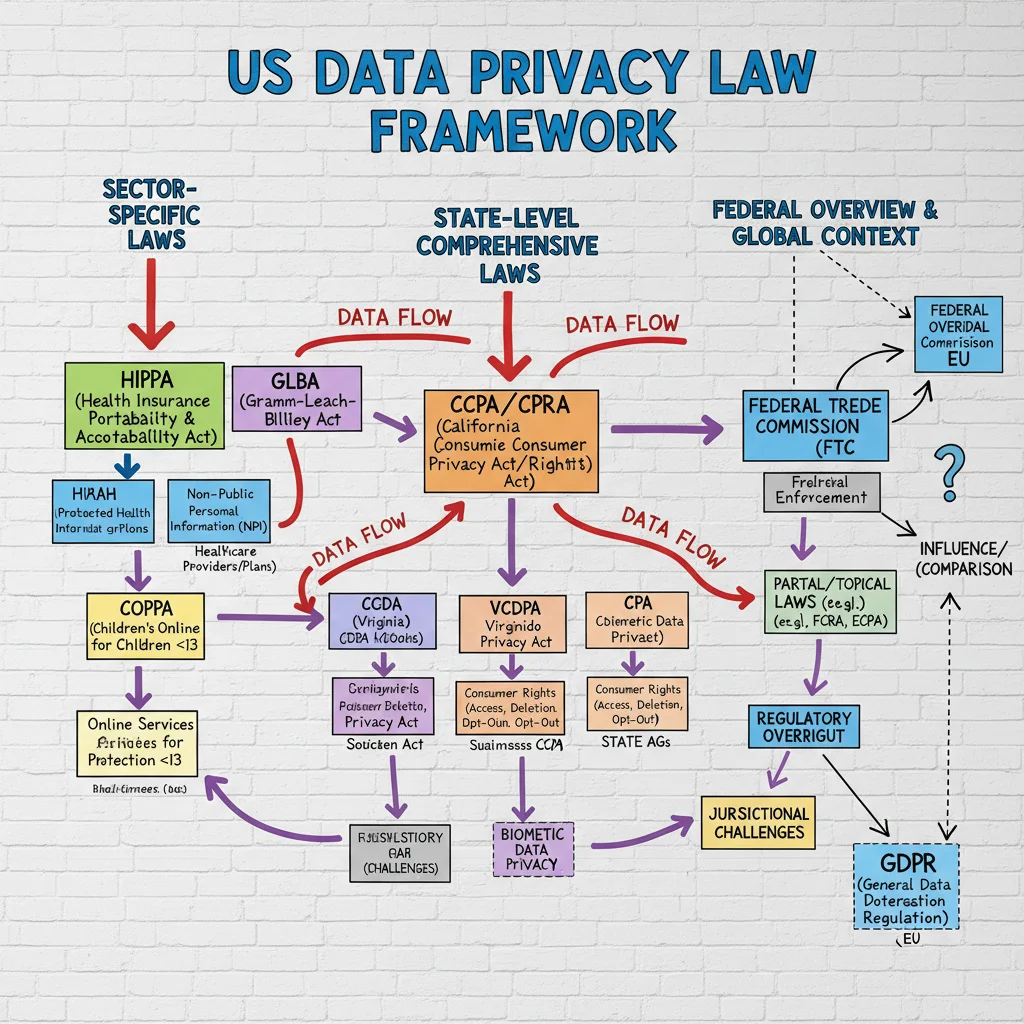
The United States does not have a single, overarching federal data protection law akin to Europe’s GDPR. Instead, it operates under a sector-specific and state-specific regulatory framework. This fragmented approach makes navigating US Data Sovereignty particularly intricate. As we look towards 2026, several key regulations and emerging trends will continue to shape this landscape:
Federal Regulations and Their Impact
- The CLOUD Act (Clarifying Lawful Overseas Use of Data Act): Enacted in 2018, this act allows US law enforcement to compel US-based technology companies to provide requested data stored on servers regardless of whether the data is stored in the U.S. or on foreign soil. This has significant implications for global cloud providers and their customers, as it asserts US jurisdiction over data held by US entities worldwide. The implications for US Data Sovereignty are profound, as it means data held by a US cloud provider, even if physically located in Germany, could still be subject to US legal demands.
- HIPAA (Health Insurance Portability and Accountability Act): This federal law protects sensitive patient health information. Entities handling Protected Health Information (PHI) in the cloud must ensure their cloud services comply with HIPAA’s security and privacy rules, including data residency requirements where applicable and robust access controls.
- FERPA (Family Educational Rights and Privacy Act): Protects the privacy of student education records. Educational institutions using cloud services must ensure vendors comply with FERPA’s provisions regarding access, storage, and sharing of student data.
- Gramm-Leach-Bliley Act (GLBA): Requires financial institutions to explain their information-sharing practices to their customers and to safeguard sensitive data. Cloud providers serving the financial sector must demonstrate compliance with GLBA’s security and privacy mandates.
- NIST Cybersecurity Framework: While not a regulation, the National Institute of Standards and Technology (NIST) provides widely adopted cybersecurity frameworks that many federal agencies and private sector organizations use to manage cybersecurity risks. Adhering to NIST guidelines often becomes a de facto requirement for demonstrating due diligence in data protection, directly impacting how organizations manage US Data Sovereignty in their cloud operations.
State-Level Data Privacy Laws
In the absence of a federal privacy law, several states have stepped up to enact their own comprehensive data privacy regulations, significantly influencing US Data Sovereignty considerations:
- CCPA/CPRA (California Consumer Privacy Act / California Privacy Rights Act): The CCPA, strengthened by the CPRA, grants California consumers significant rights over their personal information, including the right to know, delete, and opt-out of the sale or sharing of their data. For businesses operating nationwide, California’s laws often set a de facto standard due to the state’s large economy and population. Cloud providers and their clients must ensure their data processing activities align with these stringent requirements.
- Virginia CDPA (Consumer Data Protection Act): Similar to CCPA/CPRA but with its own unique provisions, the CDPA grants consumers rights regarding their personal data and imposes obligations on data controllers and processors.
- Colorado CPA (Colorado Privacy Act): Another comprehensive state privacy law effective in 2023, the CPA provides consumers with rights over their personal data and sets responsibilities for businesses handling that data.
- Utah UPPA (Utah Consumer Privacy Act) and Connecticut CTDPA (Connecticut Data Privacy Act): These laws further expand the patchwork of state-level privacy legislation, each with specific requirements for data processing, consumer rights, and security.
By 2026, it is highly probable that more states will have enacted similar legislation, creating an even more complex environment for US Data Sovereignty. Businesses must adopt flexible and scalable compliance frameworks that can adapt to this evolving legal landscape.
Challenges and Complexities of US Data Sovereignty in Cloud 2026
Navigating the intricacies of US Data Sovereignty in cloud environments by 2026 presents several significant challenges for organizations:
Jurisdictional Conflicts and Data Access Requests
The primary challenge stems from the inherent conflict between national laws and the borderless nature of cloud computing. The CLOUD Act, for instance, can put US-based cloud providers in a difficult position when faced with conflicting legal demands from US authorities and foreign governments where their data centers are located. This can lead to:
- Extraterritorial Reach: US laws asserting jurisdiction over data held abroad, potentially clashing with the sovereignty laws of other nations.
- Data Localization Requirements: Some countries mandate that certain types of data must be stored within their national borders. This directly impacts cloud strategies that rely on global distribution and redundancy.
- Government Access Requests: Businesses must be prepared to respond to legal demands for data from various jurisdictions, understanding their obligations and rights under each relevant law.
Vendor Management and Cloud Provider Selection
The choice of cloud service provider (CSP) is paramount for US Data Sovereignty compliance. Organizations must:
- Due Diligence: Thoroughly vet CSPs to understand their data handling practices, data center locations, security certifications, and their approach to legal access requests.
- Contractual Agreements: Ensure that service level agreements (SLAs) and contracts explicitly address data sovereignty, residency, privacy, and security obligations, including provisions for data access requests and breach notification.
- Shared Responsibility Model: Understand the shared responsibility model in cloud computing, where the CSP is responsible for the security of the cloud, and the customer is responsible for security in the cloud. This distinction is crucial for assigning accountability for data sovereignty.
Data Classification and Governance
Effective data governance is foundational to addressing US Data Sovereignty concerns. This involves:
- Data Inventory and Mapping: Knowing what data is stored, where it resides, who owns it, and what regulations apply to it.
- Data Classification: Categorizing data based on its sensitivity, regulatory requirements (e.g., PHI, PII), and business criticality. This dictates how data should be handled, stored, and protected.
- Policy Enforcement: Implementing clear policies and procedures for data handling, access, retention, and deletion that align with all relevant federal and state laws.
Cross-Border Data Transfers
When data moves between the US and other countries, additional layers of complexity arise. While the US currently lacks a comprehensive federal privacy law, it engages in various international data transfer mechanisms. Businesses must be aware of:
- Privacy Shield Framework (Legacy): Although the original EU-US Privacy Shield was invalidated, discussions are ongoing for new frameworks. Organizations must stay updated on any new transatlantic data transfer agreements that emerge.
- Standard Contractual Clauses (SCCs): Widely used for international data transfers, these provide contractual guarantees for data protection. However, their efficacy often depends on supplementary measures and local legal assessments.
- Binding Corporate Rules (BCRs): Internal codes of conduct for multinational corporations to transfer personal data within their group internationally.
The interplay of these mechanisms with US Data Sovereignty principles makes cross-border data management a critical area of focus for 2026.
Strategic Solutions for Compliance by 2026
To effectively navigate the complexities of US Data Sovereignty in the cloud by 2026, organizations must adopt a proactive and multi-faceted strategic approach:
1. Implement Robust Data Governance Frameworks
A strong data governance framework is the bedrock of compliance. This includes:
- Data Mapping and Discovery: Continuously identify, classify, and map all data assets across your cloud environments. Understand data flows and where sensitive information resides.
- Policy Development: Establish clear, enforceable policies for data collection, storage, processing, access, retention, and deletion that align with all applicable US federal and state laws.
- Role-Based Access Control (RBAC): Implement strict RBAC to ensure that only authorized personnel have access to sensitive data, minimizing the risk of unauthorized access or breaches.
- Regular Audits and Assessments: Conduct periodic audits of your data handling practices and cloud configurations to ensure ongoing compliance and identify potential vulnerabilities.
2. Strategic Cloud Provider Selection and Management
Choosing the right cloud partner is crucial. Organizations should:
- Evaluate Cloud Provider Capabilities: Assess CSPs based on their commitment to compliance, security certifications (e.g., FedRAMP, ISO 27001), data residency options, and their ability to support your specific regulatory requirements.
- Negotiate Strong Contracts: Ensure contracts explicitly define data ownership, data location, data processing rights, incident response protocols, and liability in case of non-compliance or breaches related to US Data Sovereignty.
- Leverage Cloud-Native Compliance Tools: Utilize features offered by CSPs for data encryption, key management, identity and access management (IAM), and logging to enhance data protection and demonstrate compliance.
3. Data Localization and Encryption Strategies
To address data residency and sovereignty concerns, consider:
- Geographic Data Placement: Where possible, store data in cloud regions that align with the jurisdictional requirements of the data subjects or applicable laws. This might involve using multiple cloud providers or hybrid cloud architectures.
- Strong Encryption: Implement robust encryption for data at rest and in transit. Use customer-managed encryption keys (CMEK) to maintain greater control over your data, even if it resides on a third-party cloud.
- Tokenization and Data Masking: For highly sensitive data, consider techniques like tokenization or data masking to reduce the risk associated with its exposure, making it less valuable even if accessed without authorization.
4. Legal Counsel and Compliance Expertise
Given the dynamic nature of the regulatory landscape, engaging legal and compliance experts is essential:
- Stay Updated: Continuously monitor changes in federal and state data privacy laws, as well as international agreements that impact US Data Sovereignty.
- Legal Review: Regularly review your cloud contracts, data processing agreements, and internal policies with legal counsel to ensure they remain compliant.
- Training and Awareness: Educate employees on data privacy best practices, company policies, and the implications of data sovereignty to foster a culture of compliance.

The Future Outlook: US Data Sovereignty Beyond 2026
The trajectory of US Data Sovereignty is likely to be characterized by continued evolution. While a federal privacy law remains elusive, the increasing number of state-level regulations might eventually pressure Congress to enact a comprehensive national standard. Such a law could streamline compliance for businesses but would also introduce new mandates and challenges.
Key trends to watch for beyond 2026 include:
- Increased Harmonization (or Fragmentation): There’s a constant tension between the desire for a unified federal approach and the reality of diverse state-level initiatives. The outcome will significantly impact the complexity of US Data Sovereignty.
- Focus on AI and Data Ethics: As Artificial Intelligence becomes more prevalent, regulations around data used for AI training, algorithmic bias, and ethical data use will likely emerge, adding new dimensions to data sovereignty.
- Supply Chain Security: The focus on supply chain security will extend to data processing, requiring organizations to have greater visibility and control over how their data is handled by all third-party vendors, including cloud providers.
- Quantum Computing and Cryptography: Advances in quantum computing could render current encryption methods vulnerable. This will necessitate a shift towards quantum-resistant cryptography, impacting how data is secured and, by extension, its sovereignty.
- International Data Transfer Mechanisms: Continued efforts to establish stable and legally robust frameworks for transatlantic and broader international data transfers will be crucial for global businesses.
Businesses that proactively adapt to these evolving trends and build resilient data governance strategies will be best positioned to thrive in the complex environment of US Data Sovereignty.
Conclusion: Mastering US Data Sovereignty for Cloud Success
The journey to mastering US Data Sovereignty in the cloud by 2026 is an ongoing process that demands vigilance, strategic planning, and continuous adaptation. The fragmented yet potent US regulatory landscape, coupled with the global nature of cloud computing, presents a unique set of challenges that cannot be overlooked. From understanding the far-reaching implications of the CLOUD Act to navigating the nuances of state-specific privacy laws like CCPA/CPRA, organizations must adopt a holistic approach to data governance and compliance.
By implementing robust data mapping, classifying sensitive information, selecting cloud providers with due diligence, and leveraging advanced security measures like encryption and access controls, businesses can build a resilient framework. Proactive engagement with legal counsel and staying abreast of legislative changes are not just best practices but necessities. The future of cloud computing success in the US market hinges on an organization’s ability to confidently assert and protect its data’s sovereignty, ensuring compliance, safeguarding customer trust, and mitigating legal and financial risks. As 2026 approaches, the time to solidify your US Data Sovereignty strategy is now, transforming potential hurdles into pathways for secure and compliant innovation.