Zero Trust Cloud Security: US Enterprise Mandate 2026

Implementing Zero Trust in Cloud Environments: A 2026 Security Mandate for US Enterprises
The cybersecurity landscape is in a constant state of evolution, with threats growing in sophistication and volume. For US enterprises, the year 2026 marks a pivotal moment: the widespread adoption and mandated implementation of Zero Trust Cloud security models. This isn’t just another IT initiative; it’s a fundamental shift in how organizations approach security, moving away from perimeter-based defenses to a ‘never trust, always verify’ paradigm. As businesses increasingly migrate critical operations and data to the cloud, understanding and effectively implementing Zero Trust principles becomes not merely an advantage, but a necessity for survival and compliance.
The traditional network security model, often referred to as ‘castle-and-moat,’ assumes that everything inside the corporate network is trustworthy, while everything outside is hostile. This approach has proven increasingly inadequate in an era defined by remote work, hybrid cloud architectures, and sophisticated insider threats. Once an attacker breaches the perimeter, they often have free rein within the network. Zero Trust Cloud security dismantles this assumption, asserting that no user, device, application, or network segment should be inherently trusted, regardless of its location relative to the corporate firewall.
This comprehensive guide will delve into the intricacies of implementing Zero Trust Cloud in US enterprises, addressing the upcoming 2026 mandate, exploring the core tenets of Zero Trust, outlining strategic implementation steps, discussing common challenges and how to overcome them, and highlighting the profound benefits this model offers. Our aim is to provide a roadmap for organizations looking to not only comply with future regulations but to establish a robust, resilient, and adaptive security posture in their cloud environments.
The 2026 Mandate: Why Zero Trust Cloud is Non-Negotiable
The push for Zero Trust Cloud adoption is gaining significant momentum, driven by a combination of escalating cyber threats, high-profile data breaches, and government directives. In the US, various federal agencies and cybersecurity frameworks, such as those from NIST (National Institute of Standards and Technology), have been advocating for Zero Trust for several years. The Biden Administration’s Executive Order 14028, ‘Improving the Nation’s Cybersecurity,’ issued in May 2021, explicitly mandated federal agencies to accelerate their transition to Zero Trust architectures. While this order directly impacts federal entities, it sets a clear precedent and expectation for the private sector, particularly critical infrastructure and organizations handling sensitive data.
By 2026, it is widely anticipated that adherence to Zero Trust Cloud principles will become a de facto, if not explicit, requirement for many US enterprises, especially those operating in regulated industries like finance, healthcare, and defense. This mandate isn’t just about avoiding penalties; it’s about safeguarding national security, economic stability, and public trust. Organizations that fail to adapt will face not only regulatory non-compliance but also increased vulnerability to cyberattacks, reputational damage, and significant financial losses.
The evolving threat landscape necessitates this shift. Cloud environments, while offering immense flexibility and scalability, also introduce new attack surfaces and complexities. Traditional security tools designed for on-premise infrastructure often struggle to provide adequate protection in dynamic, distributed cloud settings. Zero Trust Cloud provides a framework specifically designed to address these challenges, ensuring that every access request, whether from inside or outside the network, is authenticated, authorized, and continuously validated.
Understanding the Core Tenets of Zero Trust Cloud
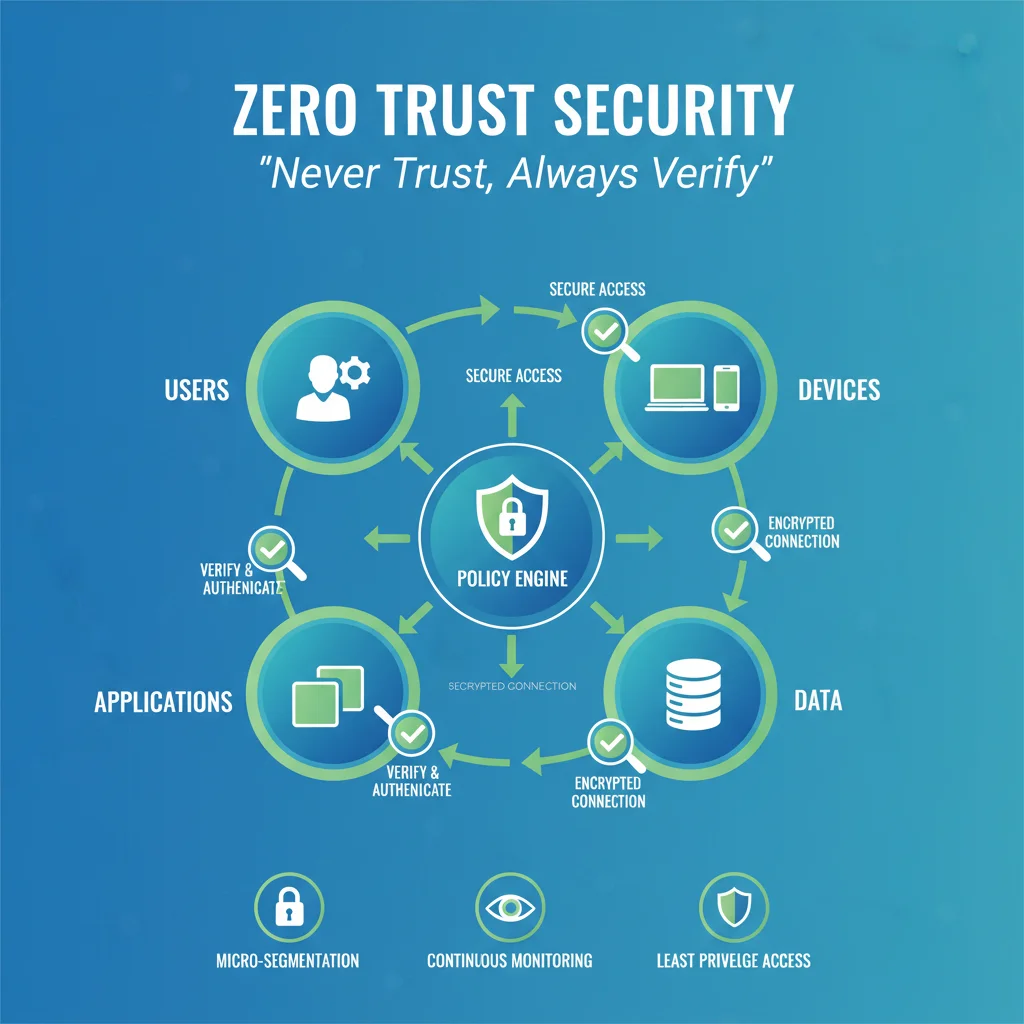
At its heart, Zero Trust Cloud is built upon several fundamental principles that guide its implementation and operation:
1. Never Trust, Always Verify
This is the foundational mantra of Zero Trust. It dictates that no user, device, application, or network segment is inherently trustworthy. Every access attempt must be explicitly verified before access is granted. This applies even to entities already within the supposed ‘perimeter’ of the cloud environment.
2. Assume Breach
A Zero Trust Cloud architecture operates under the assumption that a breach is inevitable or has already occurred. This mindset shifts the focus from preventing all breaches (an impossible task) to minimizing the blast radius of any successful attack. By segmenting networks and enforcing granular access controls, a compromise in one area does not automatically lead to widespread system access.
3. Verify Explicitly
All resource access requests must be authenticated and authorized based on all available data points, including user identity, device posture, location, service being accessed, and current threat intelligence. This explicit verification process is continuous, not a one-time event.
4. Least Privilege Access
Users and devices should only be granted the minimum level of access required to perform their specific tasks, and only for the necessary duration. This minimizes the potential damage if an account or device is compromised. In a Zero Trust Cloud model, this means applying very fine-grained permissions to cloud resources.
5. Micro-segmentation
Breaking down network perimeters into small, isolated segments is crucial. This limits lateral movement for attackers. If one segment is compromised, the attacker cannot easily move to other critical systems or data. Cloud-native tools and software-defined networking (SDN) make micro-segmentation more feasible in cloud environments.
6. Multi-Factor Authentication (MFA) Everywhere
MFA is a non-negotiable component of Zero Trust Cloud. Requiring multiple forms of verification significantly reduces the risk of unauthorized access due to compromised passwords.
7. Continuous Monitoring and Validation
Security posture is not static. All interactions, user behavior, and device health must be continuously monitored and re-evaluated against security policies. Any deviation triggers re-authentication or denial of access. This proactive approach ensures that trust is never assumed but continuously earned.
Strategic Implementation of Zero Trust Cloud for US Enterprises
Transitioning to a full Zero Trust Cloud architecture is a journey, not a single project. It requires a strategic, phased approach. Here are key steps for US enterprises:
Phase 1: Assessment and Planning
- Define the Scope: Identify critical assets (data, applications, infrastructure) residing in the cloud that need the highest level of protection.
- Current State Analysis: Evaluate existing security posture, network architecture, identity management systems, and cloud configurations. Pinpoint gaps in current trust models.
- Stakeholder Buy-in: Secure commitment from leadership, IT, security, and relevant business units. Zero Trust is an organizational shift, not just a technical one.
- Develop a Roadmap: Create a phased implementation plan with clear objectives, timelines, and measurable success metrics. Prioritize quick wins to demonstrate value.
- Policy Definition: Establish clear, granular security policies based on the principle of least privilege. What resources can access what, under what conditions?
Phase 2: Identity and Access Management (IAM) Modernization
IAM is the cornerstone of Zero Trust Cloud. Without robust identity controls, the ‘verify explicitly’ principle cannot be enforced.
- Centralized Identity Provider: Implement a strong, centralized identity provider (IdP) that can manage identities across hybrid and multi-cloud environments.
- Multi-Factor Authentication (MFA): Mandate MFA for all users, especially those with privileged access. Explore adaptive MFA based on context.
- Single Sign-On (SSO): Implement SSO to streamline user experience while maintaining strong authentication.
- Privileged Access Management (PAM): Implement PAM solutions to secure, manage, and monitor privileged accounts and access to critical cloud resources.
- Attribute-Based Access Control (ABAC): Move beyond role-based access control (RBAC) to ABAC, which grants access based on a combination of user, device, resource, and environmental attributes.
Phase 3: Network and Workload Segmentation
Micro-segmentation is vital for limiting lateral movement within cloud environments.
- Cloud-Native Segmentation: Utilize cloud provider services (e.g., AWS Security Groups, Azure Network Security Groups, GCP Firewall Rules) to create fine-grained network segments.
- Software-Defined Micro-segmentation: Implement third-party micro-segmentation solutions that provide consistent policy enforcement across heterogeneous cloud and on-premise environments.
- API Security: Secure all APIs, which are critical communication points in cloud-native applications. Implement API gateways, authentication, and authorization.
- Container and Serverless Security: Apply Zero Trust principles to ephemeral workloads like containers and serverless functions, ensuring each component is isolated and verified.
Phase 4: Device and Endpoint Security
Devices, whether corporate or personal, are potential entry points for attackers.
- Endpoint Detection and Response (EDR): Deploy EDR solutions to continuously monitor endpoint activity, detect threats, and enforce security policies.
- Device Posture Checks: Implement mechanisms to verify the security posture of devices (e.g., patch level, anti-malware status, configuration compliance) before granting access to cloud resources.
- Mobile Device Management (MDM) / Unified Endpoint Management (UEM): Manage and secure mobile devices accessing cloud applications.
Phase 5: Data Security and Application Security
Protecting data and applications is the ultimate goal of Zero Trust Cloud.
- Data Classification: Classify data based on sensitivity and criticality to apply appropriate protection mechanisms.
- Data Loss Prevention (DLP): Implement DLP solutions to prevent sensitive data from leaving controlled cloud environments.
- Encryption Everywhere: Encrypt data at rest and in transit across all cloud services.
- Cloud Access Security Brokers (CASB): Utilize CASBs to extend security policies to SaaS applications, monitor cloud activity, and enforce data governance.
- Secure Software Development Lifecycle (SSDLC): Integrate security into every stage of application development, from design to deployment, especially for cloud-native applications.
Phase 6: Visibility, Analytics, and Automation
Continuous monitoring and rapid response are critical for maintaining a Zero Trust Cloud posture.
- Security Information and Event Management (SIEM): Centralize security logs and events from all cloud and on-premise sources for correlation and analysis.
- Security Orchestration, Automation, and Response (SOAR): Automate security workflows and incident response processes to react quickly to threats.
- User and Entity Behavior Analytics (UEBA): Use AI and machine learning to detect anomalous user and entity behavior that might indicate a compromise.
- Continuous Compliance: Automate compliance checks against internal policies and regulatory requirements.
Challenges and How to Overcome Them in Zero Trust Cloud Implementation
Implementing Zero Trust Cloud is not without its hurdles. US enterprises will likely encounter several common challenges:
1. Complexity of Existing Environments
Many enterprises have sprawling, legacy IT infrastructures alongside new cloud deployments. Integrating Zero Trust across such a heterogeneous environment can be complex. Solution: Adopt a phased approach, starting with critical cloud assets and gradually extending to other areas. Leverage cloud-native security tools and APIs for integration where possible.
2. Organizational Resistance and Culture Change
Shifting from a ‘trust by default’ mindset to ‘never trust’ requires a significant cultural change. Users might perceive new security measures as inconvenient. Solution: Foster strong executive sponsorship and communicate the ‘why’ behind Zero Trust. Provide comprehensive training and involve users in the process where appropriate. Emphasize that enhanced security ultimately benefits everyone.
3. Skill Gaps
Implementing and managing advanced Zero Trust Cloud architectures requires specialized skills in cloud security, identity management, network segmentation, and automation. Solution: Invest in training existing staff, recruit cybersecurity professionals with cloud expertise, or partner with managed security service providers (MSSPs) that specialize in Zero Trust.
4. Vendor Sprawl and Integration Issues
Enterprises often use numerous security vendors, leading to integration challenges and operational overhead. Solution: Prioritize platforms that offer broad integration capabilities and a unified security posture. Consolidate vendors where possible, choosing solutions that natively support Zero Trust principles across different cloud providers.
5. Performance Overhead
Continuous authentication and authorization checks can potentially introduce latency or impact application performance if not implemented efficiently. Solution: Design Zero Trust policies with performance in mind. Utilize intelligent policy engines, caching mechanisms, and edge computing where appropriate to minimize impact. Cloud providers often offer optimized security services.

Benefits of Adopting Zero Trust Cloud for US Enterprises
Despite the challenges, the benefits of implementing Zero Trust Cloud are substantial and far-reaching:
1. Enhanced Security Posture
By eliminating implicit trust, Zero Trust significantly reduces the attack surface and limits the impact of breaches. It provides granular control over access to cloud resources, making it harder for attackers to move laterally once inside.
2. Improved Compliance and Risk Management
Zero Trust Cloud aligns with and often exceeds the requirements of various regulatory frameworks (e.g., HIPAA, PCI DSS, GDPR, CMMC). It provides better visibility and audit trails, simplifying compliance efforts and reducing overall risk exposure.
3. Better Protection for Remote and Hybrid Workforces
With employees accessing cloud resources from anywhere, Zero Trust ensures consistent security policies are applied regardless of location or device. This is crucial for securing distributed workforces.
4. Reduced Costs from Data Breaches
While initial implementation may require investment, the long-term cost savings from preventing or minimizing the impact of data breaches can be enormous. These savings come from reduced downtime, fewer regulatory fines, and preserved customer trust.
5. Agility and Innovation
By providing a secure foundation, Zero Trust Cloud enables enterprises to adopt new cloud technologies and innovate faster without compromising security. It facilitates secure adoption of SaaS, PaaS, and IaaS, and supports rapid deployment of microservices and containerized applications.
6. Streamlined Operations
Automation inherent in Zero Trust architectures, combined with centralized policy management, can lead to more efficient security operations and reduced manual effort over time.
The Future of Enterprise Security: Beyond 2026
The 2026 mandate for Zero Trust Cloud adoption is not an endpoint but a significant milestone in the ongoing evolution of cybersecurity. As threats continue to advance, so too will the Zero Trust model. Future developments will likely include:
- AI and Machine Learning Integration: Deeper integration of AI/ML for predictive threat intelligence, adaptive policy enforcement, and hyper-personalized access decisions based on real-time risk scores.
- Homomorphic Encryption and Confidential Computing: Technologies that allow computation on encrypted data, further enhancing data privacy and security in the cloud.
- Decentralized Identity: Leveraging blockchain and distributed ledger technologies for more secure, user-centric identity management.
- Quantum-Resistant Cryptography: Preparing for the advent of quantum computing by implementing cryptographic algorithms that can withstand future attacks.
US enterprises must view Zero Trust Cloud as a living architecture that requires continuous adaptation, refinement, and investment. It’s an ongoing commitment to resilience and security in an increasingly interconnected and threat-laden digital world.
Conclusion: Embracing the Zero Trust Cloud Imperative
The 2026 mandate for Zero Trust Cloud security is a clear signal: the era of implicit trust is over, especially within dynamic cloud environments. For US enterprises, this transition is not merely about compliance; it’s about building a robust, future-proof security posture capable of defending against sophisticated and persistent cyber threats. While the journey to full Zero Trust implementation presents challenges, the strategic advantages in terms of enhanced security, improved compliance, and operational resilience are undeniable.
By understanding the core tenets, adopting a phased implementation strategy, and proactively addressing potential hurdles, organizations can successfully navigate this transformation. The time to act is now. Investing in Zero Trust Cloud isn’t just an IT decision; it’s a critical business imperative that will define the security and success of US enterprises for years to come.
Embrace the ‘never trust, always verify’ philosophy, empower your security teams, and embark on the journey to a more secure and resilient cloud future. The 2026 mandate is not a burden, but an opportunity to fundamentally strengthen your organization’s cybersecurity defenses.