Cloud Data Warehousing: Scalable Solutions for Big Data Analytics in 2026

Cloud Data Warehousing: Building Scalable Solutions for Big Data Analytics in 2026
In the rapidly evolving digital landscape, the volume, velocity, and variety of data continue to explode. Businesses across every sector are grappling with unprecedented amounts of information, making the ability to store, process, and analyze this data a critical differentiator. By 2026, the imperative for robust and scalable data solutions will be more pronounced than ever, with Cloud Data Warehousing emerging as the cornerstone for effective big data analytics. This article delves into the future of cloud data warehousing, exploring the technologies, strategies, and considerations for building scalable solutions that empower insightful decision-making.
The Evolution of Cloud Data Warehousing
Traditional on-premise data warehouses, while foundational for decades, often struggle to keep pace with the demands of modern big data. Their inherent limitations in scalability, flexibility, and cost-efficiency have paved the way for cloud-based alternatives. Cloud Data Warehousing offers a paradigm shift, providing elastic scalability, pay-as-you-go pricing models, and managed services that significantly reduce operational overhead. As we look towards 2026, cloud data warehousing is not just an option but a strategic necessity for organizations aiming to harness the full potential of their data.
The journey from on-premise to cloud has been marked by several key innovations. Early cloud data warehouses primarily replicated the architecture of their on-premise counterparts, simply moving the infrastructure to the cloud. However, the true power of cloud data warehousing lies in its native cloud design, leveraging distributed computing, object storage, and serverless architectures. This evolution has led to a new generation of data warehouses that are not only scalable but also highly performant, cost-effective, and deeply integrated with a broader ecosystem of cloud services for advanced analytics, machine learning, and AI.
By 2026, we anticipate further advancements, including more sophisticated automation, enhanced data governance features, and seamless integration with real-time data streams. The focus will shift even further towards data democratization, enabling more business users to access and analyze data without requiring deep technical expertise. This will be facilitated by intuitive interfaces, natural language processing (NLP) for querying, and AI-driven insights generation, all built upon a robust cloud data warehousing foundation.
Key Pillars of Scalable Cloud Data Warehousing in 2026
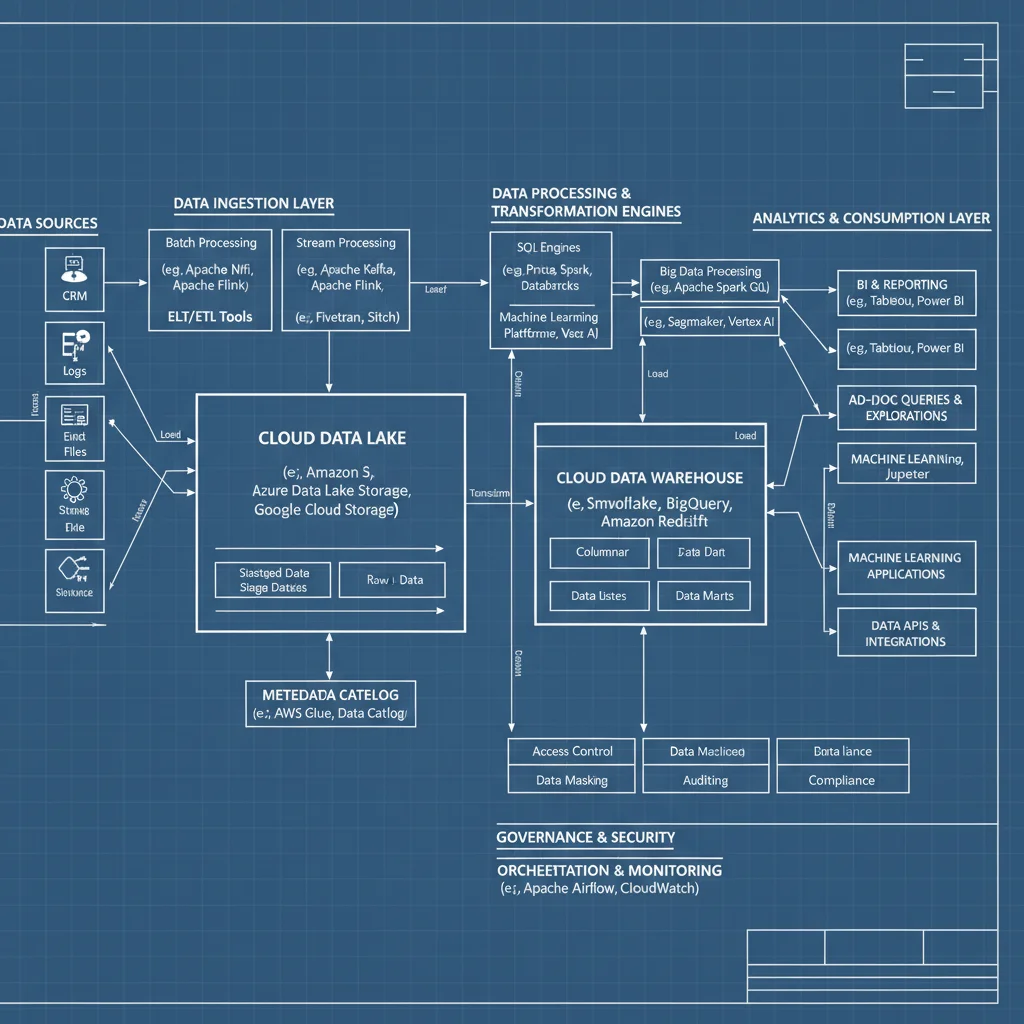
Building a truly scalable cloud data warehousing solution for big data analytics requires a deep understanding of its foundational components. These pillars ensure that the system can handle ever-increasing data volumes and complexity while maintaining performance and cost-efficiency.
1. Elastic and Distributed Storage
The ability to store vast amounts of data cost-effectively and accessibly is paramount. Cloud data warehousing solutions leverage object storage services (e.g., Amazon S3, Google Cloud Storage, Azure Blob Storage) which offer virtually limitless scalability, high durability, and competitive pricing. These services are often decoupled from compute resources, allowing independent scaling of storage and processing. This architectural choice is crucial for managing fluctuating data loads and optimizing costs.
2. Decoupled Compute and Storage Architecture
One of the most significant innovations in modern Cloud Data Warehousing is the separation of compute and storage. This design allows organizations to scale their computational power up or down independently of their storage needs. For instance, during peak analytical periods, more compute resources can be provisioned and then scaled back when demand subsides, leading to significant cost savings. This flexibility is a game-changer for big data analytics, where processing requirements can vary dramatically.
3. Advanced Query Processing Engines
The performance of a cloud data warehouse heavily relies on its query processing engine. By 2026, these engines will be even more optimized for parallel processing, columnar storage, and in-memory computing to deliver sub-second query responses on petabytes of data. Technologies like Massive Parallel Processing (MPP) architectures, combined with sophisticated query optimizers and caching mechanisms, will be standard. Furthermore, the integration of specialized accelerators for AI and machine learning workloads will become more common, enabling complex analytical models to run directly on the data warehouse.
4. Data Ingestion and Integration Capabilities
A scalable cloud data warehouse must be able to ingest data from diverse sources – relational databases, NoSQL stores, streaming data, APIs, and third-party applications – seamlessly and efficiently. This requires robust ETL (Extract, Transform, Load) or ELT (Extract, Load, Transform) pipelines, often leveraging cloud-native services for data integration (e.g., AWS Glue, Azure Data Factory, Google Cloud Dataflow). Real-time data ingestion through streaming platforms like Kafka or Kinesis will be increasingly vital for immediate insights and operational analytics.
5. Robust Security and Governance
As data volumes grow and regulations become stricter, security and governance are non-negotiable. Cloud data warehousing platforms offer advanced features like encryption at rest and in transit, fine-grained access control, data masking, and compliance certifications (e.g., GDPR, HIPAA, ISO 27001). By 2026, automated data governance tools, powered by AI, will play a larger role in ensuring data quality, lineage, and compliance across the entire data estate.
Benefits of Cloud Data Warehousing for Big Data Analytics
The adoption of Cloud Data Warehousing brings a multitude of benefits that directly impact an organization’s ability to perform advanced big data analytics and derive actionable insights.
Unmatched Scalability and Flexibility
One of the most compelling advantages is the ability to scale resources up or down on demand. This elasticity means organizations can handle sudden spikes in data volume or analytical queries without provisioning new hardware or incurring significant upfront costs. This flexibility is crucial for dynamic business environments and allows for agile experimentation with new data initiatives.
Cost Efficiency and Optimized TCO
Cloud data warehousing operates on a pay-as-you-go model, eliminating the need for large capital expenditures on hardware, software licenses, and infrastructure maintenance. Organizations only pay for the compute and storage resources they consume, leading to a significantly lower Total Cost of Ownership (TCO) compared to traditional on-premise solutions. Furthermore, managed services reduce the burden on IT staff, allowing them to focus on higher-value activities.
Enhanced Performance and Speed to Insight
Modern cloud data warehouses are engineered for performance, leveraging distributed architectures and optimized query engines to process massive datasets rapidly. This speed enables faster query execution, quicker report generation, and near real-time analytics, allowing businesses to react swiftly to market changes and customer behavior. The ability to gain insights faster translates directly into a competitive advantage.
Simplified Management and Maintenance
With cloud providers managing the underlying infrastructure, including hardware provisioning, software updates, and security patches, organizations can significantly reduce their operational burden. This simplification allows data teams to concentrate on data modeling, analysis, and developing innovative solutions rather than spending time on infrastructure management. This focus on value-added activities is a key benefit of cloud data warehousing.
Robust Security and Compliance
Leading cloud providers invest heavily in security, offering enterprise-grade features and certifications that often surpass what individual organizations can achieve on-premise. This includes physical security, network security, data encryption, and identity and access management. For big data analytics, maintaining data integrity and compliance with regulations like GDPR and CCPA is paramount, and cloud platforms provide the tools and frameworks to achieve this.
Seamless Integration with the Cloud Ecosystem
Cloud data warehouses are part of a broader cloud ecosystem, offering seamless integration with a wide array of services for data ingestion, machine learning, artificial intelligence, business intelligence, and application development. This integration capability allows organizations to build end-to-end data pipelines and advanced analytical workflows with ease, accelerating innovation and deployment of data-driven applications.
Challenges and Considerations for 2026
While the benefits are clear, organizations adopting Cloud Data Warehousing must also be aware of potential challenges and make informed decisions to ensure success by 2026.
Data Governance and Quality
As data volumes grow, maintaining data quality, lineage, and adhering to governance policies becomes more complex. Organizations need robust data governance frameworks, automated tools, and clear policies to ensure data accuracy, consistency, and compliance across their cloud data warehouse. Poor data quality can lead to flawed insights and misguided business decisions.
Cost Management and Optimization
While cloud data warehousing offers cost efficiency, improper management can lead to spiraling costs. Organizations must implement robust cost monitoring, optimization strategies, and resource management practices to avoid unexpected expenses. This includes right-sizing compute resources, optimizing storage tiers, and managing query efficiency.
Vendor Lock-in Concerns
Reliance on a single cloud provider for data warehousing can lead to vendor lock-in, making it challenging and costly to migrate to another platform later. While the benefits of cloud-native services are substantial, organizations should consider multi-cloud strategies or hybrid approaches where appropriate, especially for critical data assets.
Data Security and Privacy
Despite the strong security offered by cloud providers, organizations remain responsible for securing their data in the cloud. This includes proper configuration of access controls, encryption keys, and adherence to data privacy regulations. A shared responsibility model means that while the cloud provider secures the cloud, the customer is responsible for security in the cloud.
Skill Gap and Talent Acquisition
The rapid evolution of cloud technologies necessitates a skilled workforce capable of designing, implementing, and managing cloud data warehouses. Organizations may face challenges in finding and retaining talent with expertise in cloud architecture, data engineering, and advanced analytics. Investing in training and upskilling existing teams is crucial.
Building Your Cloud Data Warehousing Strategy for 2026
To successfully leverage Cloud Data Warehousing for big data analytics by 2026, a well-defined strategy is essential. This involves several key steps:
1. Assess Your Current Data Landscape
Begin by understanding your existing data sources, data volumes, current analytical needs, and pain points with your current data infrastructure. Identify key stakeholders and their requirements to ensure the new solution addresses real business needs.
2. Define Your Data Strategy and Goals
Clearly articulate what you aim to achieve with cloud data warehousing. Are you looking for real-time analytics, predictive modeling, improved reporting, or a combination? Define key performance indicators (KPIs) to measure success.
3. Choose the Right Cloud Provider and Platform
Evaluate leading cloud providers (AWS, Azure, Google Cloud) and their respective data warehousing offerings (e.g., Amazon Redshift, Azure Synapse Analytics, Google BigQuery). Consider factors such as scalability, performance, cost, ecosystem integration, security features, and specific industry compliance requirements.
4. Design a Robust Architecture
Develop a clear architectural blueprint that outlines data ingestion pipelines, storage layers, processing engines, data models, and integration points with other analytical tools. Focus on a decoupled architecture for flexibility and scalability. Consider data lake integration for raw, unstructured data.
5. Implement Data Governance and Security Frameworks
Establish comprehensive data governance policies from the outset, covering data quality, data lineage, access control, and compliance. Implement robust security measures, including encryption, identity management, and regular security audits.
6. Plan for Data Migration and Integration
Develop a detailed plan for migrating existing data to the cloud data warehouse. This may involve lifting and shifting, or more complex ETL/ELT processes. Ensure seamless integration with existing business applications and reporting tools.
7. Foster a Data-Driven Culture and Upskill Your Team
Technology alone is not enough. Encourage a data-driven culture within your organization. Invest in training your data engineers, analysts, and business users on the new cloud data warehousing platform and related analytical tools. This ensures maximum adoption and value realization.

The Future Landscape of Cloud Data Warehousing
Looking ahead to 2026 and beyond, the landscape of Cloud Data Warehousing will continue to evolve at a rapid pace. Several trends are expected to shape its future:
Hyper-Converged Data Platforms
The lines between data warehouses, data lakes, and data lakehouses will continue to blur, leading to more unified, hyper-converged data platforms. These platforms will offer the best of both worlds: the structured performance of data warehouses and the flexibility of data lakes, enabling diverse analytical workloads on a single, integrated platform.
AI and Machine Learning Integration
Native integration of AI and machine learning capabilities directly within the data warehouse will become standard. This will allow for in-database machine learning, automated data quality checks, intelligent data cataloging, and AI-powered query optimization, reducing the need to move data to separate ML platforms.
Real-time Analytics and Streaming Data
The demand for real-time insights will drive further advancements in streaming data ingestion and real-time analytical processing within cloud data warehouses. This will enable businesses to make instantaneous decisions based on the most current information, critical for areas like fraud detection, personalized customer experiences, and operational monitoring.
Data Mesh and Data Fabric Architectures
For large enterprises, concepts like Data Mesh and Data Fabric will gain more traction. These architectural approaches aim to decentralize data ownership and promote data as a product, with the cloud data warehouse often serving as a foundational component within this distributed data landscape.
Enhanced Data Democratization
User-friendly interfaces, natural language querying capabilities, and automated insight generation tools will make data more accessible to a wider range of business users. This democratization of data will empower more employees to leverage data for their daily tasks, fostering a truly data-driven organization.
Conclusion
By 2026, Cloud Data Warehousing will be an indispensable component of any forward-thinking organization’s data strategy. Its ability to provide scalable, flexible, and cost-effective solutions for storing and analyzing vast amounts of big data makes it a critical enabler for competitive advantage. While challenges such as data governance and cost management exist, strategic planning and the adoption of best practices can mitigate these risks. Embracing the evolution of cloud data warehousing means not just investing in technology, but in the future of data-driven decision-making and innovation. Organizations that successfully build and optimize their cloud data warehousing solutions will be well-positioned to unlock profound insights, drive business growth, and stay ahead in the dynamic digital economy.