Quantum Cryptography Threats 2027: Assessing Your Security Readiness in 2026
Quantum Cryptography Threats 2027: Assessing Your Security Readiness in 2026
The year is 2026, and the digital landscape is abuzz with anticipation and apprehension. The whispers of quantum computing, once relegated to the realm of science fiction, are now a tangible reality, rapidly advancing towards a critical threshold. Experts predict that by 2027, the capabilities of quantum computers could pose an existential threat to our current cryptographic infrastructure. This isn’t merely an upgrade in computing power; it’s a paradigm shift that could render our most trusted encryption methods obsolete, exposing sensitive data to unprecedented vulnerabilities. Are you ready for the impending wave of quantum cryptography threats?
This comprehensive article will delve into the urgency of preparing for quantum cryptography threats, providing a 2026 readiness assessment to help organizations understand their current posture and the steps required to fortify their defenses. We will explore the fundamental principles of quantum computing, its implications for cybersecurity, and the emerging field of post-quantum cryptography (PQC) as our primary line of defense. Ignoring these developments is no longer an option; proactive engagement is paramount for survival in the quantum age.
Understanding the Quantum Threat: Why 2027 is a Critical Deadline
To fully grasp the gravity of quantum cryptography threats, it’s essential to understand what quantum computing is and how it differs from classical computing. Classical computers store information as bits, which can be either 0 or 1. Quantum computers, however, use qubits, which can be 0, 1, or both simultaneously (a state known as superposition). This, combined with phenomena like entanglement, allows quantum computers to process vast amounts of information and perform certain calculations exponentially faster than classical computers.
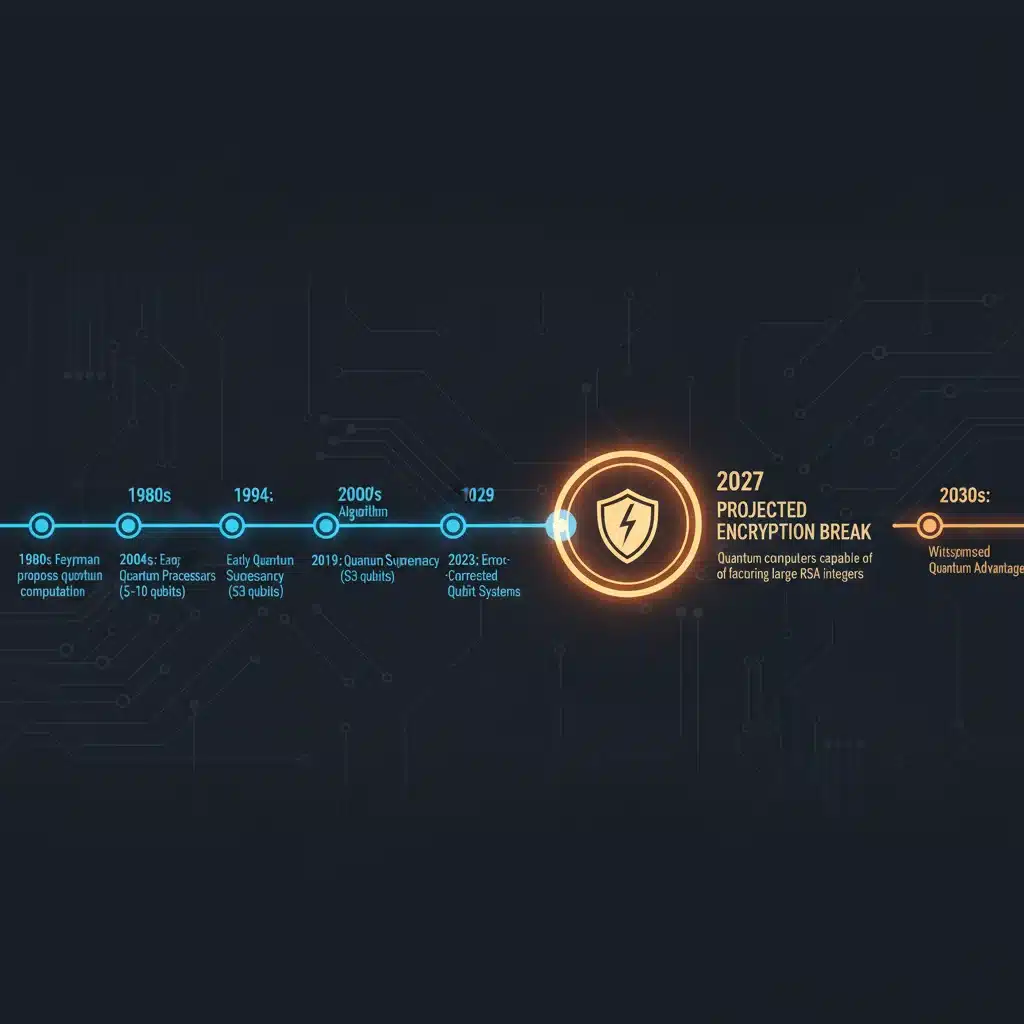
The primary concern for cybersecurity lies in Shor’s algorithm and Grover’s algorithm. Shor’s algorithm, developed by Peter Shor in 1994, is a quantum algorithm that can efficiently factor large numbers. The security of widely used public-key cryptographic systems, such as RSA and Elliptic Curve Cryptography (ECC), relies on the computational difficulty of factoring large numbers or solving discrete logarithm problems. A sufficiently powerful quantum computer running Shor’s algorithm could break these systems in a matter of hours, or even minutes, rendering them useless.
Grover’s algorithm, another quantum algorithm, can speed up the search for an element in an unsorted database. While it doesn’t break symmetric-key algorithms (like AES) or hash functions (like SHA-256) in the same way Shor’s algorithm does, it significantly reduces the effective key length. For instance, a 256-bit AES key would effectively become a 128-bit key against a quantum attack using Grover’s algorithm, making brute-force attacks more feasible.
The 2027 deadline isn’t an arbitrary date. It’s an estimation derived from the accelerating pace of quantum hardware development and the increasing number of qubits being achieved by leading research institutions and tech giants. While a universal fault-tolerant quantum computer capable of running Shor’s algorithm at scale might still be a few years away, the timeline for its arrival is shrinking. Furthermore, the ‘harvest now, decrypt later’ threat is already present. Adversaries could be collecting encrypted data today, storing it, and waiting for the advent of quantum computers to decrypt it. This means data encrypted today, if it needs to remain secure for years to come, is already at risk from future quantum cryptography threats.
The Landscape of Quantum Computing Development
Several major players, including IBM, Google, Microsoft, and various national governments, are pouring significant resources into quantum computing research. Each year brings new breakthroughs in qubit stability, coherence times, and interconnectivity. While challenges remain, such as error correction and scaling, the progress is undeniable. The focus is shifting from theoretical possibilities to engineering practical quantum systems. This rapid evolution underscores the urgency for organizations to assess their exposure to quantum cryptography threats and develop robust mitigation strategies.
Assessing Your Current Security Posture Against Quantum Cryptography Threats
A 2026 readiness assessment for quantum cryptography threats begins with a thorough understanding of your organization’s cryptographic footprint. This involves identifying all instances where cryptographic algorithms are used to protect data, communications, and systems. It’s a complex undertaking that requires a deep dive into your IT infrastructure, applications, and data flows.
Inventory Your Cryptographic Assets
The first step is to create a comprehensive inventory. This includes:
- Data at Rest: Databases, archives, cloud storage, backups, and any persistent storage where sensitive information is encrypted.
- Data in Transit: Network communications, VPNs, TLS/SSL connections for web traffic, email encryption, and inter-application communication.
- Code Signing and Authentication: Digital signatures used for software updates, firmware validation, and user/device authentication mechanisms.
- Key Management Systems: Hardware Security Modules (HSMs), key vaults, and other systems responsible for generating, storing, and managing cryptographic keys.
- Legacy Systems: Older systems or applications that might be using outdated or weaker cryptographic algorithms, which could become even more vulnerable to quantum attacks.
For each identified instance, you need to determine the specific cryptographic algorithms in use (e.g., RSA-2048, ECC-P256, AES-256, SHA-256). This detailed mapping will provide a clear picture of your current exposure to quantum cryptography threats.
Identify Critical Data and Lifespans
Not all data has the same shelf life or sensitivity. A crucial part of your assessment is to classify your data based on its sensitivity and the required confidentiality period. Data that needs to remain secure for decades (e.g., medical records, intellectual property, national security information) is at immediate risk from the ‘harvest now, decrypt later’ threat model. Data with shorter lifespans might have more time, but still requires attention.
Understanding the lifespan of your critical data will help prioritize your migration efforts. You don’t need to secure everything against quantum attacks simultaneously, but you do need a strategic roadmap for the most vulnerable and long-lived assets.
Evaluate Vendor Readiness and Supply Chain Risks
Your organization doesn’t operate in a vacuum. You rely on a vast ecosystem of third-party vendors, cloud providers, and software suppliers. Their cryptographic readiness directly impacts your own. Engage with your vendors to understand their plans for addressing quantum cryptography threats. Inquire about their PQC roadmaps, testing procedures, and timelines for offering quantum-safe solutions.
The supply chain presents a significant attack surface. A compromise in one vendor’s system due to quantum vulnerabilities could cascade throughout your entire network. This makes supply chain risk management a critical component of your quantum readiness assessment.
Strategies for Mitigating Quantum Cryptography Threats: The Path to Post-Quantum Cryptography (PQC)
The good news is that the cybersecurity community is not idly waiting for quantum computers to shatter our defenses. Significant research and development are underway in the field of Post-Quantum Cryptography (PQC), which focuses on developing new cryptographic algorithms that are resistant to attacks by both classical and quantum computers. The National Institute of Standards and Technology (NIST) has been leading a multi-year standardization process for PQC algorithms, with the first set of standards expected to be finalized soon.
Embrace a Hybrid Approach
The transition to PQC will not be an overnight switch. A pragmatic and recommended approach is to adopt a hybrid cryptographic model. This involves using both classical (pre-quantum) and post-quantum algorithms concurrently. For example, you might use an existing RSA or ECC key exchange alongside a new PQC key exchange. This provides a ‘belt and suspenders’ approach, ensuring that if one algorithm is compromised (either by classical or quantum means), the other can still protect the data.
Hybrid cryptography offers several benefits:
- Immediate Protection: It provides a layer of quantum-safe security now, even before PQC algorithms are fully mature and widely adopted.
- Risk Mitigation: It hedges against the possibility that a chosen PQC algorithm might later be found to have weaknesses.
- Gradual Transition: It allows organizations to gradually integrate PQC into their systems without a sudden, disruptive overhaul.
Develop a Quantum-Safe Migration Roadmap
Based on your cryptographic inventory and data classification, you need to develop a detailed migration roadmap. This roadmap should outline:
- Prioritization: Which systems and data require PQC migration first (e.g., long-lived data, critical infrastructure).
- Pilot Programs: Start with pilot implementations of PQC in non-critical environments to gain experience and identify potential challenges.
- Vendor Engagement: Work closely with your software and hardware vendors to ensure their products support the chosen PQC standards.
- Skill Development: Invest in training your IT and security teams on PQC concepts, implementation, and management.
- Budget Allocation: Secure the necessary financial resources for software upgrades, hardware replacements, and training.
The migration to PQC will be a complex engineering challenge, impacting various layers of your technology stack. Starting early is crucial to manage this transition effectively and mitigate quantum cryptography threats.
Stay Informed and Engage with the Community
The field of quantum computing and PQC is rapidly evolving. Staying informed about the latest research, NIST standardization updates, and industry best practices is vital. Participate in industry forums, attend conferences, and engage with cybersecurity experts to share knowledge and learn from others’ experiences. The collective intelligence of the cybersecurity community will be instrumental in navigating the challenges posed by quantum cryptography threats.
Practical Steps for Your 2026 Quantum Readiness Checklist
Here’s a practical checklist to guide your organization’s 2026 readiness assessment for quantum cryptography threats:
- Form a Quantum Readiness Task Force: Assemble a cross-functional team including IT, security, legal, and business leaders to oversee the quantum migration strategy.
- Conduct a Comprehensive Cryptographic Audit: Identify all cryptographic algorithms in use across your organization, their locations, and the data they protect.
- Classify Data by Sensitivity and Lifespan: Determine which data needs long-term quantum-safe protection, prioritizing assets that are vulnerable to ‘harvest now, decrypt later’ attacks.
- Monitor NIST PQC Standardization: Keep a close watch on NIST’s progress in standardizing PQC algorithms and plan to adopt the chosen standards.
- Engage with Vendors: Contact all relevant software and hardware vendors to understand their PQC roadmaps and ensure compatibility.
- Begin Pilot Implementations: Experiment with PQC algorithms in non-production environments to understand their performance characteristics and integration challenges.
- Invest in Quantum-Safe Key Management: Evaluate and upgrade your key management systems to support PQC algorithms and hybrid key schemes.
- Review and Update Security Policies: Adapt your organizational security policies to include requirements for quantum-safe cryptography.
- Educate and Train Staff: Provide training to your IT and security teams on the principles of quantum cryptography, PQC, and the new security protocols.
- Develop Incident Response Plans: Update your incident response plans to address potential quantum-related security breaches.
Each of these steps contributes to building a resilient defense against future quantum cryptography threats. The time to act is now, not when the threat fully materializes.
Challenges and Considerations in the PQC Transition
The journey to post-quantum cryptography is not without its challenges. Organizations will face several hurdles that require careful planning and execution.
Performance Overhead
Some PQC algorithms may have larger key sizes, larger signature sizes, or require more computational resources compared to their classical counterparts. This could lead to increased latency, higher bandwidth consumption, or greater processing demands, particularly in resource-constrained environments like IoT devices or low-power sensors. Thorough testing during pilot programs is essential to understand and mitigate these performance impacts.
Interoperability
Ensuring seamless interoperability between systems using different PQC algorithms or a mix of classical and PQC algorithms will be a significant challenge. Standardization efforts like NIST’s are crucial, but organizations must still manage the complexities of transitioning heterogeneous systems and ensuring that communication channels remain secure throughout the migration.
Cryptographic Agility
The ability to easily switch between cryptographic algorithms without major system overhauls is known as cryptographic agility. This will be more important than ever in the quantum era. Organizations should design their systems with cryptographic agility in mind, allowing for flexible updates and replacements of cryptographic modules as new PQC standards emerge or existing ones are refined. This agile approach will help organizations adapt to unforeseen developments in quantum cryptography threats.
Human Factor and Awareness
Ultimately, the success of any cybersecurity initiative hinges on the human factor. A lack of awareness or understanding among employees about the significance of quantum cryptography threats could lead to vulnerabilities. Comprehensive training and ongoing education are vital to ensure that everyone, from developers to end-users, understands their role in maintaining quantum-safe security practices.

The Future of Cybersecurity: Beyond 2027
While 2027 serves as a critical benchmark for the emergence of significant quantum cryptography threats, the transition to a quantum-safe world is an ongoing process. Cybersecurity will continue to evolve, with new threats and countermeasures constantly emerging. The efforts made today in preparing for PQC will lay the groundwork for a more resilient and adaptable security posture in the long term.
Beyond simply replacing algorithms, the quantum era might also usher in new security paradigms. Quantum Key Distribution (QKD), for instance, offers theoretically unhackable communication channels by leveraging the laws of quantum mechanics. While QKD has its own practical limitations and is distinct from PQC (which focuses on software algorithms for classical computers), it represents another facet of the quantum future that could reshape how we think about secure communication.
The journey to safeguard against quantum cryptography threats is a marathon, not a sprint. It requires continuous vigilance, investment in research and development, and a collaborative effort across industries and governments. By taking proactive steps now, organizations can transform what appears to be an existential threat into an opportunity to build stronger, more future-proof cybersecurity defenses.
Conclusion: Act Now for Quantum Security
The advent of powerful quantum computers is not a distant possibility; it’s a rapidly approaching reality that will fundamentally alter the landscape of cybersecurity. The window for proactive preparation against quantum cryptography threats is narrowing, with 2027 looming as a critical deadline for many organizations.
A comprehensive 2026 readiness assessment is not just a recommendation; it’s an imperative. By inventorying your cryptographic assets, understanding data lifespans, engaging with vendors, and developing a strategic migration roadmap to Post-Quantum Cryptography, you can position your organization to withstand the coming quantum storm. The challenges are significant, but the tools and knowledge to overcome them are emerging. The time for action is now. Secure your digital future before it’s too late.