Zero-Trust Architectures 2026: Identity-Centric Security to Prevent Breaches

Zero-Trust Architectures for 2026: Implementing Identity-Centric Security Software to Prevent 85% of Internal Breaches
In an increasingly complex and interconnected digital landscape, the traditional perimeter-based security model has proven to be woefully inadequate. The notion that everything inside an organization’s network is inherently trustworthy, while everything outside is hostile, is a dangerous relic of a bygone era. As we look towards 2026, the imperative to adopt robust cybersecurity frameworks has never been clearer. This is where Zero Trust Security architectures emerge not just as a recommendation, but as a critical necessity. This comprehensive guide will delve into the intricacies of implementing identity-centric security software within a Zero-Trust framework, aiming to significantly reduce, and potentially prevent up to 85% of internal breaches.
The Evolution of Cybersecurity Threats and the Rise of Zero-Trust Security
The threat landscape has undergone a dramatic transformation. Cybercriminals are more sophisticated, nation-state actors are more aggressive, and insider threats, whether malicious or accidental, continue to be a significant concern. High-profile data breaches, often originating from compromised credentials or internal vulnerabilities, underscore the urgent need for a paradigm shift in how organizations approach security. The perimeter has dissolved, replaced by a distributed network of users, devices, applications, and data residing both on-premises and in the cloud.
The concept of Zero Trust Security, first popularized by Forrester Research, challenges the implicit trust model by asserting, “never trust, always verify.” This fundamental principle dictates that no user, device, or application should be granted access to resources without explicit verification, regardless of their location relative to the network perimeter. Every access request is treated as if it originates from an untrusted network, requiring rigorous authentication and authorization.
For 2026, the emphasis within Zero Trust Security will pivot even more strongly towards identity-centric approaches. Identities – whether human or machine – are the new perimeter. Protecting these identities and controlling their access to resources becomes paramount in preventing unauthorized access and mitigating the impact of potential breaches. This shift acknowledges that even if an attacker bypasses traditional network defenses, they will still face formidable barriers if every access attempt requires re-verification based on identity.
Understanding Identity-Centric Zero-Trust Architectures
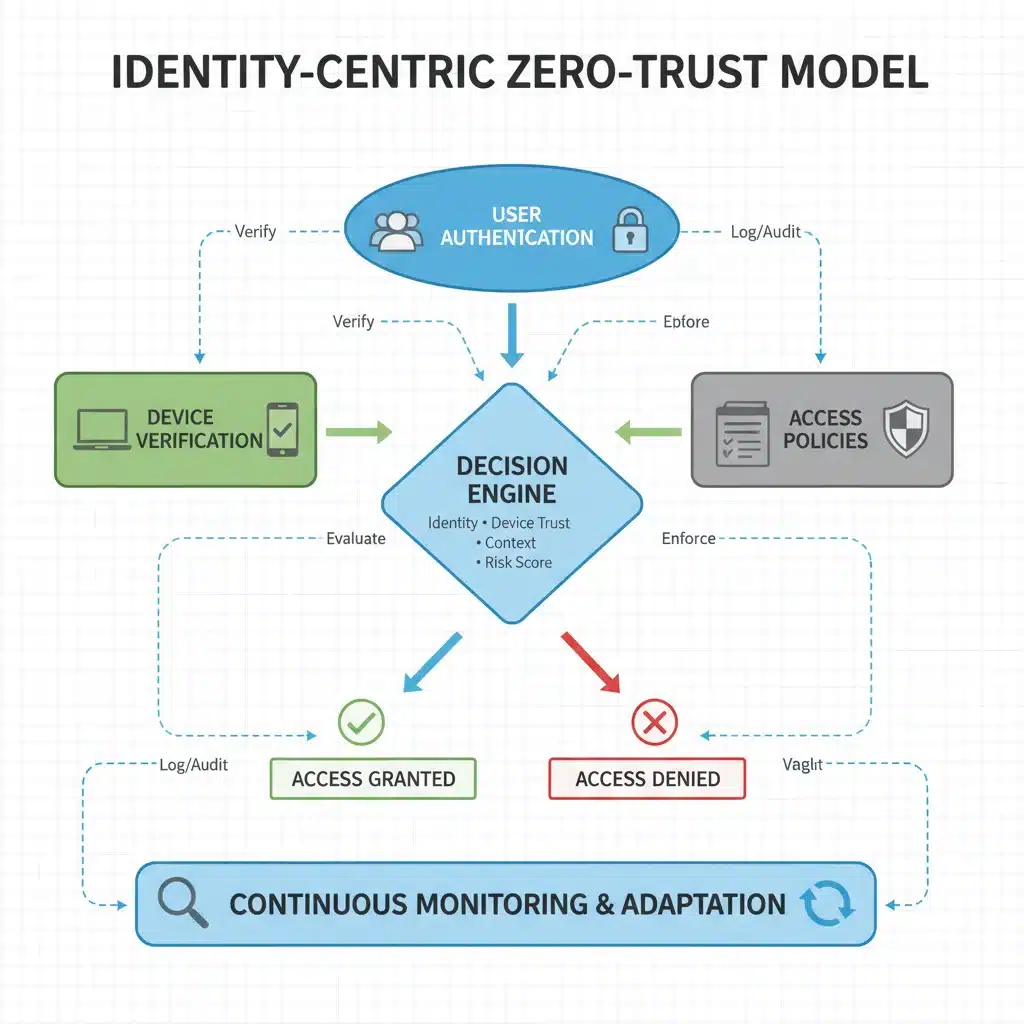
An identity-centric Zero Trust Security architecture places user and device identities at the core of all security decisions. Instead of focusing solely on network segmentation, it prioritizes verifying who or what is requesting access, what they are trying to access, and under what conditions. This approach ensures that access is granted on a least-privilege basis and continuously evaluated throughout a session.
Key Principles of Identity-Centric Zero Trust:
- Verify Explicitly: Always authenticate and authorize based on all available data points, including user identity, location, device health, service, and data classification.
- Use Least Privilege Access: Grant users and devices only the minimum access rights necessary to perform their tasks. This minimizes the potential blast radius of a compromised account.
- Assume Breach: Operate under the assumption that an attacker may already be present within the network. This mindset drives continuous monitoring and rapid response capabilities.
- Micro-segmentation: Divide networks into smaller, isolated segments, limiting lateral movement for attackers even if they gain initial access.
- Multi-Factor Authentication (MFA): Enforce strong MFA for all access attempts, significantly reducing the risk of credential theft.
- Continuous Monitoring and Validation: Continuously monitor all access requests and network traffic for suspicious activity. Re-authenticate and re-authorize regularly.
By adhering to these principles, organizations can build a more resilient security posture that is inherently more resistant to both external and internal threats. The focus on identity means that even if a user’s device is compromised, their access is still restricted and constantly scrutinized, preventing an attacker from easily moving through the network.
The Role of Identity-Centric Security Software in Zero-Trust Implementation
Implementing a true identity-centric Zero Trust Security model requires a suite of sophisticated security software. These tools work in concert to establish, enforce, and continuously monitor access policies based on identity and context. Here are the core components:
1. Identity and Access Management (IAM) Solutions:
IAM forms the bedrock of an identity-centric Zero Trust architecture. It manages user identities, authenticates users, and authorizes their access to resources. Key features include:
- Centralized User Directories: Active Directory, LDAP, or cloud-based identity providers like Azure AD, Okta, or Ping Identity.
- Single Sign-On (SSO): Streamlines user experience while maintaining strong authentication by allowing users to access multiple applications with one set of credentials.
- Multi-Factor Authentication (MFA): Essential for verifying user identity beyond a simple password. This includes biometrics, hardware tokens, and authenticator apps.
- Access Governance: Defines roles, responsibilities, and access policies, ensuring that privileges are aligned with job functions.
2. Privileged Access Management (PAM) Software:
PAM solutions are crucial for securing, managing, and monitoring privileged accounts (e.g., administrator accounts, service accounts). These accounts, if compromised, pose the greatest risk. PAM systems provide:
- Secure Credential Vaulting: Stores privileged credentials in an encrypted vault, preventing direct access by users.
- Session Recording and Monitoring: Records all activities performed during a privileged session for auditing and forensic analysis.
- Just-in-Time (JIT) Access: Grants privileged access only when needed and for a limited duration, minimizing the window of opportunity for attackers.
- Least Privilege Enforcement: Ensures that even privileged users operate with the minimum necessary rights.
3. Device Posture and Endpoint Detection and Response (EDR):
Verifying the health and security posture of every device attempting to access resources is critical. EDR solutions play a vital role in this by:
- Continuous Device Health Checks: Assesses device compliance with security policies (e.g., up-to-date patches, antivirus status, encryption).
- Threat Detection and Response: Monitors endpoint activity for malicious behavior, identifies threats, and enables rapid response actions.
- Device Trust Scoring: Assigns a trust score to each device based on its security posture, influencing access decisions.
4. Network Access Control (NAC) and Micro-segmentation:
NAC solutions control which devices can connect to the network, while micro-segmentation further isolates workloads and applications. These tools work together to:
- Onboarding and Provisioning: Manages how devices are brought onto the network and assigned initial access.
- Policy Enforcement: Ensures that devices comply with security policies before being granted network access.
- Granular Segmentation: Creates highly granular network segments, restricting communication between different applications and data sets.
5. Security Information and Event Management (SIEM) & Security Orchestration, Automation, and Response (SOAR):
SIEM collects, aggregates, and analyzes security logs and events from across the entire IT environment. SOAR platforms automate security operations tasks and incident response workflows. Together, they provide:
- Centralized Log Management: A single pane of glass for all security-related events.
- Threat Detection and Alerting: Identifies anomalous behavior and potential threats based on correlation rules and machine learning.
- Automated Response: Triggers automated actions (e.g., isolating a compromised device, blocking a malicious IP) based on detected threats.
Implementing Zero-Trust Security: A Step-by-Step Approach for 2026
Transitioning to a full Zero Trust Security model is a journey, not a destination. It requires careful planning, phased implementation, and continuous optimization. Here’s a strategic roadmap for organizations aiming for 2026:
Step 1: Define Your Protect Surface
Identify what you need to protect most. This includes critical data, applications, assets, and services (DAAS). Instead of trying to secure the entire network, focus on the most valuable assets first. This provides a clear scope for your Zero Trust initiatives.
Step 2: Map Transaction Flows
Understand how users, applications, and data interact with your protect surface. Document typical communication paths, access patterns, and dependencies. This helps in defining granular access policies and identifying potential points of vulnerability.
Step 3: Build a Zero Trust Architecture
Based on your protect surface and transaction flows, design a Zero Trust architecture that incorporates the identity-centric security software discussed earlier. This involves:
- Identity Governance: Establish robust policies for user lifecycle management, role-based access control (RBAC), and attribute-based access control (ABAC).
- Strong Authentication: Implement MFA everywhere, including for legacy applications where possible. Consider passwordless authentication for enhanced security and user experience.
- Micro-segmentation Strategy: Plan how to segment your network, starting with critical applications and data.
- Endpoint Security: Deploy EDR and ensure all devices meet security posture requirements before accessing resources.
- Data Protection: Implement data encryption at rest and in transit, and data loss prevention (DLP) solutions.
Step 4: Create Zero Trust Policies
Develop granular access policies based on the “never trust, always verify” principle. These policies should consider:
- User Identity: Who is requesting access?
- Device Identity and Posture: What device is being used, and is it healthy and compliant?
- Application Context: Which application is being accessed, and what are its security requirements?
- Environmental Factors: Location, time of day, network type, and other contextual information.
Policies should be dynamic, adapting to changes in context and threat levels.
Step 5: Monitor and Maintain
Zero Trust Security is an ongoing process. Continuously monitor all access attempts, network traffic, and system logs for anomalies. Use SIEM and SOAR solutions to automate detection and response. Regularly review and update your policies, conduct penetration testing, and adapt to evolving threats and technological changes. This continuous loop of monitoring and improvement is essential for maintaining a strong security posture.
Preventing 85% of Internal Breaches with Identity-Centric Zero Trust
The ambitious goal of preventing 85% of internal breaches through identity-centric Zero Trust Security is achievable by 2026 for several compelling reasons:
1. Eliminating Implicit Trust:
By removing the implicit trust granted to users and devices within the network, Zero Trust significantly curtails the ability of an attacker (or a malicious insider) to move laterally once they gain initial access. Every internal resource access requires re-authentication and re-authorization, making it much harder to exploit a compromised credential or endpoint.
2. Stronger Identity Verification:
The pervasive use of MFA, coupled with continuous identity verification and behavioral analytics, makes it exceedingly difficult for attackers to impersonate legitimate users. Even if credentials are stolen, the additional authentication factors act as a robust barrier.
3. Least Privilege and Micro-segmentation:
Granting only the necessary access and segmenting networks into smaller, isolated zones drastically reduces the potential damage from a breach. An attacker’s access is confined to a very small area, preventing them from reaching critical data or systems.
4. Enhanced Visibility and Monitoring:
Zero Trust architectures inherently generate a wealth of security telemetry. Every access request, every device connection, and every user action is logged and monitored. This increased visibility, when fed into SIEM and EDR systems, allows for earlier detection of anomalous behavior and faster incident response, often before significant damage occurs.
5. Securing Remote and Hybrid Work Environments:
The post-pandemic world demands security solutions that protect users and data regardless of location. Identity-centric Zero Trust Security is perfectly suited for hybrid work models, ensuring that access to corporate resources is secure whether employees are in the office, at home, or on the go.
Challenges and Considerations for 2026
While the benefits are clear, implementing Zero Trust Security is not without its challenges:
- Complexity: The integration of various security tools and the creation of granular policies can be complex, requiring skilled personnel.
- Legacy Systems: Integrating Zero Trust principles with older, legacy applications and infrastructure can be difficult and costly.
- User Experience: Overly stringent policies can sometimes hinder user productivity. A balance must be struck between security and usability.
- Cost: Investing in new security software, infrastructure, and training can be a significant financial undertaking.
- Cultural Shift: It requires a fundamental shift in how security is perceived and managed across the organization, from IT to end-users.
Addressing these challenges requires a phased approach, strong executive buy-in, continuous training, and leveraging automation wherever possible to streamline operations and reduce manual overhead.

The Future of Zero Trust: Beyond 2026
Looking beyond 2026, the principles of Zero Trust Security will continue to evolve. We can anticipate even greater integration with Artificial Intelligence (AI) and Machine Learning (ML) for predictive threat intelligence, automated policy adjustments, and more sophisticated behavioral analytics. The concept of continuous adaptive trust, where trust scores are dynamically adjusted in real-time based on ongoing monitoring, will become more prevalent. Furthermore, the convergence of identity, network, and endpoint security will lead to more unified and simpler management platforms, reducing complexity for security teams.
The growth of IoT and operational technology (OT) will also necessitate extending Zero Trust principles to these domains, securing an ever-expanding attack surface. Supply chain security will increasingly rely on Zero Trust to verify the integrity of third-party components and services. The core tenet of “never trust, always verify” will remain, but the methods and technologies for achieving it will become even more advanced and pervasive.
Conclusion: Securing Tomorrow with Zero-Trust Security
The journey towards a truly secure digital environment in 2026 and beyond hinges on the widespread adoption and sophisticated implementation of Zero Trust Security architectures. By prioritizing identity-centric security software and embracing the “never trust, always verify” mantra, organizations can erect formidable defenses against the most prevalent and damaging cyber threats, particularly internal breaches. The goal of preventing 85% of internal breaches is not just aspirational; it is a tangible outcome of a well-executed Zero Trust strategy.
Investing in the right technologies, fostering a security-first culture, and committing to continuous improvement will empower organizations to navigate the complex cybersecurity landscape with confidence. The future of security is Zero Trust, and the time to build that future is now.