Azure Arc: Unlocking Hybrid Cloud Advantage for 15% Efficiency Gains

In today’s rapidly evolving digital landscape, organizations are grappling with the complexities of managing diverse IT environments. The once clear lines between on-premises infrastructure and cloud computing have blurred, giving rise to hybrid and multi-cloud strategies. While these strategies offer unparalleled flexibility and resilience, they also introduce significant management challenges. This is where Azure Arc hybrid cloud emerges as a game-changer, providing a unified control plane that extends Azure’s management capabilities to virtually any infrastructure, anywhere. By leveraging Azure Arc, businesses can not only simplify operations but also achieve substantial efficiency gains, often exceeding 15%, by integrating their on-premises, edge, and multi-cloud assets seamlessly.
The promise of the hybrid cloud has always been about combining the best of both worlds: the control and security of on-premises environments with the scalability and innovation of the cloud. However, realizing this promise has often been hindered by fragmented tools, inconsistent policies, and a lack of centralized visibility. Azure Arc directly addresses these pain points, transforming distributed IT into a cohesive, manageable ecosystem. This article will delve deep into the capabilities of Azure Arc hybrid cloud, exploring how it empowers organizations to modernize their operations, enhance security, and drive unprecedented efficiency.
Understanding the Hybrid Cloud Challenge and Azure Arc’s Solution
The journey to digital transformation often leads organizations to adopt hybrid and multi-cloud architectures. This strategic move allows them to keep sensitive data on-premises, meet regulatory compliance, leverage existing investments, and burst workloads to the cloud as needed. However, this distributed model brings a unique set of challenges:
- Operational Complexity: Managing different infrastructure types with disparate tools leads to increased overhead and potential for errors.
- Inconsistent Governance: Applying uniform security policies and compliance standards across varied environments is a daunting task.
- Lack of Visibility: Gaining a holistic view of resources and their health across on-premises, edge, and multiple cloud providers is difficult.
- Developer Inefficiency: Developers often struggle with inconsistent environments and deployment processes.
- Data Silos: Data residing in different locations can hinder analytics and decision-making.
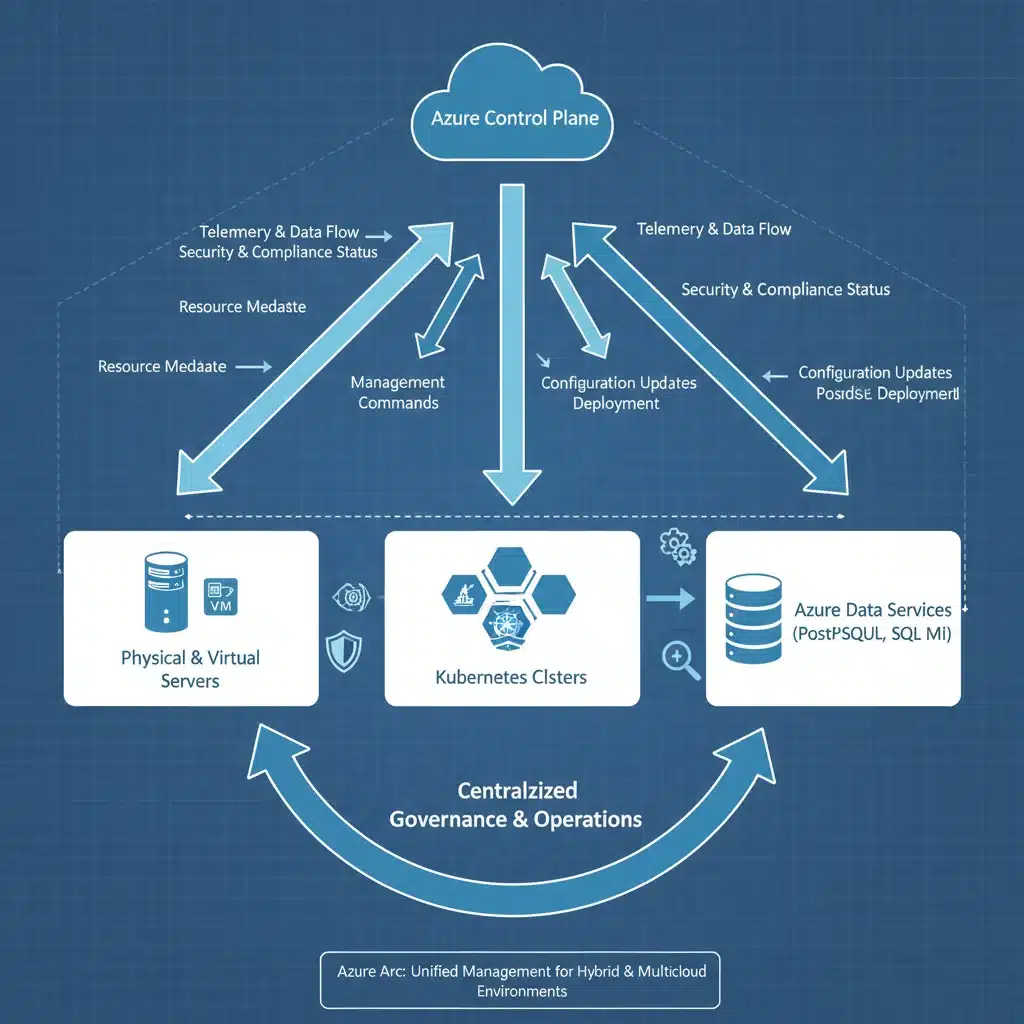
Azure Arc hybrid cloud provides a revolutionary approach to overcome these challenges. It extends the Azure control plane – the same management plane used for native Azure resources – to servers, Kubernetes clusters, and data services running outside of Azure. This means you can manage Windows and Linux servers, Kubernetes clusters, and Azure data services (like Azure SQL Managed Instance and PostgreSQL Hyperscale) wherever they reside, using familiar Azure tools, services, and policies.
The core concept is to project non-Azure resources into Azure Resource Manager (ARM), making them first-class citizens within Azure. Once projected, these resources can benefit from Azure management services such as Azure Policy, Azure Monitor, Azure Security Center, and Azure Lighthouse. This unified management paradigm is crucial for achieving the promised 15% efficiency gains, as it reduces the need for specialized tools and training, streamlines operations, and enhances security posture across the entire IT estate.
Key Capabilities of Azure Arc Hybrid Cloud
Azure Arc hybrid cloud offers a comprehensive suite of capabilities designed to bring consistency, governance, and powerful Azure services to your distributed infrastructure. Let’s explore some of its most impactful features:
1. Servers Anywhere: Unifying Management of Windows and Linux Machines
One of the foundational capabilities of Azure Arc is its ability to manage Windows and Linux physical servers and virtual machines hosted outside of Azure. This includes servers running in your data center, on other cloud providers (AWS, GCP), or at the edge. By installing a lightweight Azure Connected Machine agent on these servers, they become ‘Arc-enabled servers’ and appear as resources in Azure Resource Manager.
Once Arc-enabled, these servers can be managed using Azure services such as:
- Azure Policy: Enforce organizational standards and assess compliance at scale. This is vital for maintaining security configurations, ensuring consistent patching, and adhering to regulatory requirements across all servers, regardless of their location.
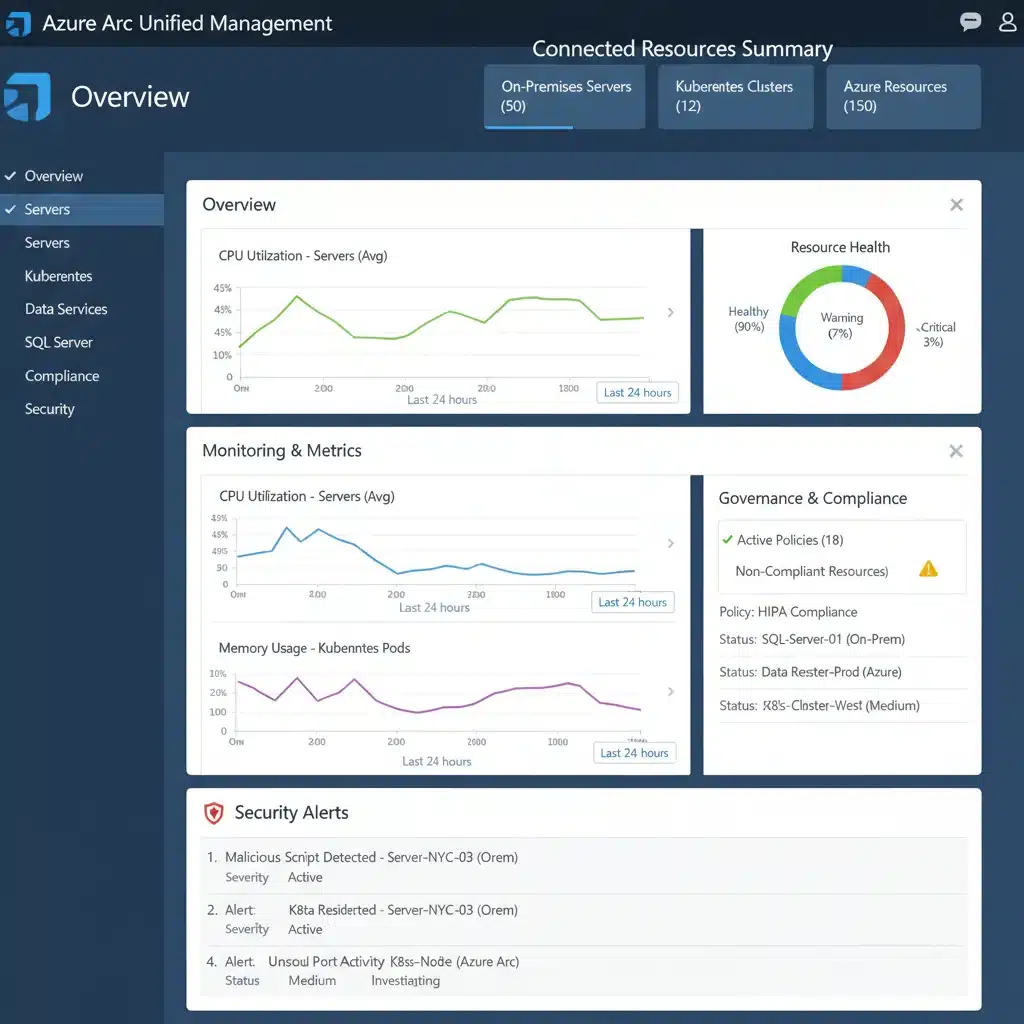
- Azure Monitor: Collect logs and metrics, monitor performance, and set up alerts for your on-premises and multi-cloud servers. This provides a single pane of glass for operational insights, reducing downtime and improving troubleshooting efficiency.
- Azure Security Center/Defender for Cloud: Gain unified security management and advanced threat protection for all your servers. This extends Azure’s robust security capabilities to your entire server fleet, identifying vulnerabilities and protecting against threats.
- Azure Automation: Automate administrative tasks, patch management, and configuration management across your hybrid environment. This significantly reduces manual effort and ensures consistency in operations.
The ability to apply consistent governance and monitoring across all servers, whether in Azure or elsewhere, is a cornerstone of the efficiency improvements offered by Azure Arc hybrid cloud. It eliminates the need for separate management tools for different environments, simplifying IT operations and reducing the risk of misconfigurations.
2. Kubernetes Clusters Anywhere: Consistent Application Deployment
Kubernetes has become the de facto standard for container orchestration, but managing multiple Kubernetes clusters across different environments (on-premises, edge, various clouds) can be complex. Azure Arc hybrid cloud simplifies this by enabling you to attach and configure Kubernetes clusters located anywhere to Azure. This means you can manage, govern, and secure your Kubernetes clusters using Azure services, just as you would with Azure Kubernetes Service (AKS).
Key benefits for Arc-enabled Kubernetes include:
- GitOps Configuration Management: Implement GitOps for consistent cluster configuration and application deployment. This allows you to store your desired cluster state in a Git repository and use Flux (an open-source GitOps tool) to automatically synchronize and apply those configurations to your Arc-enabled clusters.
- Azure Policy for Kubernetes: Enforce policies on your Kubernetes clusters, ensuring security best practices, resource governance, and compliance. For example, you can ensure that only approved container images are deployed or that specific resource limits are applied.
- Azure Monitor for Containers: Gain deep visibility into the performance and health of your Kubernetes clusters and containerized applications, regardless of where they run.
- Azure Defender for Kubernetes: Enhance the security posture of your Kubernetes clusters with threat detection and vulnerability management.
- Deploy Azure Services on Kubernetes: This is a powerful differentiator. Azure Arc allows you to deploy certain Azure data services and application services directly onto your Arc-enabled Kubernetes clusters. This brings cloud-native capabilities closer to your data and applications, enhancing performance and reducing latency.
By standardizing Kubernetes management through Azure Arc, organizations can accelerate application development and deployment, reduce operational overhead, and ensure consistent security and compliance across their entire containerized landscape. This unification is a major driver of the 15% efficiency gain.
3. Azure Data Services Anywhere: Bringing Cloud-Native Databases On-Premises
One of the most innovative aspects of Azure Arc hybrid cloud is its ability to run Azure data services on your infrastructure, whether on-premises, at the edge, or on other clouds. This includes Azure SQL Managed Instance and PostgreSQL Hyperscale. This capability allows you to bring the benefits of cloud-native data services – such as evergreen updates, elastic scalability, and unified management – to environments where you need to keep data locally.
Benefits of Arc-enabled data services:
- Evergreen Updates: Your data services receive continuous updates from Azure, ensuring you always have the latest features and security patches without manual intervention. This eliminates the burden of managing database versions and patches.
- Elastic Scalability: Scale your data services up or down based on demand, leveraging the underlying Kubernetes infrastructure.
- Unified Management: Manage your Arc-enabled data services using familiar Azure tools like Azure Data Studio, Azure CLI, and the Azure portal.
- Disaster Recovery and High Availability: Leverage built-in capabilities for high availability and disaster recovery, ensuring business continuity for your critical data.
- Reduced Latency: Keep data close to your applications and users, reducing latency and improving application performance, especially for edge scenarios.
This capability is particularly transformative for organizations with strict data residency requirements, limited connectivity, or those seeking to modernize their on-premises databases without a full migration to the public cloud. It provides the agility and innovation of the cloud directly within their existing infrastructure, contributing significantly to operational efficiency.
Achieving 15% Efficiency Gains with Azure Arc
The 15% efficiency gain mentioned in the topic is not an arbitrary figure but a realistic outcome derived from the cumulative benefits of adopting Azure Arc hybrid cloud. These gains manifest in several key areas:
1. Streamlined Operations and Reduced Manual Effort
By providing a single control plane for diverse resources, Azure Arc drastically reduces the operational complexity. IT teams no longer need to switch between multiple tools and dashboards to manage on-premises, edge, and multi-cloud assets. This unification leads to:
- Centralized Management: All resources appear in the Azure portal, allowing for consistent monitoring, deployment, and configuration.
- Automation: Leverage Azure Automation, Azure Policy, and GitOps to automate routine tasks, patch management, and configuration enforcement, freeing up IT staff for more strategic initiatives.
- Reduced Training Overhead: Teams can leverage their existing Azure skills to manage non-Azure resources, minimizing the need for new training and specialized expertise for each environment.
These operational efficiencies translate directly into cost savings and increased productivity, contributing significantly to the 15% gain.
2. Enhanced Security and Compliance Posture
Security and compliance are paramount, and maintaining them across a fragmented IT estate is resource-intensive. Azure Arc hybrid cloud extends Azure’s robust security and governance capabilities to all connected resources, ensuring a consistent security posture:
- Unified Security Monitoring: Azure Defender for Cloud provides a consolidated view of security alerts and recommendations across your entire hybrid environment.
- Consistent Policy Enforcement: Azure Policy ensures that security configurations, access controls, and compliance standards are uniformly applied to all Arc-enabled resources.
- Vulnerability Management: Identify and remediate vulnerabilities across servers and Kubernetes clusters, regardless of their location.
By proactively managing security and compliance from a central point, organizations can reduce the risk of breaches, avoid costly fines, and streamline audit processes, which are all significant efficiency boosters.
3. Faster Innovation and Application Delivery
Azure Arc hybrid cloud empowers developers and operations teams to accelerate innovation by providing consistent environments and streamlined deployment pipelines:
- Consistent Development Environments: Developers can build and deploy applications to Kubernetes clusters with the assurance that the underlying infrastructure is managed consistently, regardless of its physical location.
- GitOps for CI/CD: Implement automated, reliable, and faster deployments of applications and configurations using GitOps principles.
- Edge Computing Capabilities: Deploy Azure services and custom applications closer to data sources and users at the edge, enabling new scenarios and improving application responsiveness.
Reducing friction in the development and deployment lifecycle directly translates into faster time-to-market for new features and applications, a critical factor in competitive advantage and overall organizational efficiency.
Real-World Scenarios and Use Cases
The versatility of Azure Arc hybrid cloud makes it applicable to a wide range of industries and use cases:
- Retail: Managing thousands of point-of-sale systems and edge devices in stores. Arc can provide centralized updates, monitoring, and security for these distributed environments.
- Manufacturing: Connecting and managing industrial IoT devices and on-premises factory systems, enabling real-time data processing and analytics at the edge while leveraging Azure’s cloud-scale AI capabilities.
- Financial Services: Meeting strict data residency and compliance requirements by keeping sensitive customer data on-premises while benefiting from Azure’s management, security, and data analytics services.
- Healthcare: Securely managing patient data on-premises or at clinic locations, ensuring compliance with regulations like HIPAA, while enabling remote management and insights.
- Telecommunications: Deploying network functions and edge applications on Arc-enabled Kubernetes clusters, optimizing performance and reducing latency for 5G and other advanced services.
- Hybrid Data Estates: Modernizing legacy databases by migrating them to Arc-enabled Azure SQL Managed Instance on-premises, gaining cloud benefits without moving data to the public cloud.
These examples highlight how Azure Arc isn’t just a theoretical concept but a practical solution driving real business value across diverse sectors. The ability to extend Azure’s powerful capabilities to where your data and applications reside is a significant differentiator.
Implementing Azure Arc: Best Practices and Considerations
To maximize the benefits and achieve the target efficiency gains with Azure Arc hybrid cloud, consider the following best practices:
- Start Small, Scale Gradually: Begin by onboarding a small set of non-production servers or a single Kubernetes cluster to understand the process and capabilities.
- Define Clear Governance Policies: Before onboarding, establish clear Azure Policies for security, compliance, and resource tagging to ensure consistent management from day one.
- Network Connectivity: Ensure reliable and secure network connectivity between your on-premises/edge environments and Azure. Azure Arc agents require outbound connectivity to specific Azure endpoints.
- Security Best Practices: Implement Azure Security Center/Defender for Cloud from the outset to protect your Arc-enabled resources. Use Azure AD for identity and access management.
- Monitoring and Logging: Configure Azure Monitor for all Arc-enabled resources to gain comprehensive visibility and proactive alerting.
- Leverage Automation: Automate the onboarding process for servers and Kubernetes clusters using scripts and infrastructure-as-code tools.
- Consider Data Services: Evaluate where Azure Arc-enabled data services can bring value, especially for modernization or data residency scenarios.
By following these guidelines, organizations can ensure a smooth implementation and unlock the full potential of Azure Arc hybrid cloud, leading to significant improvements in operational efficiency and IT agility.
The Future of Hybrid and Multi-Cloud with Azure Arc
Azure Arc hybrid cloud is not just a temporary solution; it represents Microsoft’s long-term vision for hybrid and multi-cloud management. As organizations continue to distribute their workloads and data across various environments, the need for a unified control plane will only grow. Azure Arc is continuously evolving, with new services and capabilities being added to further extend Azure’s reach and provide an even more seamless experience.
The ability to run Azure services anywhere, manage any resource from a single pane of glass, and enforce consistent governance across the entire IT estate positions Azure Arc as a critical technology for modern enterprises. It empowers businesses to innovate faster, operate more efficiently, and maintain a strong security posture in an increasingly complex world. The 15% efficiency gain is just the beginning; the strategic advantages of unified management and extended Azure capabilities are immense, paving the way for truly agile and resilient IT operations.
Conclusion
The journey towards a truly integrated and efficient hybrid cloud environment has often been fraught with challenges. However, Azure Arc hybrid cloud offers a powerful and elegant solution, extending the robust management, governance, and security capabilities of Azure to your on-premises, edge, and multi-cloud infrastructure. By providing a unified control plane, it eliminates operational silos, streamlines workflows, and ensures consistent policy enforcement across your entire IT estate.
The tangible benefits, including significant operational efficiency gains, enhanced security, and accelerated innovation, make Azure Arc an indispensable tool for organizations looking to modernize their IT infrastructure without compromising on flexibility or control. Embracing Azure Arc means embracing a future where your IT environment, regardless of its physical location, can be managed with the consistency, power, and intelligence of Azure. It’s time to unlock the full potential of your hybrid cloud and experience the transformative impact of centralized, cloud-native management.