Top EDR Solutions 2026: U.S. Small Business Cybersecurity Guide
Top EDR Solutions 2026: A Critical Comparison for U.S. Small Businesses
In the rapidly evolving landscape of cyber threats, safeguarding your small business’s digital assets is no longer a luxury but a fundamental necessity. As we approach 2026, the sophistication and frequency of cyberattacks continue to escalate, making traditional antivirus software increasingly inadequate. This is where Endpoint Detection and Response (EDR) solutions step in, offering a robust, proactive defense against advanced threats. For U.S. small businesses, choosing the right EDR platform can mean the difference between a minor inconvenience and a catastrophic data breach.
This comprehensive guide is designed to help you navigate the complex world of EDR, providing a critical comparison of leading EDR solutions 2026. We’ll delve into what EDR is, why it’s indispensable for small businesses, key features to look for, and a detailed analysis of top contenders tailored for the specific needs and budget constraints of American small and medium-sized enterprises (SMEs).
What Exactly Are EDR Solutions?
Endpoint Detection and Response (EDR) is a cybersecurity technology that continuously monitors endpoint devices (such as laptops, desktops, servers, and mobile devices) to detect and investigate suspicious activities, and automatically respond to threats. Unlike traditional antivirus software that relies on known signatures to block malware, EDR employs advanced analytics, machine learning, and behavioral analysis to identify and neutralize even novel and sophisticated threats.
The Evolution from Antivirus to EDR
Historically, antivirus programs were the frontline defense. They were effective against known viruses and malware. However, modern cyber threats, including fileless malware, zero-day exploits, and sophisticated phishing campaigns, can bypass these signature-based defenses. EDR solutions bridge this gap by providing:
- Continuous Monitoring: Real-time visibility into endpoint activities.
- Threat Detection: Identification of suspicious behaviors and anomalies that indicate an attack.
- Investigation Capabilities: Tools to analyze the scope and nature of a threat.
- Automated Response: The ability to contain, remediate, and even roll back malicious changes.
For small businesses, this enhanced level of protection is crucial, as they are often targeted due to perceived weaker security postures and valuable data.
Why U.S. Small Businesses Need Robust EDR Solutions in 2026
Small businesses in the U.S. face a unique set of challenges when it comes to cybersecurity. They often lack dedicated IT security teams, have limited budgets, and yet possess valuable data that makes them attractive targets for cybercriminals. Here’s why adopting the right EDR solutions 2026 is non-negotiable:
1. Escalating Cyber Threat Landscape
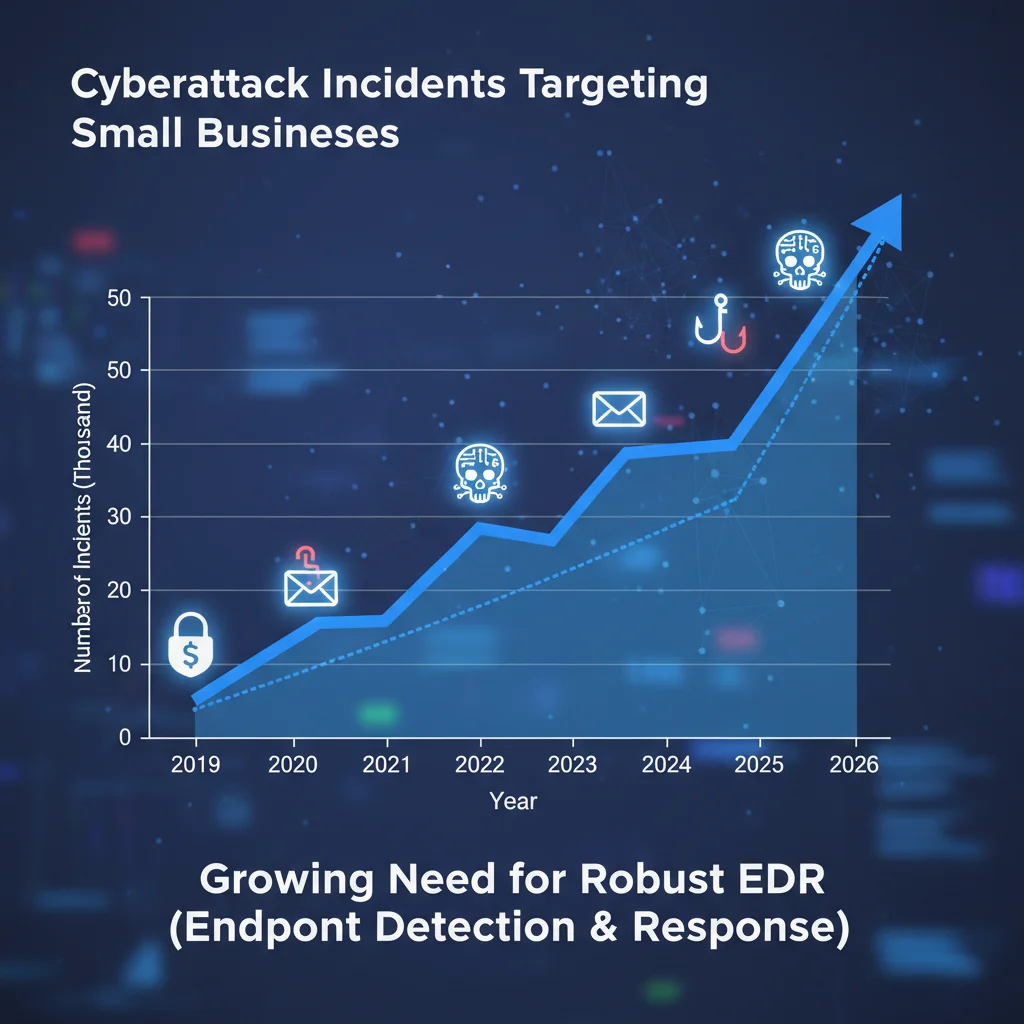
The threat landscape is more hostile than ever. Ransomware attacks continue to dominate headlines, with small businesses frequently falling victim due to their perceived vulnerabilities. Phishing, business email compromise (BEC), and supply chain attacks are also on the rise. Without comprehensive EDR, a single successful attack can lead to:
- Significant financial losses from ransom payments or recovery efforts.
- Reputational damage and loss of customer trust.
- Operational disruption and downtime.
- Legal and compliance penalties, especially concerning data privacy regulations.
2. Regulatory Compliance
Many small businesses, regardless of their size, must comply with various data protection regulations, such as HIPAA for healthcare, PCI DSS for credit card processing, and state-specific privacy laws. EDR solutions provide the necessary logging, auditing, and incident response capabilities to demonstrate compliance and avoid hefty fines.
3. Remote and Hybrid Work Models
The shift to remote and hybrid work environments has expanded the attack surface. Employees accessing sensitive data from various locations and devices introduce new vulnerabilities. EDR ensures that all endpoints, regardless of their physical location, are continuously monitored and protected, providing consistent security across your distributed workforce.
4. Resource Constraints
Small businesses typically don’t have the luxury of a 24/7 security operations center (SOC). Many modern EDR solutions 2026 offer simplified management, automated responses, and even managed EDR (MEDR) services, allowing businesses to leverage expert security without the need for an in-house team. This makes advanced cybersecurity accessible and manageable for SMEs.
Key Features to Look for in EDR Solutions for Small Businesses in 2026
When evaluating EDR solutions 2026 for your U.S. small business, it’s essential to prioritize features that offer maximum protection, ease of use, and cost-effectiveness. Here are the critical capabilities to consider:
1. Advanced Threat Detection
- Behavioral Analysis: The ability to detect anomalies and suspicious behaviors that deviate from normal patterns, indicating potential attacks even without known signatures.
- Machine Learning and AI: Leveraging AI to rapidly identify and classify threats, improving detection accuracy and reducing false positives.
- Threat Intelligence Integration: Access to continuously updated global threat intelligence feeds to identify emerging threats.
- Fileless Malware Detection: Crucial for catching sophisticated attacks that operate purely in memory without writing to disk.
2. Automated Response and Remediation
- Automated Containment: The ability to automatically isolate compromised endpoints to prevent lateral movement of threats.
- Rollback Capabilities: Restoring endpoints to a pre-infection state, minimizing damage from ransomware or other destructive attacks.
- Guided Remediation: Providing clear steps and tools for IT staff to quickly resolve detected incidents.
3. Visibility and Forensics
- Centralized Dashboard: A single pane of glass to view the security status of all endpoints, alerts, and incidents.
- Detailed Event Logging: Comprehensive records of all endpoint activities for thorough investigation and compliance.
- Threat Hunting: Tools that allow proactive searching for threats that may have bypassed initial defenses.
4. Ease of Deployment and Management
- Cloud-Native Architecture: Simplifies deployment, reduces infrastructure costs, and offers scalability.
- Intuitive User Interface: A user-friendly console that doesn’t require extensive cybersecurity expertise to operate.
- Low Resource Footprint: Ensures the EDR agent doesn’t significantly impact endpoint performance.
5. Managed EDR (MEDR) Option
For small businesses with minimal IT staff, a Managed EDR service can be a game-changer. An MEDR provider handles the monitoring, threat hunting, investigation, and response, essentially serving as your outsourced security operations center. This ensures 24/7 expert coverage without the overhead.
6. Pricing and Scalability
Look for flexible pricing models that align with small business budgets, often based on the number of endpoints. The solution should also be scalable to grow with your business.
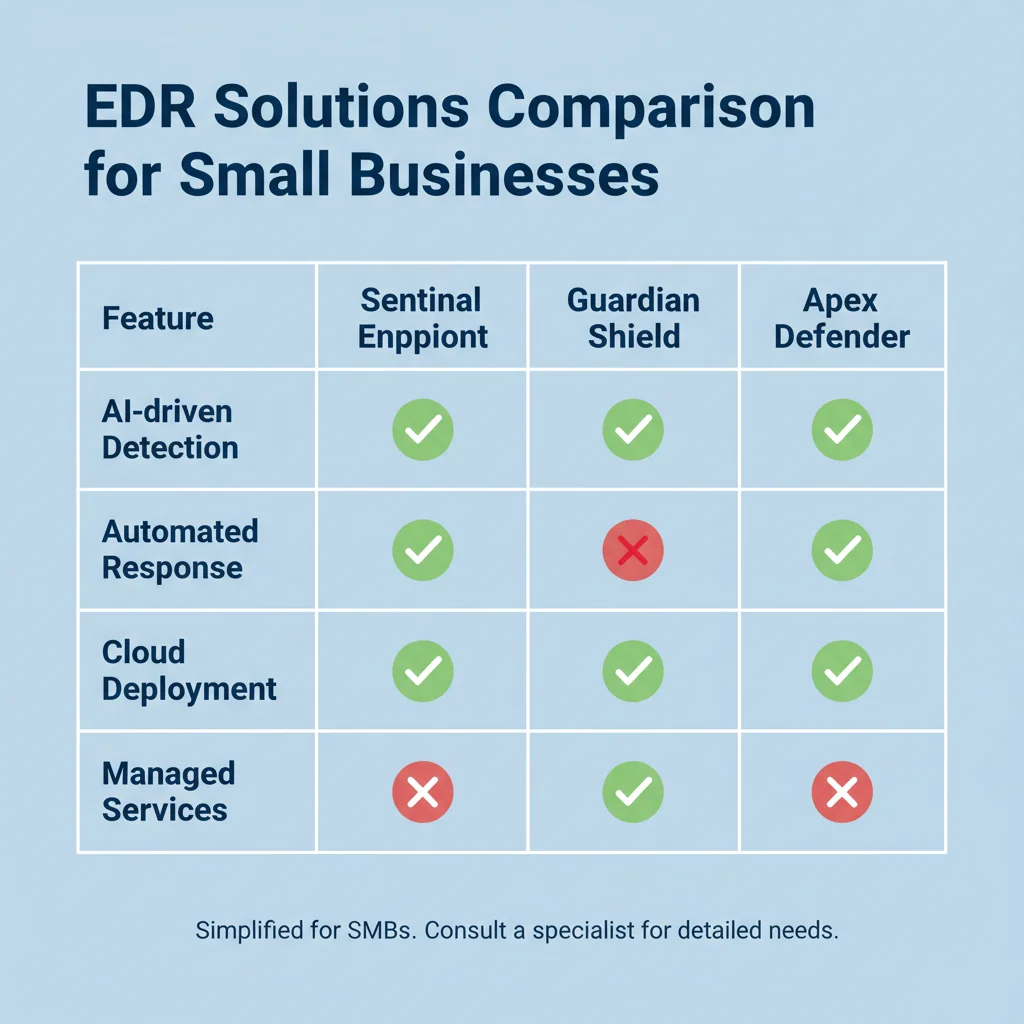
Leading EDR Solutions 2026 for U.S. Small Businesses: A Comparison
Here, we compare some of the top EDR solutions 2026 that are particularly well-suited for the unique requirements of U.S. small businesses. This comparison focuses on their core strengths, key features, and suitability for the SME market.
1. CrowdStrike Falcon Go
- Strengths: Renowned for its industry-leading threat detection capabilities, powered by AI and machine learning. Falcon Go is specifically designed for small and medium-sized businesses, offering robust protection without overwhelming complexity. It boasts a minimal endpoint footprint and excellent performance.
- Key Features: Next-gen antivirus, EDR, device control, USB device protection, firewall management. Offers cloud-native architecture for easy deployment and management.
- Ideal For: Small businesses prioritizing top-tier threat detection and a lightweight agent, even if it comes with a slightly higher price point. Businesses looking for a scalable solution that can grow with them.
- Considerations: While designed for SMEs, some advanced features might require a learning curve for very small teams.
2. SentinelOne Singularity Core (or Express for smaller teams)
- Strengths: Known for its powerful autonomous protection capabilities. SentinelOne leverages AI to detect and autonomously remediate threats, including rolling back malicious changes, without requiring human intervention. This makes it highly effective for businesses with limited IT staff.
- Key Features: Autonomous AI-driven prevention, detection, response, and hunting. Full story visibility, device control, and firewall management. Cloud-native platform.
- Ideal For: Small businesses seeking highly automated security that can operate effectively with minimal human oversight. Excellent for those concerned about ransomware and zero-day attacks.
- Considerations: The autonomous nature is a huge advantage, but understanding its full capabilities might require some initial setup and monitoring.
3. Microsoft Defender for Business
- Strengths: A compelling option for businesses already integrated into the Microsoft ecosystem (e.g., Microsoft 365 Business Premium). It offers enterprise-grade EDR capabilities tailored for SMBs, providing a unified security experience across endpoints, email, and cloud apps.
- Key Features: EDR, next-gen protection, automated investigation and remediation, threat and vulnerability management, centralized management portal.
- Ideal For: Small businesses heavily invested in Microsoft 365, looking for a cost-effective, integrated security solution that simplifies management.
- Considerations: While powerful, its full potential is best realized within the Microsoft ecosystem. Businesses not using Microsoft 365 extensively might find other solutions more suitable.
4. Sophos Intercept X Advanced with EDR
- Strengths: Sophos is well-regarded for its user-friendly interface and comprehensive suite of security tools. Intercept X Advanced combines deep learning AI for threat detection with EDR capabilities, offering strong protection against a wide range of threats, including ransomware.
- Key Features: Deep learning AI, anti-ransomware (CryptoGuard), exploit prevention, EDR with threat hunting, and synchronized security (integrates with other Sophos products).
- Ideal For: Small businesses looking for a balance of strong protection, ease of use, and a comprehensive security ecosystem. Good for those who might consider other Sophos products (firewalls, email security).
- Considerations: While robust, some users might find the console less intuitive than others, though it’s generally considered user-friendly.
5. Cynet 360 AutoXDR
- Strengths: Cynet offers an AutoXDR platform that unifies EDR, network detection and response (NDR), and user and entity behavior analytics (UEBA) into a single, automated solution. This provides broader visibility and automated response across the entire IT environment, which is highly beneficial for small businesses without dedicated security teams.
- Key Features: EDR, NDR, UEBA, deception technology, security automation, and a 24/7 MDR service built-in.
- Ideal For: Small businesses seeking a truly all-in-one security platform with integrated MDR services, simplifying their security stack and management. Excellent for those who want comprehensive protection beyond just endpoints.
- Considerations: The comprehensive nature might be more than some very small businesses need, but the integrated MDR makes it very attractive.
Deployment and Management Considerations for Small Businesses
Beyond features, how an EDR solution is deployed and managed is paramount for small businesses. Here are key aspects to consider:
Cloud-Native vs. On-Premise
For small businesses, cloud-native EDR solutions 2026 are almost always the superior choice. They offer:
- Lower Infrastructure Costs: No need to purchase and maintain servers.
- Easier Deployment: Agents can be deployed quickly across endpoints.
- Automatic Updates: The vendor handles software updates and maintenance.
- Scalability: Easily scale up or down based on your business needs.
- Remote Management: Manage security from anywhere, crucial for hybrid work models.
Managed EDR (MEDR) Services
If your small business lacks dedicated cybersecurity expertise, an MEDR service should be a strong consideration. These services provide:
- 24/7 Monitoring: Continuous oversight by security experts.
- Expert Threat Hunting: Proactive identification of threats that might evade automated defenses.
- Incident Response: Professional handling of security incidents, from investigation to remediation.
- Reduced Burden on Internal IT: Frees up your IT staff to focus on core business operations.
Many of the leading EDR vendors, or their partners, offer MEDR options, providing a complete security solution without the need for an in-house SOC.
Integration with Existing Tools
Consider how the EDR solution integrates with your existing IT infrastructure and security tools. Seamless integration with identity management, firewalls, and cloud platforms can streamline operations and enhance overall security posture.
Budgeting for EDR: Understanding the Costs
The cost of EDR solutions 2026 for small businesses can vary significantly based on the vendor, the number of endpoints, and the features included. Most EDR providers offer subscription-based pricing, typically per endpoint per month or year. When budgeting, consider:
- Per-Endpoint Cost: This is the primary cost driver.
- Feature Tiers: Higher tiers offer more advanced features like threat hunting, vulnerability management, or integrated data loss prevention (DLP).
- Managed Services: MEDR adds to the cost but can provide significant value by outsourcing security operations.
- Hidden Costs: Factor in potential training for your staff (if not using MEDR) and any integration costs.
While EDR might seem like an additional expense, consider it an investment. The cost of a data breach – including fines, lost revenue, and reputational damage – almost always far outweighs the cost of proactive protection.
The Future of Endpoint Security: What to Expect Beyond 2026
As cyber threats continue to evolve, so too will EDR solutions 2026 and beyond. We can anticipate several key trends:
- XDR (Extended Detection and Response): EDR is increasingly becoming part of a broader XDR platform, which integrates security data from endpoints, networks, cloud, and identity to provide a more holistic view and automated response. This will be crucial for small businesses seeking comprehensive security without complexity.
- Greater AI and Machine Learning Adoption: AI will become even more sophisticated in predicting and preventing attacks, reducing the need for human intervention.
- Emphasis on Identity Protection: As identity becomes the new perimeter, EDR solutions will integrate more deeply with identity and access management (IAM) systems.
- Supply Chain Security: EDR will play a crucial role in monitoring and securing endpoints that interact with third-party vendors and supply chains, mitigating risks from these increasingly common attack vectors.
- Simplified Management: Vendors will continue to focus on making powerful EDR capabilities accessible and manageable for organizations with limited security resources.
Staying informed about these trends will help small businesses continue to adapt their cybersecurity strategies effectively.
Making the Right Choice: A Step-by-Step Approach
Choosing the best EDR solutions 2026 for your U.S. small business requires a systematic approach:
- Assess Your Needs: Understand your specific risks, the types of data you handle, your regulatory obligations, and your internal IT capabilities.
- Define Your Budget: Determine what you can realistically allocate to cybersecurity, keeping in mind the cost of a breach.
- Prioritize Features: Based on your needs, identify the non-negotiable EDR features (e.g., strong ransomware protection, ease of use, MEDR option).
- Research and Shortlist: Use this guide and other resources to create a shortlist of 2-3 potential vendors.
- Request Demos and Trials: Experience the solutions firsthand. Pay attention to the user interface, ease of deployment, and performance impact.
- Check References and Reviews: See what other small businesses are saying about their experiences.
- Consider Managed Services: If you lack in-house expertise, explore MEDR options.
- Negotiate and Implement: Work with the chosen vendor to get the best pricing and ensure a smooth rollout.
Conclusion: Securing Your Small Business Future with EDR
In 2026, the question for U.S. small businesses is no longer whether to invest in advanced cybersecurity, but which solution provides the most effective and manageable defense. EDR solutions 2026 are no longer just for large enterprises; they are essential tools for small businesses to detect, investigate, and respond to the sophisticated threats that target them daily.
By carefully evaluating the options presented, considering your unique business needs, and prioritizing solutions that offer robust protection, ease of management, and scalability, you can empower your small business with the cybersecurity posture it needs to thrive securely in the digital age. Don’t let cybersecurity be an afterthought; make it a cornerstone of your business strategy for 2026 and beyond.