Ransomware Defense: Implementing Proactive Security Software Strategies for U.S. Organizations in 2026
The digital landscape is constantly evolving, and with it, the threats that organizations face. Among these, ransomware remains a particularly insidious and costly menace. For U.S. organizations, the year 2026 presents a critical juncture, demanding not just reactive measures but truly proactive Ransomware Defense Strategies. The financial and reputational damage caused by a successful ransomware attack can be catastrophic, leading to operational paralysis, data breaches, regulatory fines, and a significant loss of customer trust. Therefore, understanding and implementing robust security software strategies is no longer optional; it is an existential imperative.
This comprehensive guide will delve into the multifaceted aspects of modern ransomware defense, focusing on the proactive steps U.S. organizations must take to safeguard their digital assets. We’ll explore the latest advancements in security software, the importance of a layered defense approach, the critical role of human factors, and the necessity of a well-defined incident response plan. Our aim is to provide actionable insights that empower businesses to build resilient defenses against the ever-present threat of ransomware.
The Evolving Ransomware Threat Landscape in 2026
Before we can effectively implement Ransomware Defense Strategies, it’s crucial to grasp the current and projected threat landscape. Ransomware groups are becoming more sophisticated, employing advanced evasion techniques, exploiting zero-day vulnerabilities, and increasingly engaging in double extortion – encrypting data and threatening to publish it if the ransom isn’t paid. The rise of Ransomware-as-a-Service (RaaS) models has also lowered the barrier to entry for cybercriminals, leading to a proliferation of attacks.
In 2026, we anticipate several key trends shaping the ransomware environment:
- AI-Powered Attacks: Adversaries will leverage artificial intelligence and machine learning to automate reconnaissance, craft more convincing phishing campaigns, and dynamically adapt their attack vectors, making traditional signature-based defenses less effective.
- Supply Chain Exploitation: Attacks targeting the software supply chain will become more prevalent, allowing ransomware to propagate through trusted vendors and compromise multiple organizations simultaneously.
- Critical Infrastructure Focus: Ransomware groups will continue to target critical infrastructure sectors (e.g., energy, healthcare, water), recognizing the high stakes and increased likelihood of ransom payment.
- Evasion of Detection: Ransomware variants will employ advanced obfuscation, polymorphic code, and fileless techniques to bypass endpoint detection and response (EDR) solutions.
- Data Exfiltration as the Primary Goal: While encryption remains a threat, the exfiltration of sensitive data for sale on the dark web or for public shaming will be an even greater concern, increasing the pressure to pay.
These trends underscore the urgent need for U.S. organizations to adopt a proactive and adaptive approach to their Ransomware Defense Strategies.
Pillar 1: Proactive Security Software for Advanced Ransomware Defense
At the core of any effective Ransomware Defense Strategies lies a robust suite of security software. Merely relying on traditional antivirus is akin to bringing a knife to a gunfight. In 2026, organizations need multi-layered, intelligent solutions that can detect, prevent, and respond to sophisticated threats.
Endpoint Detection and Response (EDR) and Extended Detection and Response (XDR)
EDR solutions are fundamental. They continuously monitor endpoint activity, collect telemetry data, and use behavioral analytics to detect suspicious processes and activities indicative of ransomware. XDR takes this a step further by integrating security data from endpoints, networks, cloud environments, and email to provide a holistic view of threats, enabling faster and more accurate detection and response across the entire IT ecosystem. Implementing XDR is a critical step in building comprehensive Ransomware Defense Strategies.
Next-Generation Antivirus (NGAV) and Anti-Malware
Modern NGAV solutions move beyond signature-based detection, incorporating machine learning, artificial intelligence, and behavioral analysis to identify and block new and unknown ransomware variants. They can detect fileless malware, exploit attempts, and other advanced techniques that traditional antivirus often misses. Ensuring your NGAV is regularly updated and configured for maximum protection is a non-negotiable component of effective Ransomware Defense Strategies.
Network Segmentation and Microsegmentation
Network segmentation involves dividing a network into smaller, isolated segments. If ransomware breaches one segment, it prevents lateral movement to other parts of the network, limiting the damage. Microsegmentation takes this concept to an even finer granularity, isolating individual workloads or applications. This significantly reduces the attack surface and makes it much harder for ransomware to spread, acting as a crucial containment mechanism in your Ransomware Defense Strategies.
Data Loss Prevention (DLP)
Given the increasing threat of data exfiltration, DLP solutions are vital. They monitor, detect, and block sensitive data from leaving the organization’s network, whether through email, cloud storage, or other channels. DLP helps protect against the ‘double extortion’ tactic by preventing attackers from successfully stealing data to use as leverage.
Cloud Security Posture Management (CSPM) and Cloud Workload Protection Platforms (CWPP)
As more U.S. organizations migrate to the cloud, securing these environments becomes paramount. CSPM tools continuously monitor cloud configurations for misconfigurations that could be exploited by ransomware, while CWPPs protect workloads (VMs, containers, serverless functions) running in the cloud. These are essential for extending Ransomware Defense Strategies into modern cloud infrastructures.
Secure Email Gateways and Anti-Phishing Solutions
Email remains the primary vector for ransomware attacks. Secure email gateways filter out malicious emails, detect phishing attempts, and block suspicious attachments and links. Advanced anti-phishing solutions use AI to identify sophisticated social engineering tactics that bypass traditional filters. Investing in these technologies significantly reduces the entry points for ransomware.
Vulnerability Management and Patch Management
Ransomware often exploits known vulnerabilities in software and operating systems. A robust vulnerability management program involves continuous scanning, assessment, and prioritization of vulnerabilities. Coupled with efficient patch management, which ensures all systems are updated with the latest security patches, this significantly reduces the attack surface. Automated patching tools can streamline this process, making it a cornerstone of proactive Ransomware Defense Strategies.
Pillar 2: Robust Data Backup and Recovery Strategies
Even with the most advanced security software, a successful ransomware attack is always a possibility. Therefore, having impenetrable backup and recovery strategies is the ultimate fail-safe. This pillar is non-negotiable for effective Ransomware Defense Strategies.
Immutable Backups
Immutable backups are those that cannot be altered or deleted once created. This is crucial because many ransomware variants are designed to target and encrypt or delete backups to prevent recovery. Storing backups in an immutable format, often in air-gapped or isolated environments, ensures that you always have a clean copy of your data to restore from.
3-2-1 Backup Rule
The industry-standard 3-2-1 rule dictates: at least three copies of your data, stored on two different media types, with one copy offsite. This provides redundancy and protection against various failure scenarios, including ransomware. For U.S. organizations, incorporating cloud-based offsite backups with strong encryption and access controls is increasingly common.
Regular Testing of Backups
A backup is only as good as its ability to be restored. Organizations must regularly test their backup and recovery processes to ensure data integrity and that restoration times meet recovery time objectives (RTOs) and recovery point objectives (RPOs). Untested backups are a significant risk. This regular testing is an often-overlooked but vital part of Ransomware Defense Strategies.
Isolated Recovery Environments
Consider establishing an isolated recovery environment where you can restore critical systems and data without the risk of re-infection. This ‘clean room’ approach ensures that the restored environment is free from any lingering malware or ransomware components.
Pillar 3: Comprehensive Incident Response and Business Continuity Planning
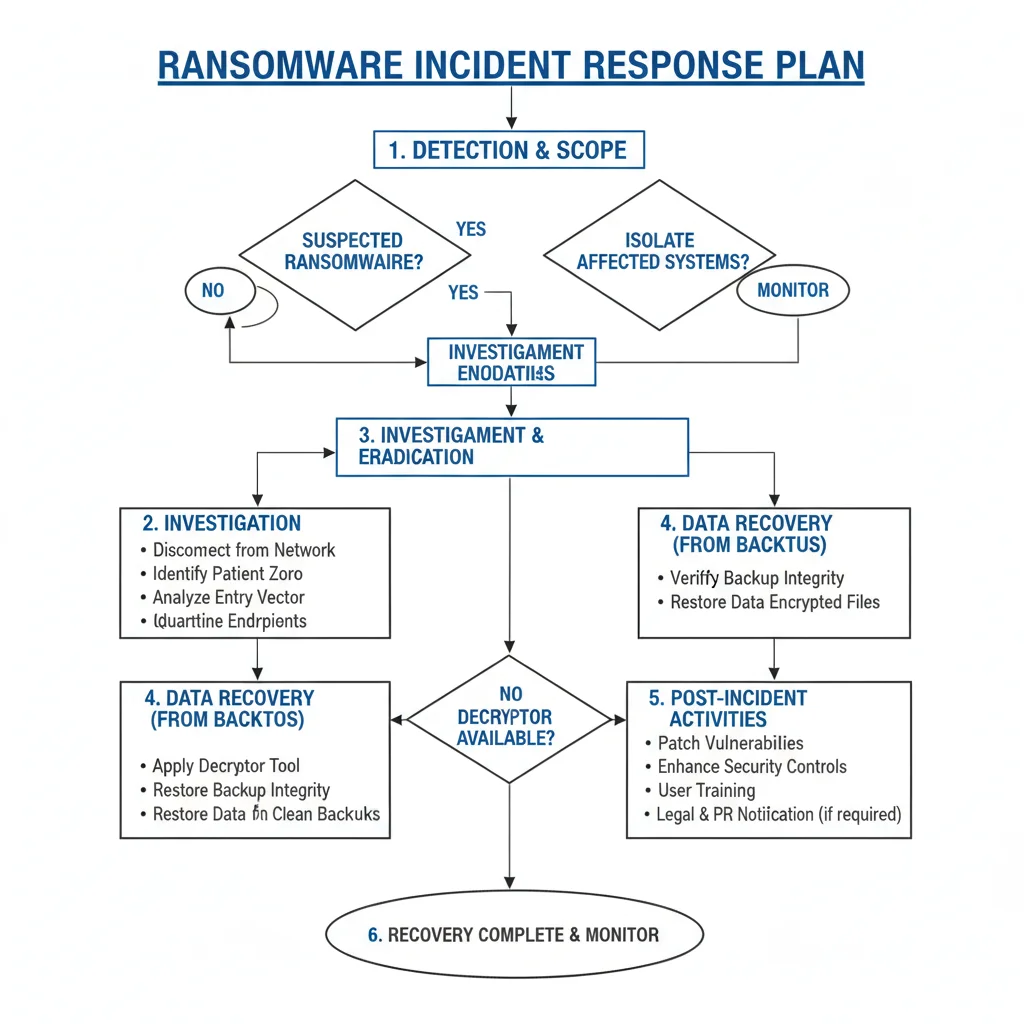
A well-defined and regularly practiced incident response plan is paramount for minimizing the impact of a ransomware attack. It’s not just about prevention; it’s about how quickly and effectively an organization can detect, contain, eradicate, and recover from an attack. This is a critical component of any robust Ransomware Defense Strategies.
Develop a Detailed Incident Response Plan (IRP)
The IRP should outline clear roles, responsibilities, communication protocols, and step-by-step procedures for handling a ransomware incident. It should cover:
- Preparation: Establishing a security team, defining roles, and acquiring necessary tools.
- Identification: Detecting the attack, confirming ransomware presence, and determining its scope.
- Containment: Isolating affected systems and networks to prevent further spread.
- Eradication: Removing the ransomware and patching vulnerabilities.
- Recovery: Restoring systems and data from backups, verifying integrity.
- Post-Incident Review: Analyzing the incident to identify lessons learned and improve future defenses.
The IRP must be regularly reviewed and updated to reflect the evolving threat landscape and organizational changes.
Business Continuity Plan (BCP) Integration
The IRP should be tightly integrated with the organization’s broader Business Continuity Plan. A ransomware attack can disrupt critical business operations, and the BCP ensures that essential functions can continue, even if some systems are compromised. This includes identifying critical services, establishing manual workarounds, and defining alternative communication channels.
Tabletop Exercises and Simulations
Simply having a plan isn’t enough; it must be tested. Regular tabletop exercises and full-scale simulations help organizations identify weaknesses in their IRP, train staff, and improve coordination among different teams. These drills build muscle memory and ensure that everyone knows their role when an actual incident occurs, strengthening your Ransomware Defense Strategies.
Cyber Insurance
While not a technical defense, cyber insurance can provide financial protection against the costs associated with a ransomware attack, including forensic investigations, legal fees, business interruption, and even ransom payment (though paying ransom is generally discouraged). However, insurers are increasingly scrutinizing an organization’s existing cybersecurity posture, making robust Ransomware Defense Strategies a prerequisite for coverage.
Pillar 4: Human Firewall – Employee Training and Awareness
Technology alone cannot fully protect an organization. The human element often represents the weakest link in the security chain. Therefore, comprehensive employee training and awareness programs are indispensable for robust Ransomware Defense Strategies.
Regular Security Awareness Training
All employees, from entry-level staff to executives, must receive regular training on cybersecurity best practices. This training should cover:
- Phishing and Social Engineering: How to identify and report suspicious emails, links, and social engineering tactics.
- Strong Passwords and Multi-Factor Authentication (MFA): The importance of complex, unique passwords and the mandatory use of MFA for all accounts.
- Safe Browsing Habits: Avoiding suspicious websites and downloads.
- Data Handling Policies: Proper procedures for handling sensitive information.
- Reporting Incidents: Clear instructions on how and when to report potential security incidents.
Training should be engaging, interactive, and tailored to different roles within the organization. Regular refreshers are crucial to keep security top of mind.
Simulated Phishing Attacks
Conducting simulated phishing campaigns helps assess the effectiveness of training and identify employees who might be susceptible to real attacks. These simulations provide valuable data for targeted training and reinforce the importance of vigilance. They are a practical application of Ransomware Defense Strategies in action.
Zero-Trust Principle for User Access
The zero-trust security model assumes that no user or device, whether inside or outside the network, should be implicitly trusted. Every access request is authenticated, authorized, and continuously validated. This principle, when applied to user access, significantly reduces the risk of ransomware spreading through compromised user accounts.
Privileged Access Management (PAM)
PAM solutions manage and secure accounts with elevated privileges, which are prime targets for ransomware attackers. By restricting, monitoring, and controlling access to critical systems and data, PAM minimizes the potential damage if a privileged account is compromised. Implementing PAM is a critical component of advanced Ransomware Defense Strategies.

Pillar 5: Continuous Monitoring and Threat Intelligence
The fight against ransomware is not a one-time effort; it requires continuous vigilance and adaptation. Proactive Ransomware Defense Strategies necessitate ongoing monitoring and the intelligent use of threat intelligence.
Security Information and Event Management (SIEM)
SIEM systems collect and analyze security logs and event data from across the IT environment. They provide real-time monitoring, correlation of events, and alerts for suspicious activities that could indicate a ransomware attack in progress. A well-tuned SIEM is essential for early detection.
Security Operations Center (SOC) or Managed Detection and Response (MDR)
For many U.S. organizations, particularly those without the resources for a dedicated in-house SOC, leveraging a Managed Detection and Response (MDR) service can be highly effective. MDR providers offer 24/7 monitoring, threat hunting, and rapid response capabilities, acting as an extension of an organization’s security team. This ensures continuous protection and expert handling of threats, which is a key part of modern Ransomware Defense Strategies.
Threat Intelligence Feeds
Subscribing to and integrating threat intelligence feeds provides organizations with up-to-date information on new ransomware variants, attack vectors, and indicators of compromise (IOCs). This intelligence allows security teams to proactively update their defenses and prepare for emerging threats. Staying informed is crucial for maintaining effective Ransomware Defense Strategies.
Regular Security Audits and Penetration Testing
Periodic security audits and penetration testing (pen testing) help identify vulnerabilities and weaknesses in an organization’s defenses before attackers can exploit them. Pen testers simulate real-world attacks to uncover gaps in security controls, allowing organizations to remediate issues proactively. These assessments are vital for validating the effectiveness of your Ransomware Defense Strategies.
Building a Resilient Ransomware Defense Framework for U.S. Organizations in 2026
Combining these pillars creates a holistic and resilient ransomware defense framework. For U.S. organizations in 2026, this means moving beyond a reactive stance to one of proactive preparedness and continuous improvement. Here’s a summary of the framework:
- Foundation of Advanced Security Software: Implement EDR/XDR, NGAV, DLP, secure email gateways, and robust cloud security solutions.
- Impenetrable Backup and Recovery: Ensure immutable, air-gapped backups following the 3-2-1 rule, with regular testing and isolated recovery environments.
- Comprehensive Incident Response: Develop, test, and integrate an IRP with BCP, supported by cyber insurance.
- Empowered Human Firewall: Conduct continuous security awareness training, simulated phishing, and enforce Zero-Trust and PAM principles.
- Vigilant Monitoring: Utilize SIEM/MDR, threat intelligence, and regular security audits/pen testing.
Each component reinforces the others, creating a formidable barrier against ransomware. The goal is not just to prevent attacks but to minimize their impact and ensure rapid recovery when prevention fails.
Compliance and Regulatory Considerations for U.S. Organizations
U.S. organizations must also consider the growing landscape of cybersecurity regulations and compliance frameworks. Adhering to standards like NIST Cybersecurity Framework, ISO 27001, HIPAA (for healthcare), PCI DSS (for payment processing), and various state-specific data privacy laws (e.g., CCPA) is not just about avoiding fines; it often mandates many of the Ransomware Defense Strategies discussed here.
For example, NIST’s five core functions – Identify, Protect, Detect, Respond, Recover – perfectly align with the multi-pillar approach to ransomware defense. Demonstrating compliance often involves implementing specific security controls, conducting risk assessments, and maintaining detailed documentation of your security posture and incident response capabilities.
The Cost of Inaction vs. Investment in Ransomware Defense
The upfront investment in robust Ransomware Defense Strategies, including advanced security software, employee training, and incident response planning, can seem substantial. However, the cost of inaction far outweighs these expenses. A single successful ransomware attack can lead to:
- Direct Financial Costs: Ransom payments (if made), recovery costs, IT forensic investigations, legal fees, and potential regulatory fines.
- Operational Disruption: Downtime, loss of productivity, and inability to serve customers.
- Reputational Damage: Loss of customer trust, negative publicity, and long-term impact on brand image.
- Data Loss: Irrecoverable data if backups are compromised or non-existent.
Investing proactively in cybersecurity is an investment in business continuity, reputation, and long-term success. It shifts the focus from damage control to strategic resilience.
Conclusion: A Proactive Stance for 2026 and Beyond
For U.S. organizations navigating the complex digital landscape of 2026, a proactive and multi-layered approach to Ransomware Defense Strategies is no longer a luxury but an absolute necessity. The threat of ransomware is not diminishing; it is evolving, becoming more sophisticated, and targeting organizations of all sizes across every sector.
By implementing advanced security software, establishing impregnable backup and recovery protocols, developing comprehensive incident response plans, empowering employees through continuous training, and maintaining vigilant monitoring, organizations can significantly bolster their defenses. This holistic approach creates a resilient framework that not only helps prevent attacks but also ensures rapid and effective recovery, minimizing disruption and protecting critical assets. The future of business success in the digital age hinges on the strength of these proactive ransomware defenses.