Mastering Email Automation: Mailchimp vs. ConvertKit vs. ActiveCampaign in 2026

In the dynamic world of digital marketing, email remains an unparalleled channel for nurturing leads, engaging customers, and driving conversions. As we look towards 2026, the sophistication of email automation platforms has reached new heights, offering businesses of all sizes the tools to create highly personalized and effective campaigns. Choosing the right platform is crucial for optimizing your marketing efforts and achieving your business objectives. This comprehensive guide will take a deep dive into three of the most prominent players in the email marketing arena: Mailchimp, ConvertKit, and ActiveCampaign, focusing on their automation capabilities, unique selling points, and what makes them stand out in an increasingly competitive landscape.
The landscape of email automation platforms is constantly evolving, with new features and integrations emerging regularly. Businesses are no longer content with simple broadcast emails; they demand intelligent systems that can adapt to customer behavior, deliver timely messages, and provide actionable insights. This article aims to equip you with the knowledge needed to make an informed decision, ensuring your chosen platform aligns perfectly with your marketing strategy for 2026 and beyond.
The Evolution of Email Automation Platforms: What to Expect in 2026
The journey of email marketing from simple newsletters to complex automation workflows has been remarkable. In 2026, the expectation for email automation platforms extends beyond basic autoresponders. Marketers now seek platforms that offer advanced AI-driven personalization, predictive analytics, deep CRM integrations, and omnichannel capabilities. The ability to segment audiences with granular precision, trigger emails based on a multitude of behavioral cues, and seamlessly integrate with other marketing and sales tools are no longer luxuries but necessities.
As businesses strive for hyper-personalization, the demand for platforms that can handle intricate customer journeys and deliver contextually relevant content at every touchpoint has intensified. This means that an effective email automation platform must not only send emails but also understand the customer, anticipate their needs, and guide them through a tailored experience. The platforms we will examine – Mailchimp, ConvertKit, and ActiveCampaign – each approach this challenge with their own strengths, catering to different business needs and marketing philosophies.
Key Trends Shaping Email Automation in 2026:
- AI-Powered Personalization: Moving beyond basic merge tags, AI will enable dynamic content generation and predictive recommendations based on individual user behavior and preferences.
- Omnichannel Integration: Seamless connection with SMS, social media, push notifications, and even offline interactions for a unified customer experience.
- Advanced Segmentation: More sophisticated ways to segment audiences based on deep behavioral data, purchase history, website activity, and demographic information.
- No-Code Automation Builders: Intuitive drag-and-drop interfaces for building complex automation workflows without requiring technical expertise.
- Enhanced Analytics and Reporting: Deeper insights into campaign performance, customer lifetime value, and ROI, often powered by machine learning.
- Privacy and Compliance: Robust features to ensure adherence to evolving data privacy regulations like GDPR and CCPA, building trust with subscribers.
Mailchimp: The All-in-One Marketing Powerhouse
Mailchimp has long been a household name in email marketing, particularly favored by small businesses and startups for its user-friendly interface and robust free plan. However, in 2026, Mailchimp has evolved far beyond simple email broadcasts, positioning itself as an all-in-one marketing platform that encompasses email, CRM, landing pages, websites, and even social media management. Its automation capabilities have grown significantly, making it a strong contender for businesses seeking an integrated solution.
Mailchimp’s Automation Capabilities in 2026:
Mailchimp’s automation features, often referred to as ‘Customer Journeys’, are designed to be intuitive and accessible. Users can create multi-step workflows based on a variety of triggers, such as new subscriber sign-ups, abandoned carts, specific product purchases, or engagement with previous emails. The visual journey builder allows for easy mapping of customer paths, incorporating conditional logic and A/B testing to optimize performance.
- Pre-built Journeys: Mailchimp offers a library of pre-designed automation templates for common scenarios like welcome series, abandoned cart reminders, and post-purchase follow-ups, making it easy for beginners to get started.
- Behavioral Tagging: Advanced tagging based on website activity, email opens, clicks, and purchase history allows for highly targeted follow-up sequences.
- Conditional Logic: Users can set up ‘if/then’ scenarios within their journeys, directing subscribers down different paths based on their actions or segment membership.
- Transactional Emails: Integration with e-commerce platforms enables automated transactional emails like order confirmations and shipping updates, which can also be customized and branded.
- Audience Segmentation: While not as granular as some competitors, Mailchimp’s segmentation tools allow for effective targeting within automation workflows, ensuring relevant content delivery.
Pros of Mailchimp for Automation:
- Ease of Use: Renowned for its intuitive drag-and-drop interface, making automation accessible even for marketing novices.
- Integrated Marketing Suite: Offers a wide range of marketing tools beyond email, providing a centralized platform for various campaigns.
- Robust Free Plan: Excellent for small businesses to start building their email lists and basic automations.
- Extensive Integrations: Connects with a vast ecosystem of third-party apps and services.
Cons of Mailchimp for Automation:
- Scalability for Complex Needs: While improving, its advanced automation capabilities might still feel less powerful or flexible compared to dedicated automation platforms for very large or complex businesses.
- Pricing Structure: Can become expensive as your list grows, especially for advanced features.
- Limited CRM Depth: While it has CRM functionalities, they are not as deep or sophisticated as dedicated CRM systems or platforms focused on sales funnels.
ConvertKit: The Creator’s Choice for Audience Building
ConvertKit has carved out a niche as the go-to email automation platform for creators, bloggers, podcasters, and online educators. Its philosophy centers around audience building, delivering highly personalized content, and selling digital products. In 2026, ConvertKit continues to excel in its core mission, offering powerful yet straightforward automation for segmenting audiences and nurturing them towards conversion.
ConvertKit’s Automation Capabilities in 2026:
ConvertKit’s automation is built around a visual workflow builder that emphasizes clarity and efficiency. It uses a tag-based system for segmentation, allowing creators to categorize subscribers based on their interests, purchases, or engagement with specific content. This approach makes it incredibly powerful for delivering highly relevant content and offers.
- Visual Automations: A clean, intuitive drag-and-drop interface for building complex sequences, including conditional paths, delays, and action-based triggers.
- Tag-Based Segmentation: This is a cornerstone of ConvertKit. Subscribers are tagged based on their actions (e.g., downloaded a specific lead magnet, attended a webinar, purchased a product), enabling hyper-targeted follow-ups.
- Event-Based Triggers: Automations can be triggered by a wide array of events, such as form submissions, product purchases, link clicks, or even custom events.
- Email Sequences: Easy to create and manage automated email sequences for welcome series, course delivery, or product launches.
- Rule-Based Automation: Simple ‘if this, then that’ rules allow for quick setup of common automation tasks without needing to build full visual workflows.
Pros of ConvertKit for Automation:
- Creator-Friendly: Designed specifically for creators, offering features tailored to their unique needs, such as landing pages, forms, and product selling capabilities.
- Powerful Segmentation: Its tag-based system allows for incredibly precise audience segmentation, leading to highly personalized communication.
- Intuitive Automation Builder: The visual automation builder is easy to understand and use, even for complex workflows.
- Excellent Deliverability: Known for strong email deliverability rates, ensuring messages reach the inbox.
Cons of ConvertKit for Automation:
- Less Design Flexibility: While focused on deliverability and content, its email template design options are more minimalist compared to Mailchimp.
- Higher Entry Price: Its free plan is more limited, and paid plans can be more expensive than Mailchimp for similar subscriber counts, especially for small businesses not focused on digital products.
- Limited CRM Features: While it tracks subscriber activity, it lacks the deep CRM functionalities found in platforms like ActiveCampaign.
ActiveCampaign: The CRM and Automation Powerhouse
ActiveCampaign stands out as a true marketing automation, email marketing, and CRM platform, designed for businesses that require sophisticated lead nurturing, sales automation, and customer lifecycle management. In 2026, ActiveCampaign continues to lead with its unparalleled automation depth, offering a level of customization and integration that caters to complex business processes and highly detailed customer journeys.
ActiveCampaign’s Automation Capabilities in 2026:
ActiveCampaign’s automation builder is arguably the most robust among the three, allowing for highly intricate, multi-channel workflows. It goes beyond email, incorporating SMS, site messages, and even CRM task automation. Its strength lies in its ability to integrate sales and marketing processes seamlessly, providing a holistic view of the customer journey.
- Advanced Automation Builder: A powerful drag-and-drop interface that supports highly complex conditional logic, branching paths, and a vast array of triggers and actions.
- Deep CRM Integration: ActiveCampaign includes a full-fledged CRM, allowing for lead scoring, deal management, and sales automation directly within the platform.
- Site & Event Tracking: Tracks website visits, specific page views, and custom events, enabling hyper-personalized follow-ups based on real-time behavior.
- Predictive Sending: Utilizes machine learning to determine the optimal time to send emails to individual subscribers for maximum engagement.
- Goals & Split Testing: Define specific goals within automations and A/B test entire automation paths to optimize conversions.
- SMS & Site Messaging: Extend automation beyond email to include text messages and personalized messages on your website, creating an omnichannel experience.
- Lead Scoring: Automatically score leads based on engagement and demographic data, helping sales teams prioritize their efforts.
Pros of ActiveCampaign for Automation:
- Unmatched Automation Depth: Offers the most comprehensive and flexible automation capabilities for complex marketing and sales funnels.
- Integrated CRM: Provides a robust CRM solution, unifying sales and marketing efforts for a complete customer view.
- Omnichannel Marketing: Supports email, SMS, site messaging, and more within its automation workflows.
- Highly Customizable: Allows for extensive customization of workflows, tags, and fields to fit specific business needs.
- Strong Analytics: Provides detailed insights into automation performance and customer engagement.
Cons of ActiveCampaign for Automation:
- Steeper Learning Curve: The sheer power and flexibility can make it more challenging for beginners to master.
- Higher Cost: Generally more expensive than Mailchimp or ConvertKit, especially as your contact list grows and you require advanced features.
- Interface Complexity: While powerful, the interface can sometimes feel overwhelming due to the multitude of options.
Comparative Analysis: Mailchimp vs. ConvertKit vs. ActiveCampaign in 2026
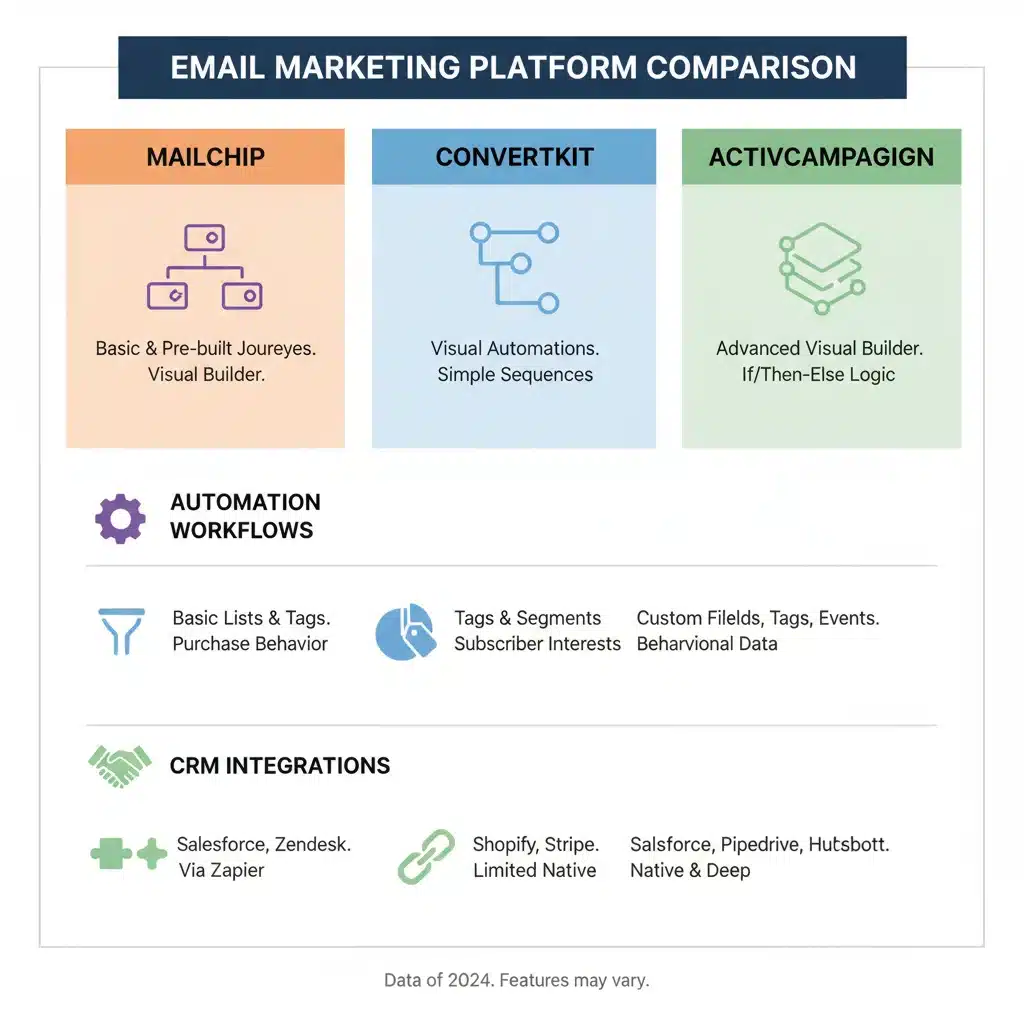
To help you make an informed decision, let’s directly compare these three email automation platforms across several critical dimensions in 2026.
Target Audience:
- Mailchimp: Best suited for small businesses, startups, and those looking for an all-in-one marketing solution with an emphasis on ease of use and a strong free tier.
- ConvertKit: Ideal for creators, bloggers, online educators, and influencers who prioritize audience building, content delivery, and selling digital products.
- ActiveCampaign: Perfect for growing businesses, e-commerce stores, and enterprises that require deep marketing automation, CRM integration, and complex sales funnels.
Automation Complexity & Flexibility:
- Mailchimp: Offers solid, user-friendly automation for common scenarios, suitable for moderate complexity.
- ConvertKit: Excellent for tag-based, content-focused automations with a clear visual builder, good for personalized content delivery.
- ActiveCampaign: Unrivaled in its ability to handle highly complex, multi-channel, and conditional automations, integrating deeply with CRM and sales processes.
Segmentation Capabilities:
- Mailchimp: Good basic to intermediate segmentation based on engagement, demographics, and purchase history.
- ConvertKit: Superior tag-based segmentation, allowing for highly granular categorization based on interests and actions.
- ActiveCampaign: Most advanced, combining tags, custom fields, lead scoring, and behavioral tracking for incredibly precise audience targeting.
CRM & Sales Integration:
- Mailchimp: Basic CRM features for contact management and tracking, but not a full-fledged CRM.
- ConvertKit: Minimal CRM features, primarily focused on subscriber management and digital product sales.
- ActiveCampaign: Full-featured CRM integrated with sales automation, lead scoring, and deal management, making it a powerful sales and marketing hub.
Ease of Use vs. Power:
- Mailchimp: High ease of use, moderate power.
- ConvertKit: High ease of use for its target audience, high power for content creators.
- ActiveCampaign: Moderate ease of use (steeper learning curve), extremely high power and flexibility.
Pricing Structure:
Pricing for all three platforms typically scales with the number of contacts and the features you require. While specific figures can change, here’s a general overview for 2026:
- Mailchimp: Offers a generous free plan for up to a certain number of contacts and basic features. Paid plans start at a competitive rate but can increase significantly with larger lists and advanced automation.
- ConvertKit: Has a free plan for up to 1,000 subscribers with limited features. Paid plans are generally more expensive per subscriber than Mailchimp, but offer more value for creators focused on selling.
- ActiveCampaign: Does not offer a free plan (only a free trial). Its pricing starts higher than the others but provides a vast array of features even at its entry-level tiers, reflecting its comprehensive capabilities. It offers the most value for businesses needing advanced automation and CRM.
When evaluating pricing, consider not just the monthly fee but also the ROI you expect from the features offered. A higher-priced platform might deliver significantly more value if its advanced automation leads to greater conversions and efficiency.

Choosing the Right Email Automation Platform for Your Business in 2026
The decision of which email automation platform to choose ultimately depends on your specific business needs, budget, technical proficiency, and marketing goals. There isn’t a one-size-fits-all answer, but by considering the strengths of each platform, you can align your choice with your strategic objectives.
Consider these questions before making your choice:
- What is your primary goal? Are you focused on building a large audience, selling digital products, or managing complex sales funnels and customer lifecycles?
- What is your budget? How much are you willing to invest in a platform, both initially and as your business scales?
- What is your technical comfort level? Do you prefer a very intuitive, drag-and-drop interface, or are you comfortable with a more powerful but potentially complex system?
- What are your integration needs? What other tools (e-commerce, CRM, analytics) do you need your email platform to connect with seamlessly?
- How complex are your automation needs? Do you need simple welcome series, or intricate multi-channel journeys based on deep behavioral data?
- How important is CRM functionality? Do you need an integrated CRM for sales and lead management, or is basic contact management sufficient?
- What is the size and nature of your audience? Are you serving a niche creative audience, a broad small business customer base, or a large enterprise client list?
Recommendations:
- For Small Businesses and Beginners (especially with limited budget): Mailchimp remains an excellent starting point due to its ease of use, comprehensive suite of basic marketing tools, and generous free plan. It allows you to grow and scale your email marketing efforts without immediate significant investment.
- For Content Creators, Bloggers, and Online Educators: ConvertKit is the clear winner. Its focus on audience building, tag-based segmentation, and seamless integration with digital product sales makes it an invaluable tool for nurturing and monetizing a creative audience.
- For Growing Businesses, E-commerce, and Advanced Marketers: ActiveCampaign offers the most robust and scalable solution. If your business requires sophisticated automation, deep CRM integration, lead scoring, and omnichannel capabilities to manage complex customer journeys and optimize sales processes, ActiveCampaign is worth the investment and learning curve.
Future-Proofing Your Email Marketing Strategy
As we move further into 2026, the importance of a well-executed email marketing strategy, powered by a capable email automation platform, cannot be overstated. The platforms discussed – Mailchimp, ConvertKit, and ActiveCampaign – represent the pinnacle of current email automation technology, each with its unique strengths. Regardless of your choice, the key to success lies in understanding your audience, crafting compelling content, and leveraging the automation features to deliver personalized experiences at scale.
The future of email marketing is intelligent, personalized, and integrated. By carefully evaluating these platforms against your business objectives, you can select a partner that not only meets your current needs but also provides the flexibility and power to adapt to the evolving demands of the digital landscape. Invest in the right email automation platform today to unlock unparalleled growth and customer loyalty tomorrow.