Securing Remote Work: Top 5 Security Software Solutions for U.S. Distributed Teams in 2026

Securing Remote Work: Top 5 Security Software Solutions for U.S. Distributed Teams in 2026
The landscape of work has irrevocably shifted, with remote and hybrid models becoming the standard for many organizations, particularly across the United States. While this flexibility offers numerous advantages, it also introduces a complex array of cybersecurity challenges. Distributed teams, by their very nature, extend the traditional network perimeter, creating more entry points for cyber threats. As we look towards 2026, the sophistication of these threats continues to evolve, making robust Remote Work Security Software not just a recommendation, but an absolute necessity for businesses of all sizes.
In this comprehensive guide, we will delve into the critical need for advanced security solutions for U.S. distributed teams and highlight the top 5 categories of Remote Work Security Software that every organization should consider implementing to safeguard their data, employees, and reputation. Our focus will be on proactive measures and integrated systems designed to tackle the unique vulnerabilities presented by a remote workforce.
The Evolving Threat Landscape for Remote Work Security Software
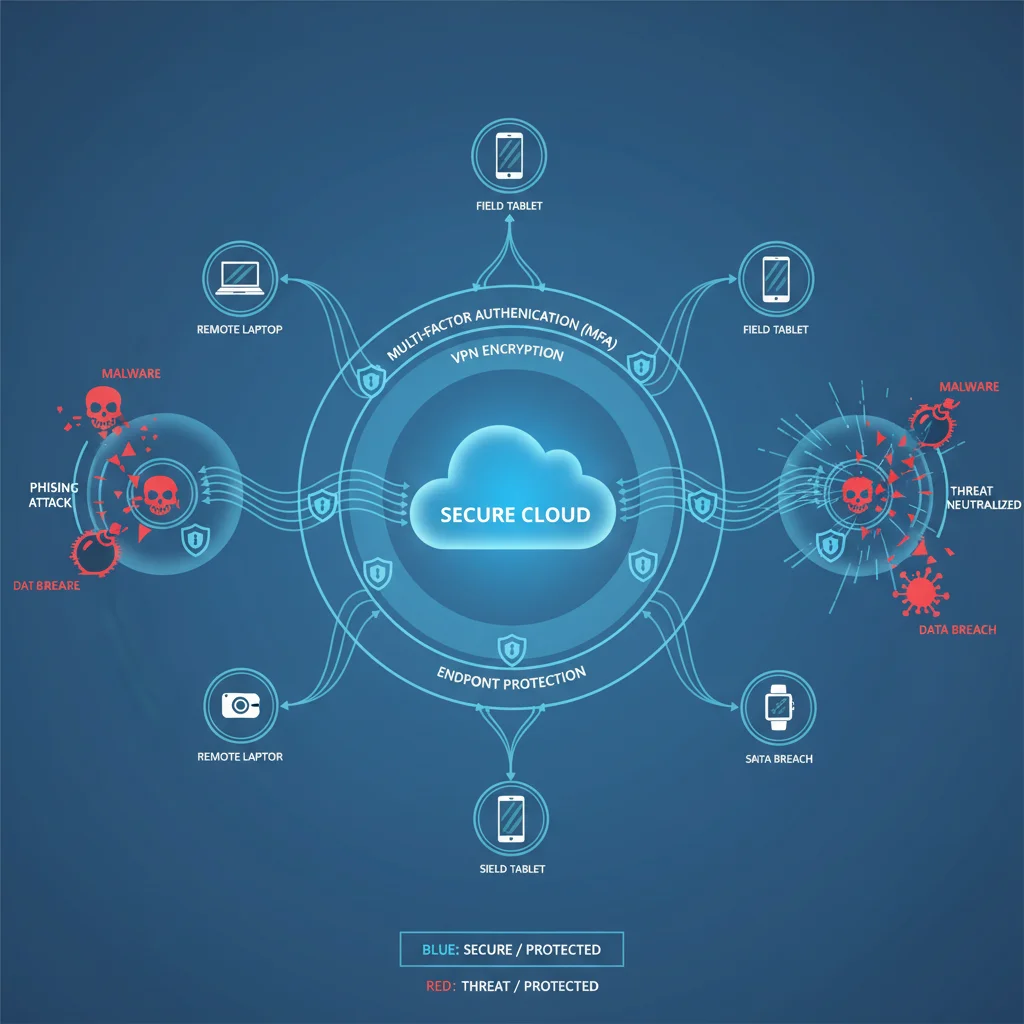
The transition to widespread remote work wasn’t merely a logistical shift; it was a seismic event for cybersecurity. Suddenly, corporate data was accessed from home networks, personal devices, and public Wi-Fi. This decentralization significantly broadened the attack surface. Cybercriminals quickly adapted, targeting these new vulnerabilities with increased phishing campaigns, ransomware attacks, and sophisticated social engineering tactics. The reliance on cloud services and personal devices means that traditional, perimeter-based security models are no longer sufficient. Organizations need a more adaptive, granular approach to Remote Work Security Software.
Key Challenges in Securing Distributed Teams:
- Expanded Attack Surface: Every remote endpoint – laptop, tablet, smartphone – becomes a potential entry point for attackers.
- Varying Network Security: Employees connect from diverse home networks, which often lack the enterprise-grade security of an office environment.
- Shadow IT: Employees may use unauthorized applications or services, creating unmonitored data flows and security gaps.
- Phishing and Social Engineering: Remote workers can be more susceptible to deceptive tactics as direct IT support is not always immediately available.
- Data Loss and Compliance: Protecting sensitive data across multiple locations and ensuring compliance with regulations like HIPAA, CCPA, and GDPR becomes more complex.
- Identity Management: Verifying the identity of users and ensuring appropriate access levels is crucial in a distributed environment.
Addressing these challenges requires a layered security strategy, underpinned by powerful and integrated Remote Work Security Software solutions. Let’s explore the top categories that will define robust remote security in 2026.
1. Advanced Endpoint Detection and Response (EDR) Solutions
Endpoint Detection and Response (EDR) has evolved beyond traditional antivirus software to become a cornerstone of modern cybersecurity, especially for remote teams. In a distributed environment, endpoints (laptops, desktops, mobile devices) are often the first line of defense and the most common target for attacks. Advanced EDR solutions provide continuous monitoring, threat detection, investigation, and response capabilities across all devices, regardless of their location.
Why EDR is Crucial for Remote Work Security Software:
- Real-time Threat Detection: EDR constantly monitors endpoint activity, identifying suspicious behaviors and anomalies that might indicate a cyberattack, even zero-day threats.
- Automated Response: Many EDR platforms can automatically isolate compromised devices, kill malicious processes, and roll back changes, minimizing damage before human intervention.
- Visibility Across Endpoints: Provides a centralized view of all endpoint activities, offering IT security teams the insights needed to understand attack paths and potential vulnerabilities.
- Behavioral Analysis: Moves beyond signature-based detection to analyze user and application behavior, catching sophisticated attacks that evade traditional defenses.
- Remote Remediation: Allows security teams to remotely investigate and remediate incidents on employee devices, crucial when physical access is impossible.
Leading EDR providers for 2026 will integrate AI and machine learning to predict and prevent attacks, offering proactive protection against evolving threats. When choosing EDR as part of your Remote Work Security Software suite, look for solutions that offer seamless integration with other security tools, scalability for growing teams, and comprehensive reporting features.
2. Zero Trust Network Access (ZTNA) and Secure Access Service Edge (SASE) Platforms
The traditional ‘castle-and-moat’ security model, where everything inside the network is trusted, is fundamentally broken in a remote work era. Zero Trust Network Access (ZTNA) and its broader architectural framework, Secure Access Service Edge (SASE), represent a paradigm shift. Instead of trusting users or devices based on their location, ZTNA operates on the principle of ‘never trust, always verify.’
Understanding ZTNA and SASE for Remote Work Security Software:
- Zero Trust Network Access (ZTNA): This technology ensures that every user and device, regardless of their location, must be authenticated and authorized before gaining access to specific applications or data. Access is granted on a least-privilege basis, meaning users only get access to what they absolutely need.
- Secure Access Service Edge (SASE): SASE converges networking and security functions into a single, cloud-native service. It combines ZTNA with other essential security services like Secure Web Gateway (SWG), Cloud Access Security Broker (CASB), Firewall-as-a-Service (FWaaS), and SD-WAN.
For U.S. distributed teams, ZTNA and SASE are revolutionary. They eliminate the need for traditional VPNs that often grant overly broad network access once connected. With ZTNA, access is application-specific, dynamic, and continuously verified. SASE further streamlines this by delivering all security and networking capabilities from the cloud, ensuring consistent policy enforcement and performance for remote users, no matter where they are. This unified approach significantly enhances your Remote Work Security Software strategy.
3. Cloud Access Security Brokers (CASB)
As remote teams increasingly rely on cloud-based applications and storage (SaaS, PaaS, IaaS), Cloud Access Security Brokers (CASBs) have become indispensable components of Remote Work Security Software. CASBs act as a security policy enforcement point between cloud service consumers and cloud service providers, ensuring that an organization’s security policies are extended to cloud resources.
The Role of CASB in Securing Cloud Data:
- Visibility: CASBs provide visibility into all cloud application usage, including sanctioned and unsanctioned (shadow IT) applications, helping organizations understand their cloud risk posture.
- Data Security: They enforce data loss prevention (DLP) policies for data stored in or transmitted to/from the cloud, preventing sensitive information from leaving the organization’s control.
- Threat Protection: CASBs can detect and prevent malware, ransomware, and other threats within cloud applications and storage.
- Compliance: They help organizations maintain compliance with various regulatory requirements by monitoring and controlling access to sensitive data in the cloud.
- Access Control: CASBs enforce granular access controls, ensuring that only authorized users can access specific cloud resources, often integrating with identity providers for seamless authentication.
For distributed teams, where data is constantly moving between devices and various cloud services, a robust CASB solution is vital. It helps prevent data breaches, ensures compliance, and provides the necessary oversight to manage cloud risks effectively. Integrating CASB with other elements of your Remote Work Security Software suite, such as SASE, offers a more holistic security posture.
4. Multi-Factor Authentication (MFA) and Identity and Access Management (IAM) Solutions
Identity is the new perimeter. In a remote work environment, simply relying on usernames and passwords is a recipe for disaster. Phishing attacks and credential stuffing are rampant, making robust identity verification paramount. Multi-Factor Authentication (MFA) and comprehensive Identity and Access Management (IAM) solutions are fundamental pillars of effective Remote Work Security Software.
The Power of MFA and IAM:
- Multi-Factor Authentication (MFA): MFA requires users to provide two or more verification factors to gain access to an application or system. This could involve something they know (password), something they have (phone, security token), or something they are (biometrics). Even if a password is stolen, the attacker cannot gain access without the second factor.
- Identity and Access Management (IAM): IAM encompasses the policies, processes, and technologies that manage digital identities and control user access to resources. This includes user provisioning, de-provisioning, single sign-on (SSO), and privileged access management (PAM).
For remote teams, MFA should be enforced across all critical applications and systems. IAM solutions streamline the process of managing user identities, ensuring that employees have the correct access levels based on their role and that access is revoked promptly when an employee leaves the organization. This prevents unauthorized access and reduces the risk of insider threats. A strong IAM framework, coupled with ubiquitous MFA, is non-negotiable for modern Remote Work Security Software strategies.
5. Secure Communication and Collaboration Platforms with Built-in Security
Remote teams rely heavily on communication and collaboration tools – video conferencing, chat applications, project management platforms. While these tools boost productivity, they also present significant security and privacy risks if not properly secured. Choosing platforms with robust, built-in security features is crucial for Remote Work Security Software.
Key Security Features to Look for:
- End-to-End Encryption (E2EE): Ensures that only the sender and intended recipient can read messages, protecting sensitive discussions from eavesdropping.
- Data Loss Prevention (DLP) Integrations: Prevents sensitive information from being shared inappropriately within the platform.
- Granular Access Controls: Allows administrators to control who can access what content, who can join meetings, and who can share files.
- Audit Trails and Logging: Provides a record of activities within the platform, aiding in incident investigation and compliance.
- Secure File Sharing: Features like password protection, expiry dates, and download restrictions for shared files.
- Vulnerability Management: Providers who regularly audit and update their platforms to address new vulnerabilities.
While many popular collaboration tools offer some security features, organizations should evaluate them carefully to ensure they meet their specific security and compliance requirements. For highly sensitive communications, dedicated secure messaging platforms might be necessary. Prioritizing platforms with strong security baked into their core functionality is a smart investment in your overall Remote Work Security Software ecosystem.

Implementing Your Remote Work Security Software Strategy for 2026
Beyond selecting the right software, successful implementation requires a holistic approach. Here are additional considerations for U.S. distributed teams:
Employee Training and Awareness:
Even the best Remote Work Security Software can be circumvented by human error. Regular, engaging cybersecurity training is paramount. Employees must be educated on phishing scams, strong password practices, safe browsing, and the importance of reporting suspicious activity. This continuous education fosters a security-aware culture, turning your employees into your strongest defense.
Incident Response Plan:
Despite best efforts, breaches can occur. A well-defined incident response plan is critical. This plan should outline steps for identifying, containing, eradicating, recovering from, and learning from security incidents. Remote teams need clear communication protocols and tools to execute this plan effectively, ensuring minimal downtime and data loss.
Regular Security Audits and Vulnerability Assessments:
The threat landscape is constantly changing. Regular security audits, penetration testing, and vulnerability assessments help identify weaknesses in your systems and processes. This proactive approach allows you to address potential gaps in your Remote Work Security Software stack before they are exploited by attackers.
Data Backup and Recovery:
Robust data backup and recovery solutions are essential. In the event of a ransomware attack or data corruption, being able to quickly restore critical data ensures business continuity. These solutions should be secure, regularly tested, and geographically dispersed for added resilience.
Compliance and Regulatory Adherence:
U.S. businesses operate under a complex web of compliance regulations (e.g., HIPAA, PCI DSS, SOX, CCPA). Your chosen Remote Work Security Software solutions must support these requirements, and your security policies should reflect them. Regular reviews ensure ongoing compliance as regulations evolve.
Unified Security Management:
Managing multiple disparate security tools can be challenging. Look for solutions that offer centralized management dashboards, integrated reporting, and automation capabilities. A unified security management platform can significantly reduce the operational burden on IT teams and provide a clearer, more comprehensive view of your security posture.
The Future of Remote Work Security Software
Looking ahead to 2026 and beyond, the trend in Remote Work Security Software will be towards even greater integration, automation, and intelligence. AI and machine learning will play an increasingly prominent role in predicting threats, automating responses, and adapting security policies in real-time. The SASE model will continue to mature, offering a truly unified and cloud-native approach to securing the distributed enterprise.
Furthermore, an emphasis on user experience will be key. Security solutions need to be effective without hindering productivity. Seamless, invisible security that protects without frustrating users will be the hallmark of successful Remote Work Security Software implementations.
Conclusion: Prioritizing Remote Work Security Software for Business Resilience
For U.S. distributed teams, the question is no longer if you need robust security, but how comprehensively you implement it. The five categories of Remote Work Security Software discussed – Advanced EDR, ZTNA/SASE, CASB, MFA/IAM, and Secure Communication Platforms – form a formidable defense against the sophisticated cyber threats of today and tomorrow.
Investing in these solutions is not just about protection; it’s about business resilience, maintaining customer trust, ensuring regulatory compliance, and enabling your remote workforce to operate efficiently and securely from anywhere. By prioritizing a layered, adaptive, and intelligent security strategy, U.S. businesses can confidently navigate the complexities of the remote work era, securing their digital assets and empowering their teams for success in 2026 and beyond.
Embrace these advanced Remote Work Security Software solutions to build a secure foundation for your distributed operations and stay ahead in the ever-evolving cybersecurity landscape.