EDR Implementation Plan: Small Business Cybersecurity 2026

In today’s rapidly evolving digital landscape, small businesses face an unprecedented array of cyber threats. From sophisticated ransomware attacks to advanced persistent threats, the stakes have never been higher. Traditional antivirus solutions, while still foundational, are often insufficient to combat modern, stealthy attacks that bypass signature-based detection. This is where Endpoint Detection and Response (EDR) software becomes not just beneficial, but essential. An effective EDR implementation plan is crucial for any small business aiming to fortify its cybersecurity defenses in 2026 and beyond.
EDR systems offer a proactive and comprehensive approach to cybersecurity by continuously monitoring endpoints (laptops, desktops, servers, mobile devices) for malicious activity, providing real-time threat detection, investigation, and automated response capabilities. For small businesses, the challenge often lies not in recognizing the need for EDR, but in understanding how to effectively implement it without overwhelming limited IT resources. This article will guide you through a practical, 3-month EDR implementation plan specifically designed for small businesses, ensuring a smooth transition to enhanced endpoint security.
Understanding the Imperative: Why EDR for Small Businesses in 2026?
The threat landscape is constantly shifting, with cybercriminals increasingly targeting small businesses, often viewing them as easier targets with fewer security resources than larger enterprises. A data breach can be catastrophic, leading to significant financial losses, reputational damage, and potential legal ramifications. EDR goes beyond traditional antivirus by providing:
- Continuous Monitoring: Real-time visibility into endpoint activities, identifying suspicious behaviors that traditional antivirus might miss.
- Threat Detection and Analysis: Advanced analytics and machine learning to detect known and unknown threats, including fileless attacks and zero-day exploits.
- Automated Response: Capabilities to automatically isolate compromised endpoints, terminate malicious processes, and roll back changes, minimizing damage.
- Forensic Capabilities: Tools to investigate security incidents, understand the scope of a breach, and prevent future attacks.
- Improved Compliance: Helps meet regulatory requirements by demonstrating robust security controls.
For small businesses, an effective EDR implementation plan is an investment in business continuity and resilience. It democratizes advanced cybersecurity, making enterprise-grade protection accessible and manageable.
Month 1: Planning, Assessment, and EDR Selection
The first month of your EDR implementation plan is critical for laying a solid foundation. Hasty decisions here can lead to significant challenges down the line. This phase focuses on understanding your current environment, defining your needs, and selecting the right EDR solution.
Week 1-2: Internal Assessment and Requirement Gathering
Begin by thoroughly assessing your current IT infrastructure and security posture. This involves:
- Inventory All Endpoints: Create a comprehensive list of all devices that need protection. This includes company-owned laptops, desktops, servers, virtual machines, and potentially even employee-owned devices if a BYOD (Bring Your Own Device) policy is in place. Document operating systems, software versions, and user groups.
- Identify Existing Security Solutions: Document all current security tools (antivirus, firewalls, intrusion detection systems, etc.). Understand their functionalities, limitations, and how they might integrate or conflict with a new EDR solution.
- Define Your Security Objectives: What are you trying to achieve with EDR? Is it improved threat detection, faster incident response, better visibility, or compliance? Clearly defined objectives will guide your selection process.
- Assess Your IT Team’s Capabilities: Evaluate your internal IT staff’s expertise in cybersecurity. Do they have the skills to manage an EDR solution, or will you need a managed EDR (MEDR) service? This is a crucial consideration for small businesses with limited in-house expertise.
- Budget Allocation: Determine a realistic budget for the EDR software, potential implementation services, and ongoing maintenance/subscriptions. Remember to factor in both upfront and recurring costs.
Week 3-4: EDR Vendor Research and Selection
With your requirements in hand, begin researching EDR vendors. Focus on solutions designed for small to medium-sized businesses (SMBs), as enterprise-grade solutions can be overly complex and expensive. Key criteria for selection include:
- Ease of Use and Management: For small businesses, an intuitive interface and easy management are paramount. Look for cloud-native solutions that simplify deployment and ongoing operations.
- Detection Capabilities: Evaluate the vendor’s ability to detect various types of threats, including ransomware, fileless attacks, and sophisticated malware. Look for solutions that leverage AI/ML for behavioral analysis.
- Response Capabilities: Can the EDR solution automate responses like isolating endpoints, killing processes, or rolling back malicious changes?
- Scalability: Ensure the solution can grow with your business.
- Integration: Check if it integrates with your existing security tools (e.g., firewalls, SIEM if you have one).
- Vendor Support and Training: Excellent customer support and readily available training resources are vital for small businesses.
- Cost-Effectiveness: Compare pricing models (per endpoint, per user) and ensure it aligns with your budget.
- Managed EDR (MEDR) Options: If your internal IT resources are stretched, consider vendors that offer managed EDR services. This offloads the burden of 24/7 monitoring and incident response to experts.
Request demos, participate in trials, and read reviews from other small businesses. Don’t shy away from asking tough questions about false positives, resource consumption, and incident response workflows. A well-chosen EDR solution is the cornerstone of your EDR implementation plan.
Month 2: Deployment, Configuration, and Initial Testing
Month two is all about getting the EDR solution up and running. This phase requires careful execution to minimize disruption and ensure proper functionality. Your EDR implementation plan shifts from theoretical to practical application.
Week 5-6: Pilot Deployment and Policy Configuration
Before a full rollout, conduct a pilot deployment on a small, representative group of endpoints. This allows you to identify and resolve any issues in a controlled environment:
- Establish a Pilot Group: Select a diverse group of endpoints, including different operating systems and user roles.
- Agent Deployment: Install the EDR agent on the pilot group’s devices. Most EDR solutions offer various deployment methods, including group policy, RMM (Remote Monitoring and Management) tools, or manual installation.
- Initial Policy Configuration: Work with your vendor’s support or documentation to configure initial policies. This includes setting up detection rules, response actions (e.g., automatically isolate, alert), and exclusions for legitimate applications that might trigger false positives.
- Monitor Performance and Stability: Observe the pilot endpoints for any performance degradation or software conflicts. Address these issues before a wider rollout.
- Test Detection Capabilities: If safe and permissible, use benign test files or simulated attacks (e.g., EICAR test file) to confirm the EDR solution is detecting and alerting as expected.
Week 7-8: Full Deployment and Integration
Once the pilot is successful, proceed with the full deployment across all identified endpoints:
- Staged Rollout: Consider a phased rollout to manage potential issues. Deploy to departments or groups incrementally rather than all at once.
- Leverage Automation: Utilize deployment tools (GPO, RMM) to automate agent installation across your network, saving time and reducing errors.
- Verify Installation: After deployment, verify that the EDR agent is active and communicating with the central management console on all endpoints.
- Integrate with Existing Systems: If applicable, integrate the EDR solution with other security tools like your firewall, SIEM, or identity management system. This creates a more unified security posture and enhances threat visibility.
- Baseline Normal Activity: Allow the EDR system time to learn your network’s normal behavior. This machine learning process is crucial for minimizing false positives and accurately identifying anomalies.
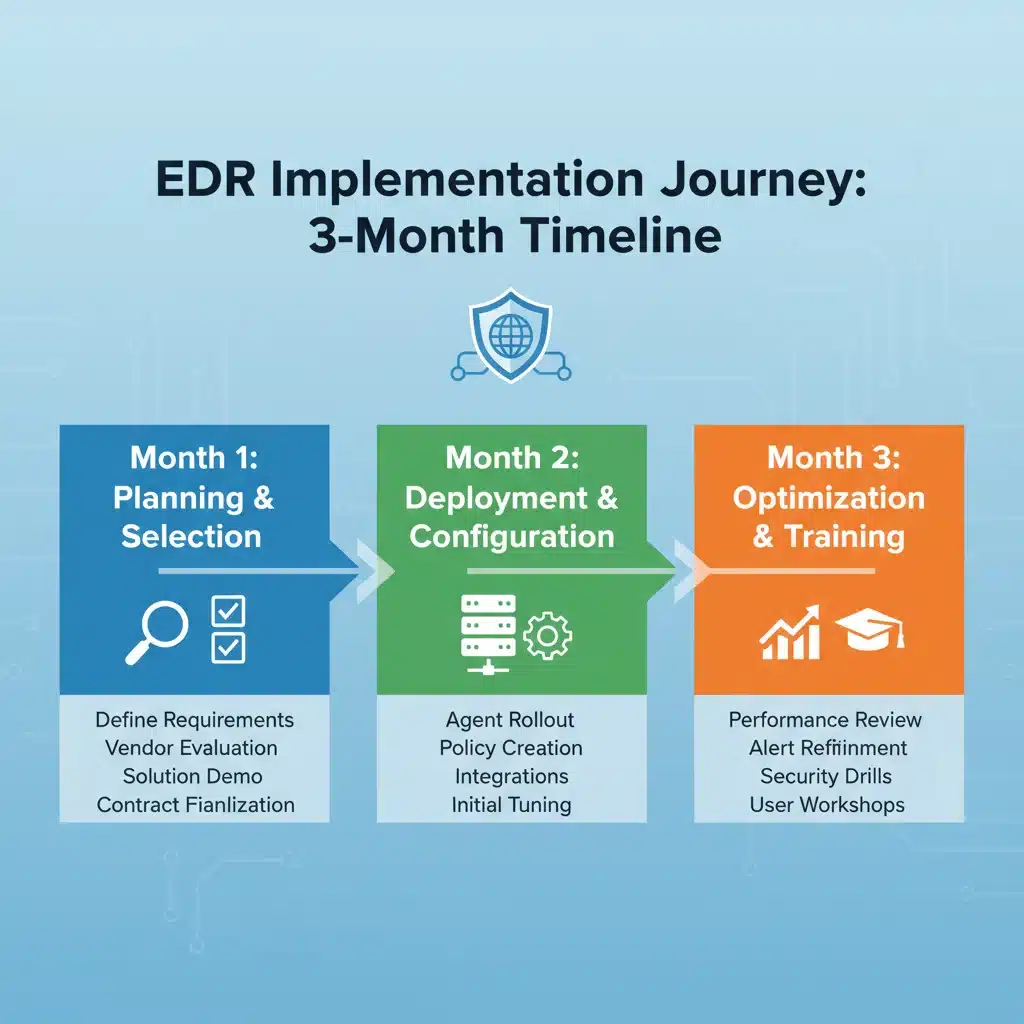
Month 3: Optimization, Training, and Ongoing Management
The final month of your EDR implementation plan focuses on fine-tuning the system, empowering your team, and establishing processes for long-term effectiveness. This is where the true value of EDR begins to shine.
Week 9-10: Policy Refinement and Incident Response Planning
With the EDR solution fully deployed, it’s time to optimize its performance:
- Refine Policies: Based on the data collected and any alerts triggered, adjust EDR policies. Create specific rules for different user groups or sensitive systems. Fine-tune exclusions to reduce false positives while ensuring critical threats are still detected. This iterative process is vital for maximizing EDR effectiveness.
- Develop Incident Response Playbooks: Create clear, actionable playbooks for various types of security incidents (e.g., ransomware, malware infection, data exfiltration). These playbooks should outline roles, responsibilities, communication protocols, and steps for containment, eradication, recovery, and post-incident analysis.
- Test Incident Response: Conduct tabletop exercises or simulated incident response scenarios to test your playbooks and ensure your team understands their roles. This proactive testing is a cornerstone of a robust EDR implementation plan.
- Review Alerts and Logs: Regularly review EDR alerts and logs. Understand why certain alerts are triggered and differentiate between legitimate threats and benign activities. This continuous learning helps improve the system’s accuracy.
Week 11-12: User Training, Reporting, and Continuous Improvement
The final weeks focus on the human element and establishing a cycle of continuous improvement:
- User Awareness Training: Educate all employees about the importance of cybersecurity and their role in maintaining it. Explain common threat vectors (phishing, social engineering) and how EDR helps protect them. Emphasize that EDR is a protective measure, not a surveillance tool.
- IT Team Training: Ensure your IT staff receives comprehensive training on how to use the EDR console, interpret alerts, conduct investigations, and execute response actions. Many vendors offer certifications or advanced training modules.
- Establish Reporting Mechanisms: Set up regular reporting on EDR performance, detected threats, and incident response metrics. These reports help demonstrate the value of your EDR investment and inform future security strategies.
- Schedule Regular Reviews: Plan for quarterly or semi-annual reviews of your EDR configuration, policies, and incident response plan. The threat landscape changes constantly, and your defenses must evolve with it.
- Stay Informed: Keep up-to-date with the latest cybersecurity threats and EDR best practices. Participate in industry forums, subscribe to threat intelligence feeds, and attend webinars.

Key Considerations for Small Businesses Implementing EDR
While the 3-month EDR implementation plan provides a structured roadmap, small businesses should keep several overarching considerations in mind:
Budget Constraints
Small businesses often operate with tighter budgets. Prioritize EDR solutions that offer a strong return on investment (ROI) in terms of threat prevention and reduced incident response costs. Cloud-based EDR solutions often have lower upfront costs and are easier to manage, making them ideal for SMBs. Explore different pricing tiers and look for bundled security offerings.
Limited IT Resources
Many small businesses lack dedicated cybersecurity personnel. This makes ease of use, automation, and strong vendor support paramount. As mentioned, managed EDR (MEDR) services can be a game-changer, providing 24/7 expert monitoring and response without requiring an in-house security operations center (SOC). This outsourcing of expertise can significantly enhance your security posture without overburdening your existing IT team.
Integration with Existing Infrastructure
Ensure the chosen EDR solution integrates seamlessly with your current IT environment. This includes compatibility with your operating systems, network infrastructure, and other security tools. Poor integration can lead to gaps in coverage or operational inefficiencies. Modern EDR platforms often provide APIs for integration, enhancing the overall visibility and control across your security stack.
Employee Training and Awareness
Technology alone is never enough. Human error remains a leading cause of security breaches. Regular and engaging cybersecurity awareness training for all employees is critical. They need to understand the threats they face (e.g., phishing, social engineering) and how their actions contribute to the overall security of the organization. Your EDR implementation plan should explicitly include this aspect, as an informed workforce acts as an additional layer of defense.
Data Privacy and Compliance
Depending on your industry and location, you may be subject to various data privacy regulations (e.g., GDPR, CCPA, HIPAA). Ensure your chosen EDR solution and your implementation practices comply with these regulations. Understand where data is stored, how it’s processed, and who has access to it. Transparency in your data handling is not just good practice but often a legal requirement.
Scalability for Future Growth
As your small business grows, so will its IT infrastructure and cybersecurity needs. Choose an EDR solution that can scale with you, accommodating more endpoints and potentially offering advanced features as your requirements evolve. Migrating to a new EDR solution later can be disruptive and costly, so planning for scalability from the outset is a smart move within your EDR implementation plan.
Continuous Monitoring and Adaptation
Cybersecurity is not a one-time project; it’s an ongoing process. Once your EDR is implemented, it requires continuous monitoring, policy adjustments, and regular updates to remain effective against new threats. The 3-month plan is a starting point, not an endpoint. Establish a routine for reviewing EDR alerts, analyzing incidents, and updating your security posture based on threat intelligence and lessons learned from past incidents.
Beyond the 3-Month EDR Implementation Plan: What’s Next?
Completing this 3-month EDR implementation plan is a significant achievement, but it marks the beginning of your ongoing cybersecurity journey. Here’s what comes next:
- Regular Policy Reviews: The threat landscape is dynamic. Review and update your EDR policies quarterly or bi-annually to ensure they remain effective against emerging threats.
- Advanced Threat Hunting: As your team gains experience, explore advanced threat hunting capabilities offered by your EDR. This proactive approach involves actively searching for threats that have evaded initial detection.
- Expanding EDR Coverage: Consider extending EDR protection to other areas, such as cloud workloads or containers, if your business utilizes them.
- Threat Intelligence Integration: Integrate external threat intelligence feeds into your EDR to enhance its ability to detect and respond to the latest threats.
- Security Awareness Reinforcement: Continuously reinforce cybersecurity best practices through ongoing training and simulated phishing campaigns.
- Performance Optimization: Periodically review the EDR agent’s performance on endpoints to ensure it’s not causing undue resource consumption or conflicts with other critical business applications.
Conclusion: Securing Your Small Business Future with EDR
Implementing an EDR solution might seem daunting for a small business, but with a structured EDR implementation plan, it is an achievable and highly beneficial endeavor. This 3-month roadmap for 2026 provides a clear path from assessment and selection to deployment, optimization, and ongoing management. By investing in EDR, small businesses can move beyond reactive security measures to a proactive, resilient cybersecurity posture, safeguarding their valuable assets and ensuring business continuity in an increasingly hostile digital world.
Don’t wait for a breach to understand the value of robust endpoint protection. Start planning your EDR implementation today and take a decisive step towards a more secure future for your small business.