SIEM Implementation Guide 2026: U.S. Enterprise Security

In the rapidly evolving landscape of cyber threats, robust security measures are not just an advantage, but a necessity. For U.S. enterprises, the year 2026 brings with it an even greater imperative to solidify their defenses against sophisticated attacks, comply with stringent regulations, and maintain operational integrity. At the heart of this enhanced security posture lies a powerful ally: Security Information and Event Management (SIEM) systems. This comprehensive SIEM Implementation Guide is designed to equip U.S. enterprises with the knowledge and strategies required to successfully deploy and optimize a SIEM solution, transforming their cybersecurity operations for the challenges ahead.
The digital transformation journey, while offering immense opportunities, also expands the attack surface for organizations. Data breaches, ransomware attacks, and insider threats continue to escalate in frequency and sophistication. A well-implemented SIEM system acts as the central nervous system of an organization’s security infrastructure, collecting, analyzing, and correlating security data from various sources to detect and respond to threats in real-time. This guide will delve into the critical aspects of planning, selecting, deploying, and maintaining a SIEM solution, ensuring your enterprise is well-prepared for the cybersecurity demands of 2026 and beyond.
Understanding the Evolving Threat Landscape for U.S. Enterprises
Before embarking on any SIEM implementation guide, it’s crucial to understand the context. The threat landscape facing U.S. enterprises in 2026 is characterized by several key trends. State-sponsored attacks are becoming more prevalent and destructive, targeting critical infrastructure and intellectual property. Organized cybercrime groups are leveraging advanced techniques, including AI-driven phishing and polymorphic malware, to bypass traditional defenses. Furthermore, the insider threat, whether malicious or accidental, remains a persistent challenge, often exacerbated by remote work models and complex IT environments.
Regulatory Compliance and Data Privacy
U.S. enterprises operate under a complex web of regulatory requirements, including HIPAA, PCI DSS, SOX, CCPA, and emerging state-specific data privacy laws. These regulations often mandate specific security controls, logging practices, and incident response capabilities. A SIEM solution is instrumental in achieving and demonstrating compliance by providing a centralized repository for security logs, facilitating audit trails, and enabling rapid reporting on security incidents. The ability to quickly identify and respond to data breaches is paramount not only for security but also for avoiding hefty fines and reputational damage.
The Rise of Cloud and Hybrid Environments
Cloud adoption continues to accelerate, with many U.S. enterprises operating in hybrid or multi-cloud environments. This distributed infrastructure presents unique security challenges, as traditional perimeter-based security models are no longer sufficient. A modern SIEM must be capable of ingesting and analyzing logs from cloud services (IaaS, PaaS, SaaS), on-premise systems, and endpoint devices, providing a unified view of security events across the entire digital estate. This holistic visibility is a cornerstone of effective threat detection and response.
Phase 1: Strategic Planning and Assessment for SIEM Implementation
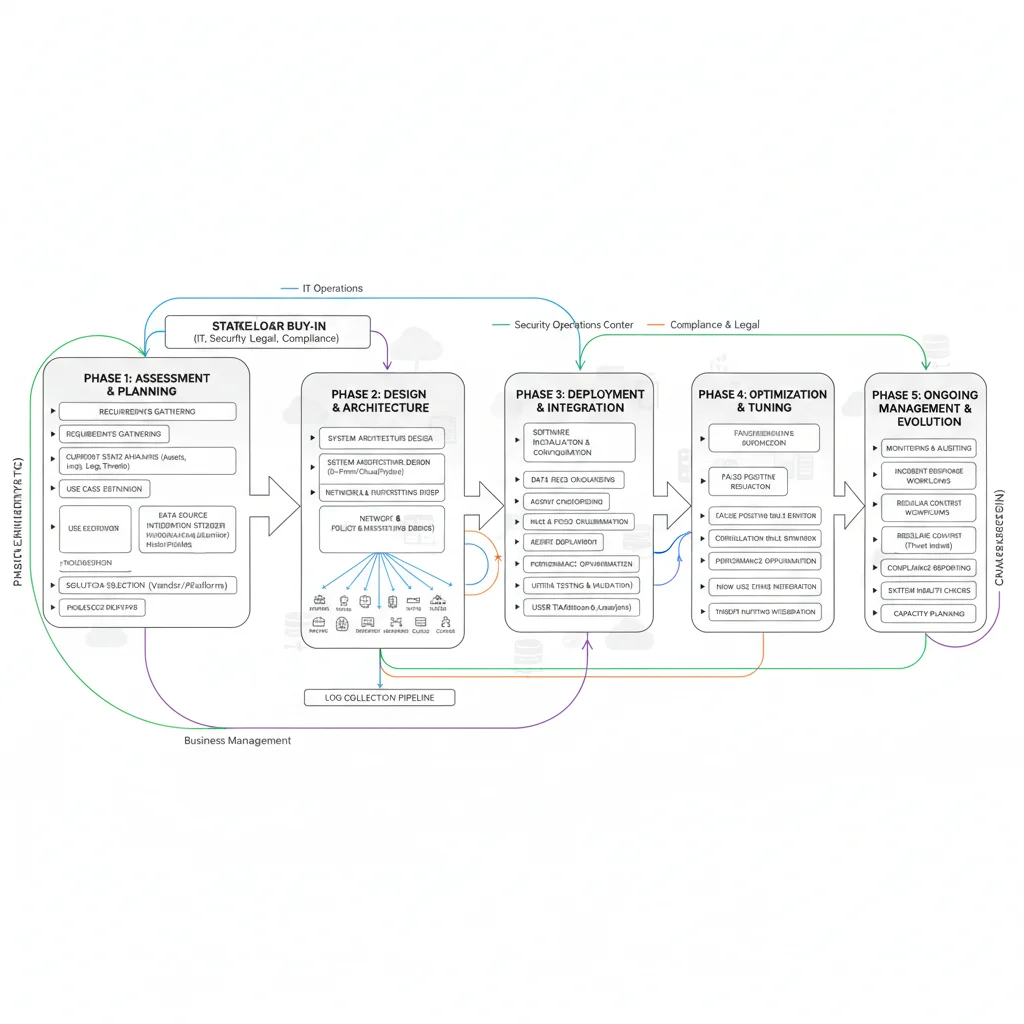
A successful SIEM implementation guide begins with meticulous planning. Rushing into a SIEM deployment without a clear strategy can lead to costly failures, underutilized features, and continued security vulnerabilities. This initial phase involves understanding your organization’s specific needs, defining objectives, and securing executive buy-in.
Defining Your Security Objectives and Use Cases
What specific security problems are you trying to solve with a SIEM? Are you primarily focused on compliance reporting, insider threat detection, advanced persistent threat (APT) detection, or a combination of these? Clearly defined security objectives will guide your SIEM selection and configuration. Common use cases for U.S. enterprises include:
- Compliance Reporting: Generating reports for HIPAA, PCI DSS, GDPR, CCPA, etc.
- Threat Detection: Identifying known and unknown threats, including malware, ransomware, and zero-day exploits.
- Incident Response: Streamlining the detection, analysis, and containment of security incidents.
- Vulnerability Management: Integrating with vulnerability scanners to prioritize and address security weaknesses.
- User Behavior Analytics (UBA): Detecting anomalous user activities that may indicate insider threats or compromised accounts.
- Cloud Security Monitoring: Gaining visibility into security events across cloud platforms.
Assessing Your Current Infrastructure and Data Sources
Before you can collect data, you need to know what data is available. Conduct a thorough assessment of your existing IT infrastructure. Identify all potential log sources, including:
- Firewalls, routers, and network devices
- Servers (Windows, Linux, virtual machines)
- Endpoint devices (laptops, desktops, mobile devices)
- Cloud services (AWS, Azure, Google Cloud, SaaS applications)
- Databases
- Intrusion Detection/Prevention Systems (IDS/IPS)
- Antivirus and Endpoint Detection and Response (EDR) solutions
- Identity and Access Management (IAM) systems
- Application logs
Understand the volume, velocity, and variety of data generated by these sources. This assessment will inform your SIEM sizing requirements and data ingestion strategy.
Budgeting and Resource Allocation
A SIEM solution represents a significant investment. Beyond the initial software/hardware costs, consider ongoing expenses for:
- Maintenance and support
- Staff training and certification
- Data storage
- Integration with other security tools
- Potential consulting services
Allocate sufficient human resources for the SIEM’s deployment, configuration, and ongoing management. A SIEM is only as effective as the team operating it.
Phase 2: SIEM Solution Selection
Choosing the right SIEM solution is a critical step in this SIEM implementation guide. The market offers a wide array of options, from traditional on-premise deployments to cloud-native platforms and managed SIEM services. Your selection should align with your defined objectives, budget, and existing IT environment.
Key Features to Look For
When evaluating SIEM solutions, prioritize features that directly address your security objectives:
- Log Collection and Normalization: Ability to ingest data from diverse sources and normalize it into a common format for analysis.
- Correlation and Analytics: Advanced correlation engines, machine learning, and AI capabilities to detect complex attack patterns.
- Threat Intelligence Integration: Seamless integration with internal and external threat intelligence feeds.
- Incident Response Capabilities: Features for alert prioritization, case management, and automated response actions (SOAR integration).
- Reporting and Dashboards: Customizable dashboards and reports for operational visibility and compliance auditing.
- Scalability and Performance: Ability to handle growing data volumes without performance degradation.
- Cloud and Hybrid Support: Native support for cloud environments and SaaS applications.
- User Behavior Analytics (UBA): Capabilities to detect anomalous user activities.
- Endpoint Detection and Response (EDR) Integration: Enhances visibility at the endpoint level.
On-Premise vs. Cloud-Native vs. Managed SIEM
- On-Premise SIEM: Offers maximum control and customization but requires significant upfront investment in hardware, software, and dedicated IT staff for management. Suitable for organizations with strict data residency requirements or existing data centers.
- Cloud-Native SIEM: Leverages the scalability and flexibility of cloud infrastructure. Reduces operational overhead and capital expenditure. Ideal for organizations with a strong cloud presence and a desire for agile security solutions.
- Managed SIEM (MSSP): Outsourcing SIEM deployment, management, and monitoring to a third-party managed security service provider (MSSP). This option is excellent for U.S. enterprises with limited in-house cybersecurity expertise or resources, providing 24/7 monitoring and expert threat hunting without the heavy investment.
Vendor Evaluation and Proof of Concept (POC)
Engage with multiple vendors, request demonstrations, and conduct a proof of concept (POC) with your top contenders. A POC allows you to test the SIEM’s capabilities with your actual data and infrastructure, validating its effectiveness and ease of use in your specific environment. Pay close attention to integration capabilities, vendor support, and the total cost of ownership (TCO).
Phase 3: Deployment and Configuration
Once a SIEM solution is selected, the deployment and configuration phase begins. This is where the theoretical planning translates into practical implementation, requiring careful execution to ensure the system performs optimally.
Data Source Integration and Log Collection
This is often the most labor-intensive part of any SIEM implementation guide. Connect all identified log sources to the SIEM. This involves configuring agents, syslog forwarders, APIs, or direct integrations depending on the source and SIEM capabilities. Ensure that logs are collected securely, efficiently, and in their entirety. Prioritize critical data sources first, such as firewalls, domain controllers, and critical servers, then expand to other systems.
Data Normalization and Parsing
Raw logs come in various formats. The SIEM must normalize and parse this data into a structured format that can be easily analyzed. This process involves identifying key fields (e.g., source IP, destination IP, event type, username) and mapping them to a common schema. Effective normalization is crucial for accurate correlation and reporting.
Rule and Alert Configuration
Configure correlation rules and alerts based on your defined security objectives and use cases. Start with a baseline of common threats and compliance requirements, then refine and expand as you gain a deeper understanding of your environment. Avoid alert fatigue by fine-tuning thresholds and prioritizing alerts based on severity and potential impact. Leverage threat intelligence feeds to create rules that detect emerging threats.
Dashboard and Reporting Setup
Create custom dashboards and reports that provide relevant insights for different stakeholders. Security analysts need operational dashboards for real-time threat monitoring, while management requires high-level summaries of security posture and compliance status. Automated reporting can significantly reduce the manual effort required for audits.
Phase 4: Optimization and Continuous Improvement
A SIEM is not a set-it-and-forget-it solution. Continuous optimization and improvement are essential to keep pace with evolving threats and ensure the system remains effective. This ongoing process is a vital part of any robust SIEM implementation guide.
Baseline Establishment and Anomaly Detection
After initial deployment, allow the SIEM to collect data and establish a baseline of normal network and user behavior. This baseline is critical for effective anomaly detection. Machine learning algorithms within the SIEM can learn these patterns and flag deviations that may indicate malicious activity. Regularly review and adjust baselines as your environment changes.
Rule Tuning and Alert Fatigue Management
Alert fatigue is a common challenge in SIEM operations. Regularly review triggered alerts to identify false positives and fine-tune correlation rules. Adjust thresholds, suppress irrelevant events, and refine rule logic to ensure that security analysts are only responding to actionable threats. This iterative process improves the signal-to-noise ratio and prevents burnout.
Threat Hunting and Proactive Monitoring
Beyond reacting to alerts, leverage your SIEM for proactive threat hunting. Security analysts should actively search for indicators of compromise (IOCs) and suspicious activities that might not trigger automated alerts. Utilize the SIEM’s search and analysis capabilities to explore data, identify hidden threats, and uncover advanced attack techniques. This proactive approach is a hallmark of mature security operations.
Integration with Incident Response Workflows
Integrate the SIEM with your existing incident response (IR) plan and tools. When an alert is triggered, ensure there’s a clear process for investigation, containment, eradication, recovery, and post-incident analysis. Consider integrating with Security Orchestration, Automation, and Response (SOAR) platforms to automate repetitive IR tasks and accelerate response times.
Phase 5: Staffing, Training, and Organizational Alignment
The best SIEM in the world is ineffective without skilled personnel to operate it. Investing in your team is as crucial as investing in the technology itself. This phase is often overlooked in a typical SIEM implementation guide, but it is paramount for long-term success.
Building a Skilled Security Operations Center (SOC) Team
For U.S. enterprises, establishing or enhancing a Security Operations Center (SOC) is often a direct consequence of SIEM deployment. A SOC team typically includes:
- Security Analysts: Responsible for monitoring alerts, investigating incidents, and performing threat hunting.
- Incident Responders: Focused on containing and remediating security incidents.
- Threat Intelligence Analysts: Researching and integrating external threat data.
- SIEM Engineers: Managing and optimizing the SIEM platform itself.
Consider the structure and staffing model that best fits your organization’s size and resources. For smaller enterprises, a hybrid approach or managed SIEM service might be more appropriate.
Training and Continuous Education
Provide comprehensive training for your SOC team on the specific SIEM solution, threat analysis techniques, and incident response procedures. Cybersecurity is a dynamic field, so continuous education, certifications, and staying abreast of the latest threats and vulnerabilities are vital. Encourage participation in industry conferences, workshops, and online courses.
Fostering Collaboration Across Departments
Effective cybersecurity is a team sport. Ensure strong collaboration between the security team, IT operations, legal, compliance, and executive management. The SIEM provides a common platform for sharing security insights, but organizational alignment is key to translating these insights into effective action. Regular communication and clear escalation paths are essential.

Future Trends and Considerations for 2026 and Beyond
As U.S. enterprises look towards 2026, several emerging trends will influence the evolution of SIEM and cybersecurity strategies. Staying ahead of these trends is crucial for maintaining a resilient security posture.
AI and Machine Learning in SIEM
Artificial intelligence (AI) and machine learning (ML) are already integral to modern SIEMs, enhancing capabilities in anomaly detection, threat correlation, and automated response. Expect further advancements in AI-driven threat prediction, behavioral analytics, and natural language processing (NLP) for more intuitive security investigations. These technologies will help security teams sift through vast amounts of data more efficiently and identify subtle indicators of compromise that human analysts might miss.
Extended Detection and Response (XDR)
XDR is emerging as an evolution of SIEM, offering a more unified and contextualized view of threats by integrating and correlating data across endpoints, networks, cloud, and identity. While SIEM focuses on log management and correlation, XDR aims for deeper data ingestion and analysis from security tools themselves, providing richer telemetry and automated response capabilities. Many SIEM vendors are incorporating XDR-like features, or enterprises may consider dedicated XDR platforms as an augmentation or alternative.
Identity-Centric Security
With the rise of remote work and cloud services, identity has become the new perimeter. SIEM solutions will increasingly focus on identity-centric security, leveraging data from IAM systems, privileged access management (PAM) solutions, and user behavior analytics to detect identity-based attacks, such as account compromise, privilege escalation, and lateral movement. This shift emphasizes securing access and user credentials as a primary defense mechanism.
Automation and Orchestration (SOAR)
Security Orchestration, Automation, and Response (SOAR) platforms are becoming indispensable for U.S. enterprises. Integrating SOAR with your SIEM allows for the automation of routine security tasks, such as enriching alerts with threat intelligence, blocking malicious IPs, or isolating compromised endpoints. This significantly reduces manual effort, speeds up incident response, and frees up security analysts to focus on more complex threat hunting and strategic initiatives.
Regulatory Landscape Evolution
The regulatory environment in the U.S. is continuously evolving. New state privacy laws, sector-specific regulations, and federal mandates will continue to shape compliance requirements. A flexible SIEM solution that can adapt to these changing reporting and auditing needs will be critical for U.S. enterprises to remain compliant and avoid penalties.
Conclusion: Fortifying U.S. Enterprise Security with a Robust SIEM
The journey of SIEM implementation guide is multifaceted, requiring strategic planning, careful selection, meticulous deployment, and continuous optimization. For U.S. enterprises navigating the complex cybersecurity landscape of 2026, a well-executed SIEM strategy is not merely an IT project; it is a fundamental pillar of business resilience and continuity. By centralizing security data, enhancing threat detection, streamlining incident response, and ensuring regulatory compliance, SIEM empowers organizations to proactively defend against an ever-growing array of cyber threats.
As you embark on or refine your SIEM journey, remember that technology is only one part of the equation. Investing in skilled personnel, fostering a culture of security awareness, and adapting to emerging trends like AI, XDR, and identity-centric security are equally vital. By embracing a holistic approach, U.S. enterprises can transform their security operations, safeguard their critical assets, and build trust with their customers and stakeholders in the digital age. The time to fortify your defenses is now, and a comprehensive SIEM implementation is your strategic imperative for a secure future.