
In an increasingly complex and hostile cyber landscape, traditional cybersecurity measures are often reactive, struggling to keep pace with sophisticated and persistent threats. The digital battleground demands innovative strategies that not only detect but actively mislead and neutralize adversaries. Enter Deception Technology Cyberattacks – a proactive, intelligent defense mechanism that is rapidly gaining traction as a cornerstone of modern security software.
The promise of deception technology is significant: to divert a substantial percentage of cyberattacks away from critical assets, thereby safeguarding valuable data, systems, and operations. Industry experts and analysts project that by 2026, deception technology could be responsible for diverting as much as 70% of attacks from an organization’s most vital resources. This isn’t just an incremental improvement; it represents a paradigm shift in how we approach cyber defense, moving from mere detection to strategic engagement and neutralization.
This comprehensive article will explore the intricate world of deception technology, delving into its fundamental principles, its evolution, the mechanisms by which it achieves such impressive diversion rates, and its profound impact on the future of cybersecurity. We will examine the various components of a deception platform, the benefits it offers to organizations of all sizes, and the challenges that lie ahead in its widespread adoption. Understanding Deception Technology Cyberattacks is no longer optional; it is essential for any organization committed to building a resilient and formidable cyber defense.
The Evolving Threat Landscape: Why Traditional Defenses Fall Short
Before we fully appreciate the revolutionary potential of Deception Technology Cyberattacks, it’s crucial to understand the limitations of conventional cybersecurity approaches. For decades, security has largely relied on a perimeter-based defense model: build strong walls (firewalls, intrusion prevention systems), scan for known threats (antivirus, intrusion detection systems), and patch vulnerabilities. While these are indispensable components of any security strategy, they are inherently reactive and often insufficient against today’s advanced persistent threats (APTs) and zero-day exploits.
Attackers are more sophisticated than ever. They employ stealthy techniques, blend into normal network traffic, and often dwell within networks for extended periods before launching their final assault. They actively bypass traditional defenses, exploit human error through social engineering, and leverage supply chain vulnerabilities. Signature-based detection, while effective against known malware, is powerless against novel threats. Behavioral analytics offer some improvement but can still be overwhelmed by polymorphic malware and carefully crafted attack campaigns.
The sheer volume of alerts generated by traditional security tools also presents a significant challenge. Security operations centers (SOCs) are often inundated with false positives, leading to alert fatigue and the potential for real threats to be overlooked. This ‘needle in a haystack’ problem makes it difficult for security teams to prioritize and respond effectively, leaving critical assets vulnerable.
Moreover, the cost of a data breach continues to skyrocket, encompassing not only financial penalties and recovery costs but also irreparable damage to reputation and customer trust. The stakes are higher than ever, necessitating a shift towards more proactive, intelligent, and engaging defense mechanisms that can deceive, detect, and deter attackers before they reach their intended targets. This is precisely where Deception Technology Cyberattacks shines, offering a solution that turns the tables on adversaries.
What is Deception Technology? A Strategic Overview
At its core, deception technology is a cybersecurity strategy that involves deploying a network of traps, lures, and decoys designed to trick attackers into revealing their presence and intentions. Instead of merely blocking attacks, deception technology actively engages with them, diverting them away from genuine assets and into controlled, monitored environments. Think of it as a digital minefield or a sophisticated honeytrap, meticulously crafted to attract, trap, and analyze malicious activity.
The primary goal of Deception Technology Cyberattacks is multi-faceted:
- Early Detection: By presenting attractive, fake targets, deception technology can detect attackers much earlier in the kill chain, often before they even interact with real production systems.
- Attack Diversion: It steers attackers away from valuable assets, buying precious time for security teams to respond and neutralize the threat.
- Threat Intelligence Gathering: When an attacker interacts with a decoy, every action they take – the tools they use, the commands they execute, their methods of lateral movement – is meticulously recorded. This provides invaluable, real-time threat intelligence specific to the organization.
- Reduced False Positives: Because legitimate users have no reason to interact with decoy systems, any interaction with a deception asset is almost certainly malicious, leading to high-fidelity alerts and fewer false positives.
- Forensic Analysis: The controlled environment of a deception platform allows for safe and detailed analysis of attacker tactics, techniques, and procedures (TTPs), aiding in future defense strategies.
The concept isn’t entirely new; honeypots have existed for years. However, modern deception technology goes far beyond simple honeypots. It involves dynamic, distributed, and highly realistic environments that mimic an organization’s actual infrastructure, making them incredibly convincing to attackers. These sophisticated systems are often integrated with other security tools, providing a holistic view of the threat landscape.
How Deception Technology Works: Mechanisms and Components
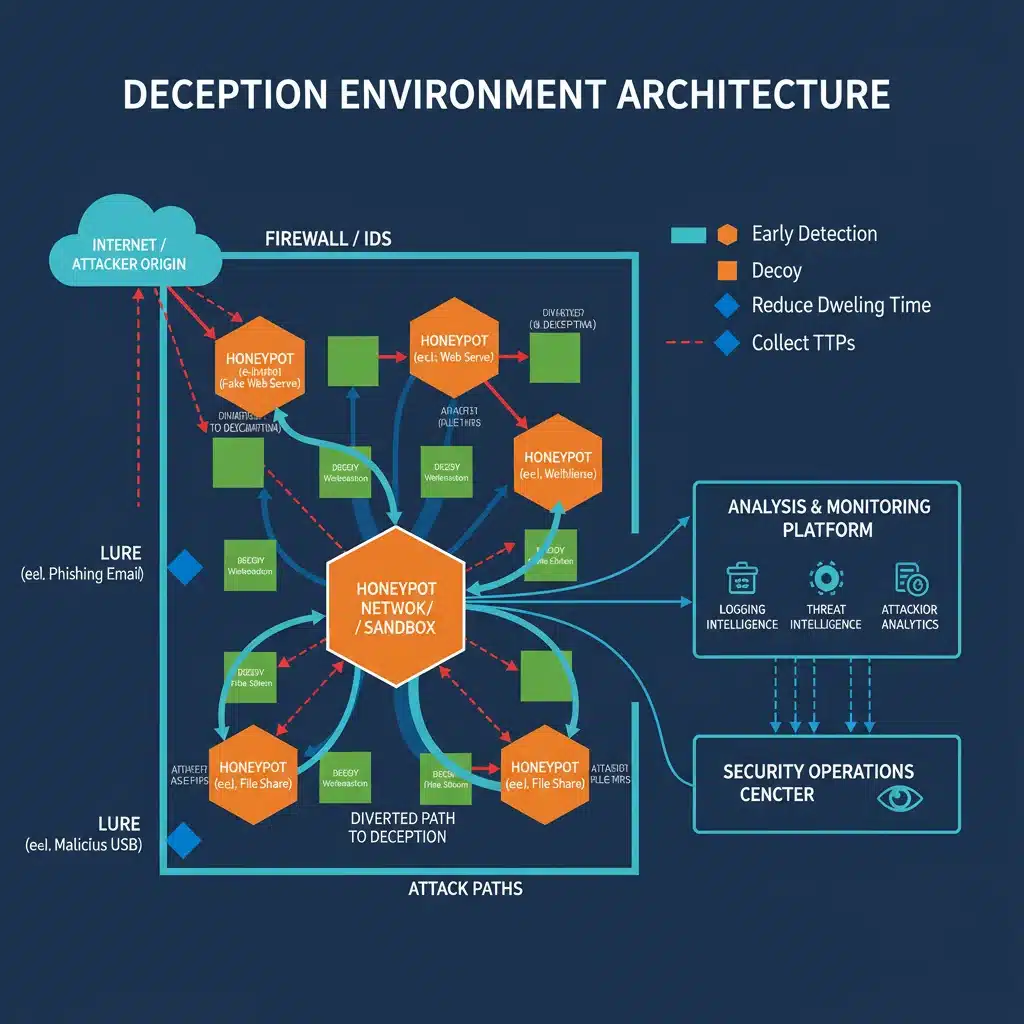
To understand the projected 70% diversion rate for Deception Technology Cyberattacks, it’s essential to grasp the underlying mechanisms. A typical deception platform comprises several key components working in concert:
Honeypots and Honeynets
These are the classic components. A honeypot is a single computer system intended to attract and trap attackers. A honeynet is a network of honeypots. Modern deception platforms deploy highly interactive and realistic honeypots that emulate various operating systems, applications, databases, and network services. These aren’t just empty shells; they can mimic real-world interactions, making them indistinguishable from genuine production systems to an attacker.
Decoys and Lures
Decoys are fake assets deployed across the network, designed to look like legitimate servers, workstations, network devices, or even cloud instances. Lures are pieces of information strategically placed on legitimate endpoints or servers to entice attackers towards the decoys. These can include fake credentials, sensitive-looking documents, configuration files, or even tempting network shares. The goal is to make the decoys appear valuable and the lures irresistible.
Deception Management Platform
This is the central nervous system of the deception environment. It’s responsible for deploying, managing, and monitoring all the honeypots, decoys, and lures. It collects data on attacker interactions, analyzes TTPs, generates high-fidelity alerts, and often integrates with Security Information and Event Management (SIEM) systems, Security Orchestration, Automation, and Response (SOAR) platforms, and endpoint detection and response (EDR) solutions. The management platform ensures the deception environment remains dynamic and adapts to new threats.
Breadcrumbs and Baiting
Beyond simple lures, breadcrumbs are digital artifacts left on legitimate systems that subtly point attackers towards deception assets. These can be fake entries in ARP caches, DNS records, browser histories, or even fake entries in Active Directory. By following these breadcrumbs, attackers inadvertently reveal their presence and pivot towards the decoys, effectively diverting them from real assets.
Attack Analysis and Intelligence
Once an attacker interacts with a deception asset, their every move is monitored and recorded. This includes command execution, file access, network connections, and any attempts at lateral movement. This forensic data is invaluable. It provides real-time insights into the attacker’s motives, tools, and methods, allowing organizations to understand their adversaries better and strengthen their actual defenses.
The Projected Impact: Diverting 70% of Attacks by 2026
The ambitious projection of diverting 70% of Deception Technology Cyberattacks from critical assets by 2026 is based on several factors and the accelerating adoption of these advanced solutions. This isn’t a magic bullet that will eliminate all threats, but a powerful force multiplier that significantly reduces the attack surface and increases the cost for attackers.
Increased Adoption and Sophistication
As organizations become more aware of the limitations of traditional security, the adoption of deception technology is growing rapidly. Vendors are continuously innovating, making deception platforms more realistic, easier to deploy, and more integrated with existing security ecosystems. The ability to deploy thousands of dynamic decoys across an entire network, including cloud environments, makes it increasingly difficult for attackers to distinguish between real and fake.
Enhanced Early Detection
The earlier an attack is detected, the less damage it can inflict. Deception technology excels at early detection by trapping attackers during their reconnaissance or lateral movement phases, long before they can reach critical databases or intellectual property. This early warning system is crucial for preventing breaches rather than just responding to them.
High-Fidelity Alerts and Reduced Noise
One of the biggest pain points for SOC teams is the overwhelming number of alerts, many of which are false positives. Deception technology generates very few false positives because any interaction with a decoy is almost certainly malicious. This allows security teams to focus their resources on genuine threats, leading to faster response times and more effective mitigation strategies. This operational efficiency contributes directly to the ability to divert attacks effectively.
Attacker Disorientation and Frustration
Deception Technology Cyberattacks aims to disorient and frustrate attackers. When an attacker spends time and resources interacting with fake systems, they waste valuable time and reveal their TTPs without gaining access to anything of value. This increases the cost of attack for the adversary, making the organization a less attractive target and potentially causing them to abandon their efforts.
Proactive Threat Intelligence
The real-time, context-rich threat intelligence gathered from deception interactions is invaluable. It allows organizations to understand who is targeting them, how they are operating, and what they are looking for. This intelligence can then be used to proactively strengthen real defenses, patch specific vulnerabilities, and improve incident response plans, further contributing to the diversion of future attacks.
Benefits of Implementing Deception Technology
Beyond the impressive diversion statistics, integrating Deception Technology Cyberattacks into a cybersecurity strategy offers a multitude of tangible benefits for organizations:
Superior Threat Detection
As discussed, deception technology provides an unparalleled ability to detect even the most stealthy and sophisticated attacks, including zero-day exploits and APTs, by engaging attackers early in the kill chain.
Reduced Mean Time to Detect (MTTD) and Respond (MTTR)
With high-fidelity alerts, security teams can quickly identify and validate threats, drastically reducing the time it takes to detect an attack. The detailed intelligence gathered also speeds up the response process, as teams have a clearer understanding of the threat’s nature and scope.
Enhanced Incident Response Capabilities
Deception platforms provide a safe environment for incident responders to observe and analyze attacker behavior without risking real production systems. This hands-on experience and detailed forensic data significantly improve the effectiveness of incident response playbooks.
Protection for Critical Assets
By diverting attackers away from crucial data, intellectual property, and operational systems, deception technology directly protects an organization’s most valuable assets, minimizing the potential for data breaches, service disruptions, and financial losses.
Cost-Effectiveness in the Long Run
While there’s an initial investment, the long-term cost savings from preventing successful breaches, reducing false positives, and improving operational efficiency often outweigh the implementation costs. The ability to gather targeted threat intelligence also reduces reliance on generic, less relevant threat feeds.
Improved Security Posture and Compliance
Implementing advanced security measures like deception technology demonstrates a proactive approach to cybersecurity, which can be beneficial for regulatory compliance, insurance purposes, and showcasing a strong security posture to customers and partners.
Empowering Security Teams
By providing clear, actionable intelligence and reducing alert fatigue, deception technology empowers security analysts to be more effective and efficient, transforming them from reactive firefighters into strategic defenders.
Challenges and Considerations for Adoption
While the benefits of Deception Technology Cyberattacks are compelling, its implementation is not without challenges. Organizations considering this technology should be mindful of several key factors:
Complexity of Deployment and Management
Creating a realistic and convincing deception environment requires careful planning and expertise. The decoys must seamlessly blend into the existing infrastructure, and the lures must be strategically placed. Managing a dynamic deception platform requires ongoing effort to ensure its effectiveness and realism.
Maintaining Realism and Evasion Techniques
Sophisticated attackers may develop methods to detect deception environments. Organizations must continuously update and evolve their deception strategies to maintain realism and stay ahead of attacker evasion techniques. This requires a commitment to ongoing research and development within the security team or through vendor partnerships.
Integration with Existing Security Tools
For maximum effectiveness, deception technology needs to integrate seamlessly with existing security information and event management (SIEM), security orchestration, automation, and response (SOAR), and endpoint detection and response (EDR) solutions. Poor integration can lead to silos of information and hinder overall response capabilities.
Resource Requirements
Deploying and managing deception technology requires skilled personnel. Security teams need to be trained on how to interpret deception alerts, analyze attacker behavior, and leverage the gathered intelligence effectively. While it reduces false positives, it adds a new layer of expertise required.
Scope and Coverage
Organizations must carefully define the scope of their deception strategy. Should it cover the entire network, specific critical segments, or cloud environments? The broader the coverage, the more complex the deployment, but also potentially more effective the diversion.
Legal and Ethical Considerations
While generally accepted as a legitimate defense mechanism, organizations must be aware of any legal or ethical implications of actively engaging with attackers, especially concerning data collection and potential attribution. Generally, within an organization’s own network, this is not an issue, but policies should be clear.

The Future of Deception Technology in Cybersecurity
The trajectory for Deception Technology Cyberattacks is one of rapid growth and increasing sophistication. Looking towards 2026 and beyond, we can anticipate several key developments:
AI and Machine Learning Integration
AI and ML will play an even more crucial role in automating the deployment and management of deception environments, making them more dynamic and adaptive. AI can analyze attacker behavior in real-time to generate more convincing decoys and lures, and to predict attacker next moves. It will also enhance the fidelity of threat intelligence derived from deception interactions.
Cloud-Native Deception
As organizations continue their migration to cloud environments, deception technology will become increasingly cloud-native. This means deploying decoys and lures seamlessly across IaaS, PaaS, and SaaS platforms, making the cloud a less hospitable environment for attackers.
Integration with XDR and SASE
Deception technology will become a fundamental component of Extended Detection and Response (XDR) platforms, providing an additional layer of proactive threat intelligence. It will also integrate with Secure Access Service Edge (SASE) frameworks, offering deception capabilities at the network edge and for remote workforces.
Active Defense and Countermeasures
While primarily focused on detection and diversion, future iterations of deception technology may incorporate more active defense mechanisms, such as automatically quarantining infected systems or feeding disinformation back to attackers. This must be approached with extreme caution and clear legal frameworks.
Human-Centric Deception
Beyond systems and networks, deception could extend to social engineering countermeasures, creating deceptive digital identities or personas to lure and analyze human-centric attacks, though this area presents significant ethical challenges.
Conclusion: A New Era of Cyber Resilience
The projection that Deception Technology Cyberattacks will divert 70% of attacks from critical assets by 2026 is a bold one, yet it underscores the transformative potential of this proactive defense strategy. In an age where traditional defenses are increasingly outmatched, deception technology offers a refreshing and effective approach, turning the tables on adversaries by using their own methods against them.
By creating realistic traps, lures, and decoys, organizations can detect threats earlier, gather invaluable intelligence, and most importantly, steer malicious actors away from their most precious digital assets. While challenges in deployment, management, and maintaining realism exist, the ongoing innovation in this field, coupled with increasing industry adoption, suggests that deception technology is poised to become an indispensable component of any robust cybersecurity strategy.
For businesses and security professionals, embracing deception technology is not just about adopting another tool; it’s about fundamentally changing the defensive posture from reactive to proactive, from merely blocking to actively engaging and neutralizing. The future of cybersecurity is one where the digital battlefield is riddled with intelligent traps, ensuring that critical assets remain secure and resilient against the ever-evolving tide of cyber threats. Preparing for 2026 means investing in smart, strategic defenses today, with deception technology leading the charge.